Emerson ControlWave® Micro Hybrid Controller
Product Overview
Project Details
Product Name ControlWave ® Micro
Product type: Hybrid controller (integrating PLC and RTU functions)
Core design concept: low power consumption, modularity, and scalability
Applicable scenarios include process factories, remote SCADA systems, oil and gas, water treatment, and hazardous areas
Key certifications ATEX, UKCA, CE, Class I, Div. 2 (Groups A-D, T4), EN 60079 series standards
Hardware system configuration
(1) Base unit and expansion unit
Base unit: Aluminum casing, including power module (slot 1), CPU module (slot 2), remaining slots for I/O or communication modules, with three specifications of 3/4/8 slots:
3 slots: 86.4 × 152.4 × 147 mm (3.4 × 6.0 × 5.8 in), weight 0.32 kg
4 slots: 114.3 × 152.4 × 147 mm (4.5 × 6.0 × 5.8 in), weight 0.36 kg
8 slots: 228.6 × 152.4 × 147 mm (9.0 × 6.0 × 5.8 in), weight 0.68 kg
Expansion Unit: Aluminum casing, additional I/O module installation, available in 2/4/8 slot three specifications, supporting up to 14 I/O modules (base unit+expansion unit combination):
2 slots: 57 × 152.4 × 147 mm (2.25 × 6.0 × 5.8 in), weight 0.27 kg
4 slots/8 slots: Same size and weight corresponding to the base unit
(2) CPU module parameters
CPU model, core parameters, communication port configuration, power consumption
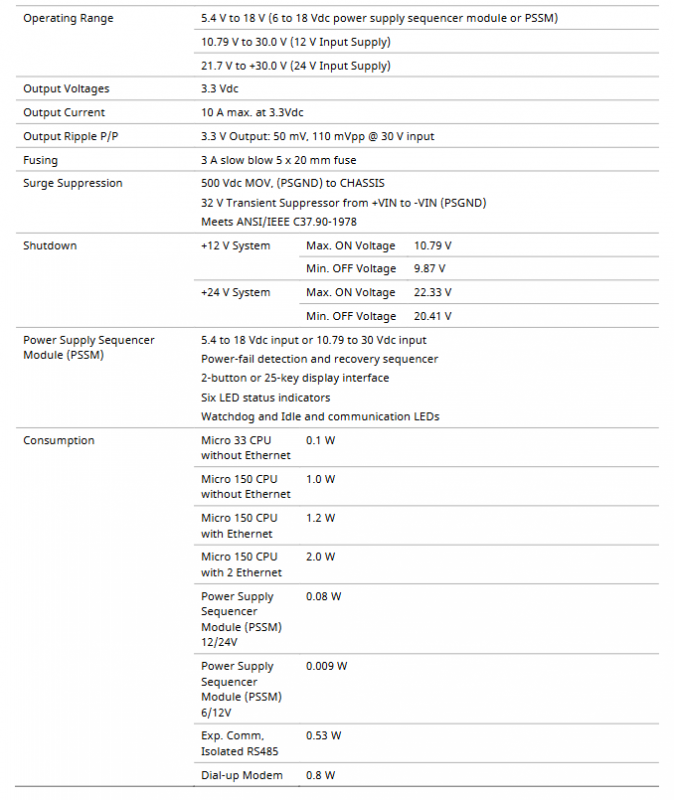
33 MHz 32-bit ARM 9 processor, Boot 512 KB, 2 MB backup SRAM, 64 MB SDRAM, 16 MB flash memory, 2 RS-232 (9-pin D-sub)+1 RS-485 (9-pin D-sub), maximum baud rate of 115.2 KB 0.1 W (without Ethernet)
150 MHz 32-bit ARM 9 processor, same memory configuration, optional key lock security switch option 1:1 Ethernet+2 RS-232+1 RS-485; Option 2: 2 Ethernet+1 RS-232+1 RS-485 1.0 W (no Ethernet), 1.2 W (1 Ethernet), 2.0 W (2 Ethernet)
(3) Power module
Input voltage range:
6-18Vdc PSSM:5.4-18 Vdc
12-24Vdc PSSM: 10.79-30.0 Vdc (12V system), 21.7-30.0 Vdc (24V system)
Output characteristics: 3.3 Vdc voltage, maximum 10 A output current, ripple 50-110 mVpp (30V input)
Protection function: 3A slow melting fuse, 500Vdc MOV surge suppression, in compliance with ANSI/IEEE C37.90-1978 standard
Power consumption: 0.08 W for 12/24V PSSM, 0.009-0.53 W for 6/12V PSSM
(4) Classification and Characteristics of I/O Modules
I/O Type Typical Configuration Connection Method Key Features
Hybrid I/O 6 DI/DO+4 AI+2 HSC ± 1 AO local/remote terminals (with fuses) support multiple signal types, cost optimization
DI/DO 12 DI+4 DO, 16 DI, 16 DO, 8 DI (120-240 Vac) local/remote terminal (optional fuse) isolation type optional, maximum 6A relay output
AI/AO 6 AI+2 AO, 8 AI (isolated), 4 AO (isolated) local/remote terminals (optional fuse) support 4-20 mA signal, surge protection
Temperature class 6 TC (thermocouple), 4 RTD (thermistor) local/remote terminal adaptation for industrial temperature measurement scenarios
Special function 4 HSC (high-speed/low-speed counter), 8 HART/BTI (2-channel AO) local/remote terminals support HART protocol to meet high-precision counting requirements
(5) Distributed I/O System (DIOS)
Core configuration: Adopting the same external dimensions as the base unit, supporting up to 14 I/O modules
Communication method: Connected to the base unit through standard Ethernet
Key features:
Built in dedicated CPU module (communication engine) responsible for data transmission between the base unit and DIOS
Equipped with power failure/recovery control function, battery backup RAM retains I/O data during short power outages
Detailed explanation of communication functions
(1) Hardware communication port
Serial communication:
Basic port: The CPU module comes with 2 RS-232+1 RS-485 (33 MHz CPU) or flexible combination (150 MHz CPU)
Expansion module: Supports 3 types of communication modules (1 RS-232+1 RS-485; Including a 56kb dial-up modem; 2 RS-232+2 RS-485)
Isolation feature: RS-485 port isolated to 500 Vdc
Ethernet communication:
Port specifications: 10/100 Mbps, RJ45 interface, up to 2 ports (150 MHz CPU optional)
Applicable scenarios: Communication between base unit and DIOS, remote connection to SCADA system
(2) Support communication protocols
Protocol type, key characteristics, application scenarios
Modbus supports RTU/ASCII/TCP, master/slave mode, command codes 1-8/15/16, integer/IEEE 4-byte floating point industrial equipment interconnection, SCADA data acquisition
DNP3 supports SAv5 security authentication (device authentication, anti external interference) for remote SCADA systems in high security scenarios
Other standard protocols BSAP, FOUNDATION fieldbus, HART, DFI, CIP, serial ASCII are compatible with multi vendor devices for process control signal transmission

Software and Programming Environment
(1) Programming software: ControlWave Designer
Compatibility: Fully compliant with IEC 61131-3 standard
Programming languages: Supports 5 industry standard languages (functional block diagrams, structured text, sequential functional diagrams, ladder diagrams, instruction lists)
Function library:
Basic library: 200+commonly used functional blocks (triggers, counters, timers, arithmetic/Boolean operations, type conversions, etc.)
ACCOL III professional library: 60+industrial specific functional blocks (PID, lead lag, AGA gas flow calculation, scheduling sorting, file processing, etc.), suitable for scenarios such as oil and gas, water treatment, etc
(2) Auxiliary software tools
Software Name Core Functions Key Features
OpenBSI network configuration, communication diagnostics, data viewing support serial BSAP and Ethernet IP communication, access to ControlWave controllers
Object Server OPC compatible server adapts to low bandwidth/high latency networks (wireless, satellite, cellular) and directly connects to ControlWave series devices
The historical data collection system timestamp historical database management is stored in the controller flash memory, supports scheduled/on-demand collection, and exports as CSV/ODBC format, automatically completes missing data after communication is restored
Audit system event and alarm records store major events, real-time/historical alarms, exported as text files through OpenBSI, and support fault tracing
Safety and environmental characteristics
(1) Security protection
Physical security:
Key switch: three positions (run/remote/local), control program download and modification permissions
Operation mode: Refuse local/network modification of programs
Remote mode: only allows network modifications (requires security authentication)
Local mode: Allow local/network modifications (requires security authentication)
Access control:
User Management: Supports 240 user accounts, with a maximum username/password length of 16 characters
Encryption protection: 56 bit encryption technology, 64 customizable access permissions (data read/write, configuration editing, diagnostic operation, etc.)
(2) Environmental adaptability
Environmental parameter specifications
Working temperature -40 to 70 ° C (no display/keyboard); -20 to 70 ° C (with display/keyboard)
Storage temperature -40 to 85 ° C
Working humidity 5-95% (non condensing)
Conformal coating complies with ANSI/ISA 71.04 Class G3 standard and is suitable for harsh environments
Vibration protection 1.0 g (10-150 Hz); 0.5 g(150-2000 Hz)
Electromagnetic compatibility radiation immunity of 3 V/m (80 MHz-1 GHz, IEC 61000-4-3:2002); Radiation emission complies with IEC 55022:1998