Parker EVM32-II Modular Expansion Base Plate
In modern industrial automation control systems, the I/O expansion capability directly determines the system’s adaptation range, integration level, and on-site deployment flexibility. The Parker EVM32-II, as a modular I/O expansion board designed for motion control systems, features standardized hardware architecture, hot swappable SIM module expansion, compatibility with multiple types of signals, and high reliability industrial protection design. It has become the core expansion component of the 6K series controller in scenarios such as on-site signal acquisition, actuator driving, and analog adjustment. This product achieves rapid cascading and expansion through standardized interfaces, supporting multiple signal types such as digital, analog, and relay outputs. It can meet the I/O expansion needs of packaging equipment, CNC machine tools, automated production lines, detection equipment, material conveying systems, and other fields. This article comprehensively analyzes the technical characteristics, module selection, safe operation, and system integration of EVM32-II based on its hardware architecture, standard configuration, optional modules, installation specifications, and electrical adaptation requirements, providing a complete technical reference for engineering integration, equipment debugging, and on-site maintenance.
EVM32-II Product Positioning and Core Values
EVM32-II is a distributed I/O expansion board designed specifically for Parker 6K controllers. Its core design goal is to achieve rapid expansion of signal channels such as digital input, digital output, analog input, analog output, and high-power relay output without changing the structure of the main controller. The motherboard adopts a modular slot design, supporting multiple SIM (Signal I/O Module) functional modules for plug and play. Users can freely combine and configure according to the on-site I/O points, signal types, driving capabilities, and isolation requirements, greatly reducing system wiring complexity, control cabinet space occupation, and later maintenance costs.
Compared with traditional fixed I/O modules, EVM32-II has three outstanding advantages: firstly, it has a highly flexible configuration, supporting mixed insertion of multiple types of modules such as 8-channel digital signals, 8-channel analog signals, solid-state relays, and high current relays, and can build dedicated I/O units as needed; Secondly, the cascading expansion capability is strong, and multiple EVM32-II can be connected in series through standard cables to meet the large-scale I/O point requirements; Thirdly, it has industrial grade reliability, equipped with electrostatic protection, anti reverse structure, ventilation and heat dissipation design, and can operate stably in harsh industrial environments. At the same time, the motherboard is deeply compatible with the 6K controller instruction system, and some advanced modules support controller native drivers and program calls, significantly improving system integration efficiency and operational stability.
EVM32-II standard configuration and factory components
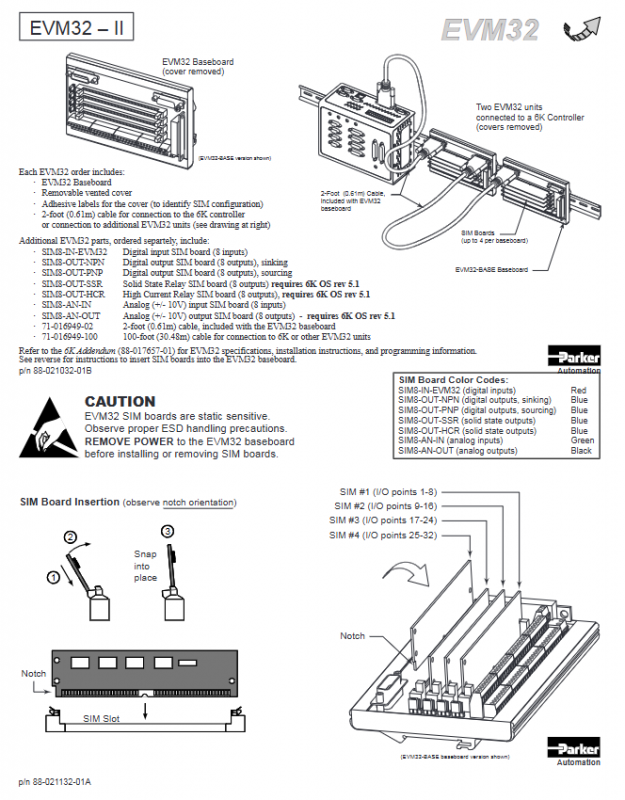
Each EVM32-II expansion board is equipped with complete basic components at the factory, ensuring that users can complete the basic installation and connection immediately without the need to purchase additional basic accessories. Its standard configuration includes the following four parts:
The EVM32 motherboard serves as the core carrier of the entire expansion system, integrating power supply circuits, signal buses, module slots, cascade interfaces, and protection circuits to provide unified power supply, signal transmission, and fault isolation for all SIM modules. It is the basic hardware platform for I/O expansion.
The detachable ventilation cover plate adopts a breathable structure design, which ensures dust prevention and foreign object intrusion while achieving rapid heat dissipation inside the bottom plate, avoiding module performance degradation or failure caused by accumulated heat during long-term operation. The detachable design of the cover plate facilitates the installation, inspection, and replacement of SIM modules, improving on-site maintenance efficiency.
The configuration identification adhesive label is used to stick on the outside of the ventilation cover, visually identifying the SIM module type and I/O configuration currently installed in the EVM32-II, facilitating on-site engineers to quickly identify the hardware architecture, avoid wiring errors, program configuration errors, and other issues, and improve the accuracy of debugging and maintenance.
The standard connection cable comes standard with a length of * * 2 feet (0.61 meters) * * connection cable, mainly used in two scenarios: one is to directly connect to the 6K controller, realizing communication and command interaction between the main controller and the expansion board; The second is used for cascading expansion between multiple EVM32-II devices to build a distributed I/O network. The cable adopts standardized interfaces and features anti reverse insertion design, ensuring stable and reliable connection.
Analysis of the full range of optional SIM expansion modules
EVM32-II supports 7 independently ordered SIM function modules, covering signal types such as digital input, digital output, analog input, analog output, and high reliability relay output. Each module optimizes electrical characteristics and driving capabilities for different industrial scenarios, and users can freely choose according to the interface type, signal amplitude, and load power of the on-site equipment.
(1) Digital input module
SIM8-IN-EVM32 is an 8-channel digital input module, mainly used to collect binary switch signals such as on-site sensor signals, button signals, limit switch signals, photoelectric switch signals, etc. The module adopts industrial grade electrical design, compatible with typical industrial field voltage levels, with clear and stable input logic, anti-interference ability, and can accurately identify high and low level states, providing reliable on-site status feedback for the controller.
(2) Digital output module
SIM8-OUT-NPN: 8-channel NPN leakage type digital output module, suitable for driving NPN interface type relays, indicator lights, small solenoid valves and other loads. The output side adopts a current injection drive method, which is compatible with most European and American standard field devices.
SIM8-OUT-PNP: 8-channel PNP source type digital output module, using source current drive mode, suitable for Asian standard automation equipment, can directly drive small actuators, with fast output response speed, suitable for high-frequency switching scenarios.
SIM8-OUT-SSR: 8-channel solid-state relay output module, with no mechanical contacts, no action noise, long service life, and extremely fast response speed, suitable for high-frequency switching and high-precision triggering scenarios. This module must be used in conjunction with the 6K controller operating system V5.1 or higher to ensure proper functionality activation.
SIM8-OUT-HCR: 8-channel high current relay output module, with higher driving capability, can directly drive medium to high power loads without the need for external relays, simplifying the system structure. This module also requires a 6K controller OS version not lower than V5.1 to ensure stable high current output control.
(3) Analog quantity module
SIM8-AN-IN: 8-channel analog input module, supporting * * ± 10V * * standard analog signal acquisition, can be connected to analog output devices such as pressure sensors, displacement sensors, temperature transmitters, flow sensors, etc., to achieve high-precision acquisition and transmission of continuous physical quantities, suitable for closed-loop control and process monitoring applications.
SIM8-AN-OUT: 8-channel analog output module, outputting * * ± 10V * * standard analog signals, can directly drive proportional valves, servo speed control units, frequency converters, analog instruments and other execution devices, achieving continuous adjustable control of parameters such as speed, pressure, flow rate, etc. This module belongs to advanced extension function and can only work properly on 6K controller V5.1 or above system version.
(4) Expansion cable accessories
In addition to the functional modules, users can separately order * * 100 feet (30.48 meters) * * extended connection cables (model 88-021032-01B) to meet long-distance deployment needs, enabling EVM32-II to be installed on the field device end far away from the control cabinet, achieving true distributed I/O expansion, significantly reducing the length of field wiring, and improving the system’s anti-interference ability.
Color coding system for SIM module
In order to facilitate quick identification of module types on site and reduce installation and maintenance error rates, the EVM32-II supporting SIM module adopts a unified color coding rule. Different functional types correspond to exclusive identification colors, and engineers can directly judge module functions based on their appearance colors
Digital input module (SIM8-IN-EVM32): red
NPN digital output, PNP digital output, solid-state relay output, high current relay output: blue
Analog input module (SIM8-AN-IN): green
Analog output module (SIM8-AN-OUT): black
The color coding system corresponds one-to-one with module functions, which can significantly improve recognition efficiency in high-density slot scenarios and avoid hardware damage or system failures caused by mixed or incorrect insertion.
Safety operation specifications and installation requirements
EVM32-II and its SIM module belong to industrial control precision electronic components, which are sensitive to static electricity, live plugging, and other operations. Improper installation can directly lead to module breakdown, motherboard damage, or system loss of control. Therefore, the following safety and installation regulations must be strictly followed:
(1) Requirements for electrostatic protection
All SIM modules are static sensitive components, and standard ESD (electrostatic discharge) protection measures must be implemented during the handling, installation, and disassembly process: operators must wear anti-static wristbands, anti-static clothing, and anti-static shoes; Laying anti-static pads on the operating table; The module should be placed in an anti-static packaging bag before installation, and direct contact with metal pins and circuit boards is prohibited.
(2) Mandatory requirement for power-off operation
Before installing or removing any SIM module, the power supply to the EVM32-II motherboard must be completely cut off, and live plugging and unplugging are prohibited. Live operation can generate instantaneous surge voltage, breakdown the internal chips of the module, damage the bus interface, resulting in permanent module failure, and may also affect the safe operation of the 6K main controller.
(3) Mechanical installation specifications
When inserting the SIM module into the slot, it must be strictly aligned with the * * Notch * * direction to ensure that the module pins are completely aligned with the motherboard slot, and pushed in evenly with force. It is forbidden to forcefully insert diagonally or press forcefully to avoid damaging the pins and motherboard solder pads. After installation, check if the module is secure and not loose to ensure long-term operation without any poor contact issues.
Technical documentation and system adaptation instructions
The complete electrical specifications, installation dimensions, wiring definitions, communication protocols, programming instructions, and debugging methods of EVM32-II are detailed in the 6K Addendum, document number 88-017657-01. Users should prioritize referring to this official document when conducting system integration, program development, and troubleshooting to ensure that configuration and programming comply with hardware specifications.
The official part number for the EVM32-II base plate is 88-021132-01A, which can be used to accurately match products during spare parts procurement and after-sales support, avoiding model confusion.
In terms of system adaptation, EVM32-II seamlessly integrates with the 6K controller, and the basic digital and analog modules can be directly recognized by the controller; SSR、HCR、 Advanced modules such as analog output need to be upgraded to V5.1 or higher operating system versions in order to fully unlock driver capabilities, protect logic and programming functions, and ensure the normal operation of output accuracy, response speed, and load protection functions.
Application scenarios and system integration advantages
EVM32-II, with its modular, highly flexible, and reliable features, can be widely used in I/O expansion scenarios for various automation devices
Packaging and printing equipment: extended sensor input, solenoid valve output, flying saw synchronous control analog quantity adjustment;
Machine tools and cutting equipment: limit signal acquisition, tool servo control, cooling system drive;
Automated assembly line: multi station digital input detection, cylinder control, analog speed regulation;
Detection and testing equipment: high-precision analog acquisition, output calibration, switch linkage control;
Material handling and warehousing equipment: position signal feedback, frequency converter control, safety circuit expansion.
At the system integration level, EVM32-II can achieve cascading of multiple units and quickly build large-scale I/O networks; Distributed deployment reduces wiring costs and interference risks; Standardized modules reduce spare parts inventory pressure; Anti mistake design and electrostatic protection enhance on-site stability; Native adaptation with 6K controller, shortening development cycle and reducing debugging difficulty, providing cost-effective expansion solutions for equipment manufacturers and system integrators.