OMRON SYSMAC One NSJ series programmable controller
1. Core positioning of the product
The NSJ series is an Omron SYSMAC One integrated controller that combines HMI display and PLC control. Its core value is the miniaturization and standardization of control cabinets, eliminating inefficiencies and waste in design, installation, and maintenance processes, and adapting to unified deployment in global production bases.
2. Hardware specifications and dimensions
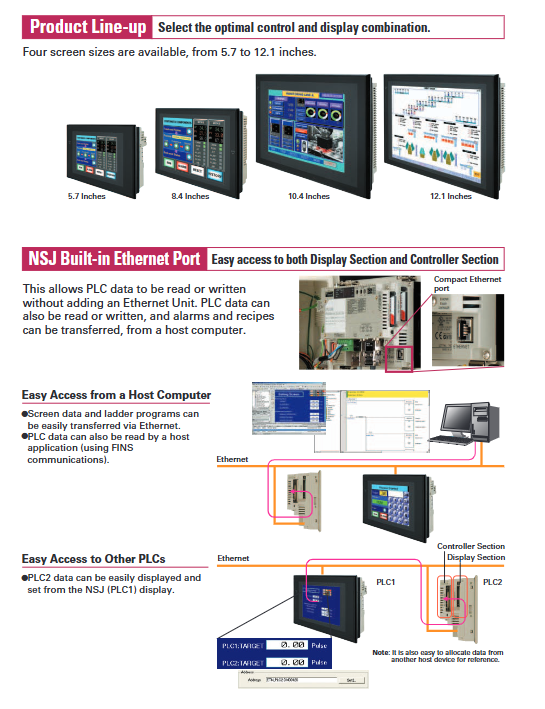
Screen specifications: 5.7/8.4/10.4/12.1-inch color TFT LCD, resolution coverage QVGA~SVGA
Body thickness: NSJ5 is 79.0mm, NSJ8/10/12 is 73.3mm
Installation adaptation: compatible with 400-500mm wide control cabinets, no need for independent PLC space
Protection level: IP65 front panel, NEMA4, UL Type4
3. Core performance parameters
Parameter specifications
The maximum number of I/O points is 1280
User program 60K steps
Basic instruction execution time 0.04 μ s
Maximum of 3 expansion racks
FB program memory 1024KB
288 tasks (32 cycles+256 interrupts)
4. Interface and Communication
Standard interfaces: USB, RS-232C, DeviceNet master station, 10/100Base TX Ethernet
DeviceNet: baud rate 500/250/125kbps, maximum support for 63 slave stations
Extended communication: Controller Link, Ethernet expansion unit
Upper computer access: supports FINS, FTP, email, Socket communication
5. Design and debugging convenience
Single USB cable completes high-speed transmission of screen data and ladder program
Built in CX Simulator simulation, can be debugged without the need for a real machine
SAP intelligent component library exceeds 2000, drag and drop to quickly complete the screen
Compatible with NS series screens and CJ series PLC program asset reuse
6. Maintenance and troubleshooting
Standard PLC fault diagnosis and DeviceNet fault diagnosis, screen guidance for troubleshooting
Quickly switch to the ladder diagram monitoring interface in 5 seconds, supporting address search
Support one click backup of storage card (screen data+PLC program) without the need for a computer
Modular replacement reduces downtime and lowers the variety of spare parts
7. Expansion accessories
Expansion units: NSJW-ETN21 (Ethernet), NSJW-CLK21-V1 (Controller Link), NSJW-IC101 (I/O Control)
Storage: 128/256/512MB flash memory card
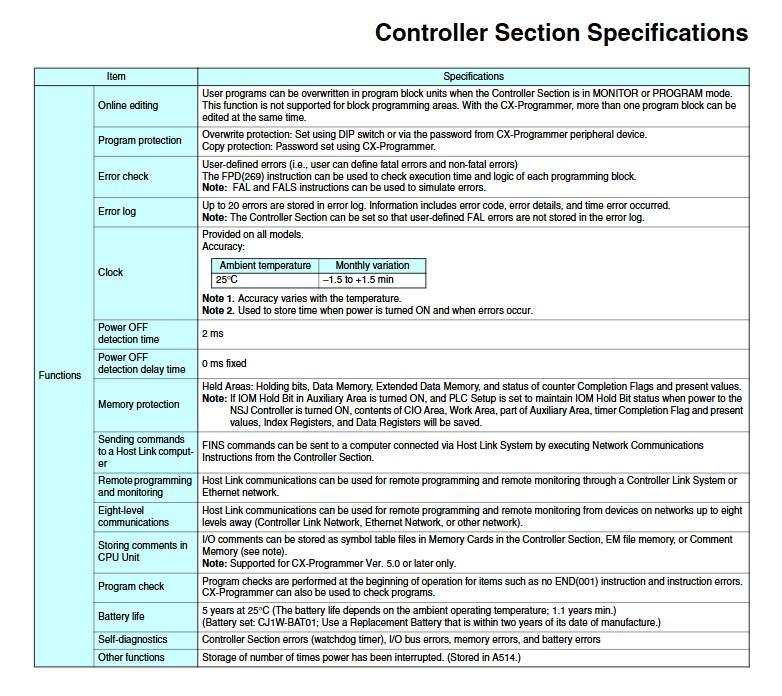
Battery: CJ1W-BAT01, with a lifespan of 5 years at 25 ℃
Cable: RS-232C, RS-422A conversion, I/O connection cable
8. Application scenarios
Simple robot positioning control
DeviceNet intelligent slave monitoring
Production progress and alarm management
Barcode recognition and data uploading
Integrated control of small devices
9. Certification and Standards
Safety regulations: cULus, CE, UL Type4
EMC:EN61131-2、EN61000-6-4、EN61000-6-2
Working environment: temperature 0~50 ℃, humidity 20~90% RH (no condensation)
Key questions and answers
What are the core advantages of NSJ series compared to traditional separated HMI+PLC?
The core advantage is integrated integration, without the need for independent PLC and PLC power supply. The thinnest body is 73.3mm, saving control cabinet space; Standard DeviceNet master station without initial setup, reducing wiring; Single USB cable debugging, built-in simulation and fault diagnosis, significantly reducing design, debugging and maintenance costs, supporting global control cabinet standardization.
What is the communication capability and scalability of the NSJ series?
Standard Ethernet DeviceNet、USB、RS-232C, Can access the display and control parts simultaneously through a single network port; DeviceNet supports 63 slaves; Scalable Ethernet, Controller Link, I/O control unit, supporting up to 3 CJ series expansion racks and 30 expansion units, compatible with Omron CJ series modules.
What are the key convenient maintenance features of the NSJ series?
Standard dual fault diagnosis tool, screen guidance for troubleshooting without manual required; Switching ladder diagram monitoring in 5 seconds, supporting address and instruction search; Support one click backup of screen data and PLC programs on storage cards; When there is a malfunction, modular overall replacement can be used to reduce downtime and unify spare parts to lower management costs.