OMRON ZFX-C Vision Sensor
Product and Model Classification
1. Core positioning
ZFX-C is a programming free intelligent visual sensor with a 3.5-inch touch screen for direct display and one click AUTO teaching. It is suitable for assembly inspection, appearance defects, size measurement, and color sorting.
2. Model differences
Model Camera Number Single Bank Maximum Detection Item Function Range
ZFX-C20/C25 2 128 Full Function (Graphic/Flexible/Labeling/Logging)
ZFX-C10H/C15H 1 32 Foundation+Defect Detection
ZFX-C10/C15 1 32 Simplification (Pattern/Bright Fundamentals)
Safety and usage regulations
Security level: Non safety product, not suitable for personal protection.
Environmental requirements: 0~50 ℃, 35%~85% RH, no condensation, no strong electromagnetic.
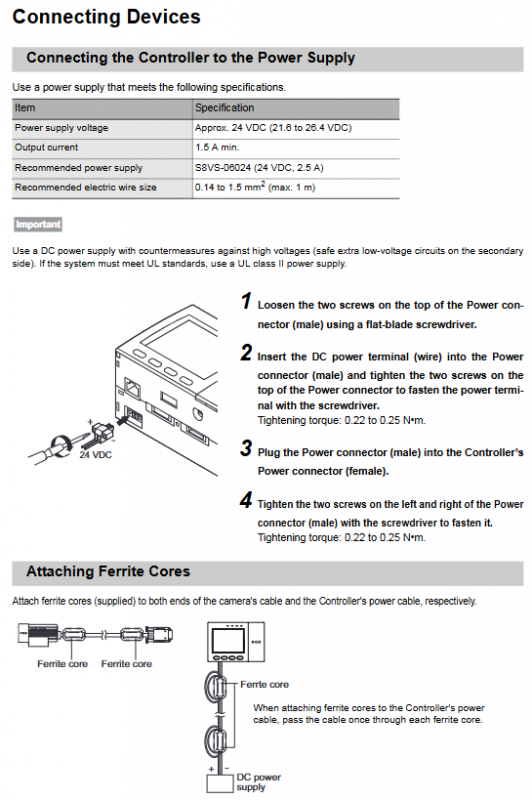
Power supply: DC24V ± 10%, reverse connection is strictly prohibited, and strong and weak electricity should be separated.
Maintenance: Clean the lens with air blowing and prohibit alcohol/acetone.
Hardware installation and wiring
1. Installation method
Controller: DIN rail/panel installation, vertically placed to ensure heat dissipation.
Camera: Fixed bracket, adjustable focus ring, maximum bus cable length of 28.4m.
2. Definition of Core I/O
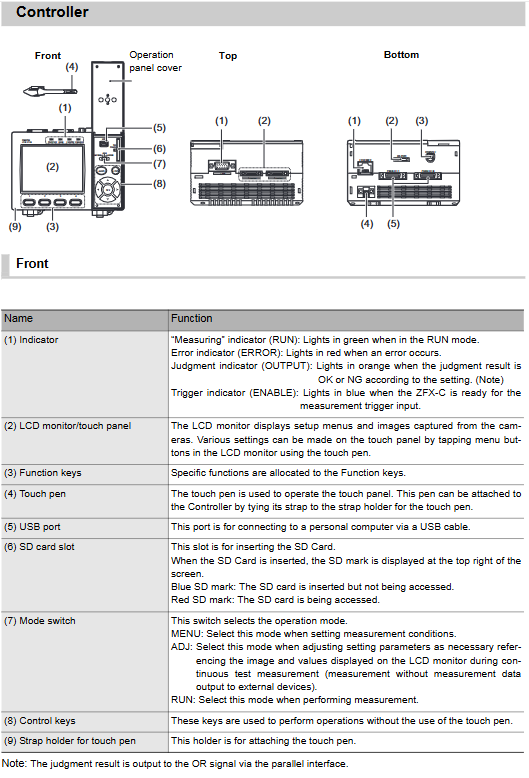
Input: TRIG (trigger), TEACH (teach), BANK1-3 (switch), ENABLE (enable).
Output: OR (total judgment), ERROR (fault), RUN (running), GATE (data valid).
Parallel interface: 20 pin standard port+expansion port, supporting NPN/PNP compatibility.
Three major operating modes
MENU mode: Set detection items, areas, parameters, cameras, and systems.
ADJ mode: continuous measurement, threshold adjustment, review of historical images, log adjustment.
RUN mode: formal operation, result output, data logging, statistical display.
Detection tools (10 core categories)
1. Shape detection
Pattern Search: Template matching with the highest accuracy.
Graphic Search: Contour priority, low contrast stability.
Flexible Search: Multiple templates (36) compatible with differences.
Sensitive Search: Subdivide grids and detect small differences.
2. Size/color/edge detection
Area/Labeling/MultiColors: Area, counting, multi-color (4-color) sorting.
Position/Width/Count/Angle: Edge position, width, quantity, angle.
Bright/HOU: Brightness and hue judgment, resistant to light fluctuations.
3. Application detection
Grouping: Multi template classification (64), product segmentation.
Defect: Region segmentation comparison, scratch, dirt, and missing material detection.
Advanced features
1. Position correction
Supports 8 correction methods (edge/area/template/dual template, etc.), automatically correcting offset and rotation.
2. Calculation and Logic
Supports 32 variables, 32 sets of data, and 32 sets of judgment expressions.
Functions: MAX/MIN/ABS/ATAN/NIST/IND/OR/IMAX/IMIN.
3. Bank management
Built in: 32 Bank.
SD card expansion: 32 sets x 32=1024 Bank, quickly switch product formulas.
4. Log monitoring
Up to 3 channels can be recorded simultaneously, saving 10000 pieces of data, supporting trend charts, alarms, and exporting CSV.
Communication and output
1. Interface
Ethernet: 100Base TX, IP customized, port 23.
Serial port: RS232/422, with a maximum baud rate of 115200bps.
Parallel: Supports handshake/non handshake, with an output cycle of 2~10000ms.
2. Output format
ASCII/binary, with timestamp, comma separated, SD card automatically creates folders.
System settings
Camera: Shutter 1/170~1/20000s, gain x 1/1.5/2, white balance, strobe.
Display: ECO energy-saving, OK/NG color, customizable list format.
Security: Mode password, RUN key lock, AUTO save switch.
Fault diagnosis
Handling of Error Causes
Camera unconnected cable loose/damaged, reinserted, replaced, checked power supply
Triggering error ENABLE not ready waiting for enable, debounce
Parallel timeout handshake does not respond. Check PLC timing and extend timeout
SD card abnormal lock/damage unlock, format, replace card
Key issues
Question 1: What is the core difference in functionality and capacity between C20/C25 and C10/C15?
answer:
C20/C25: Supports dual cameras, single bank 128 item detection, with full functionality of graphic/flexible/labeling/log monitoring.
C10/C15: Only single camera, single bank 32 item detection, only open basic template and brightness detection, without advanced contour and log functions.
Question 2: What is the function of ZFX-C position correction? What calibration methods are supported?
Answer: Function: When the workpiece deviates/rotates, the detection area is automatically corrected to ensure stable measurement. Support methods: 8 types including edge position, area, marking, template, dual template, angle, contour, and graphic search.
Question 3: What is the difference between “handshake mode ON/OFF” in parallel interfaces? How to choose on-site?
answer:
OFF (asynchronous): The result is directly output, locked by GATE signal, simple and fast, suitable for high-speed single line.
ON (synchronous): Transmission requested by DSA signal, anti loss, more stable, suitable for multiple data/PLC strict timing.
Selection: OFF for high-speed single line; Multi data, long-distance, and error proof ON.