Schneider Telemecanique TSX17 Micro PLC Communication Module
Products and Applicable Systems
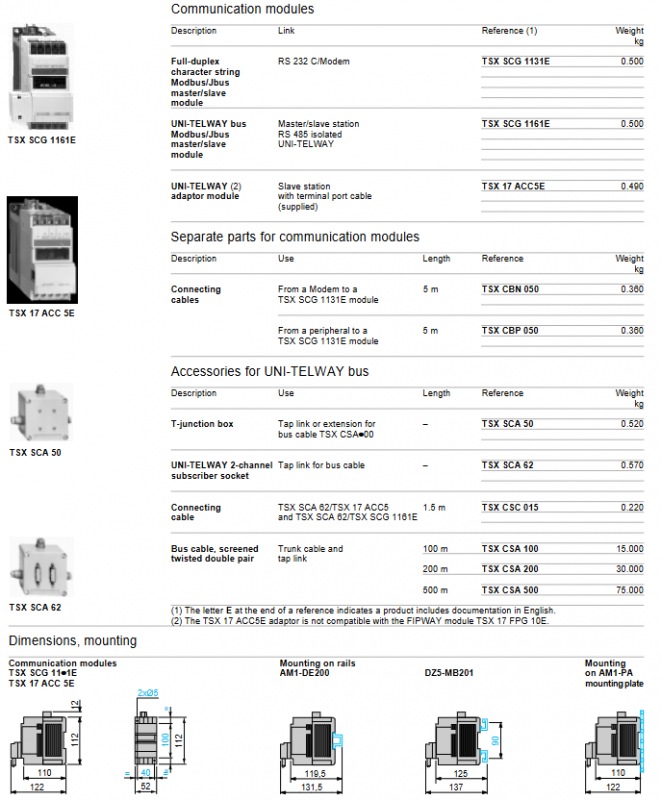
The communication expansion module around TSX17-20 micro PLC belongs to Schneider Telemecanique micro PLC series.
Applicable host: TSX17-20
Must be paired with: PL7-2 language card (TSX P17 20 FC2/FD2, etc.)
Usage: Serial port peripheral connection, Modbus/Jbus communication, UNI-TELWAY bus networking
Core Communication Module Description
1. TSX SCG 1131 (RS232C communication module)
Interface: RS232C full duplex asynchronous serial port
Protocol: Modbus/Jbus (master/slave), string mode
Transmission: Maximum 30 bytes
Baud rate: 150-19200bps (programmable)
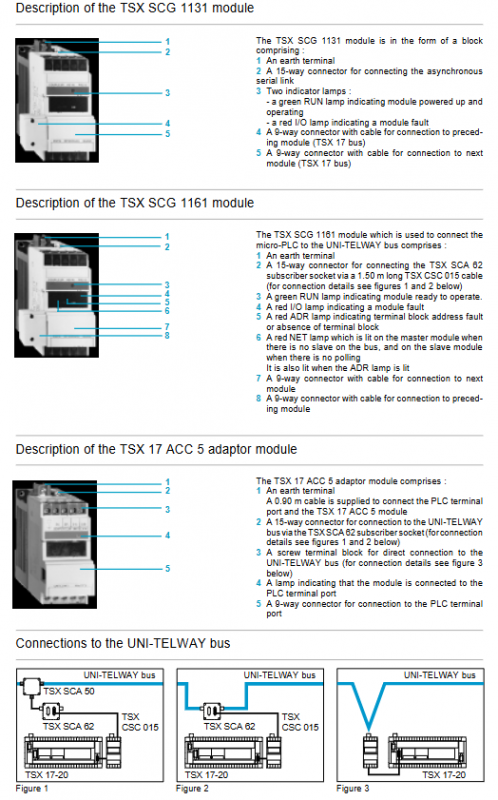
Indicator light: green RUN, red I/O fault
Connecting peripherals: printer, touch screen, computer, modem
2. TSX SCG 1161 (UNI-TELWAY bus module)
Purpose: To connect to UNI-TELWAY industrial bus
Role: Master or Slave
Indicator lights: RUN, I/O fault, ADR address, NET network
Structure: Extended I/O bus access
3. TSX 17 ACC5 (UNI-TELWAY adapter)
Purpose: Convert PLC serial port to UNI-TELWAY slave station
Connection: Directly connect to the PLC terminal port
Restrictions: Can only be used as a slave, not compatible with FIPWAY module
Communication specification parameters
Project parameters
Communication methods RS232C, Modbus/Jbus, UNI-TELWAY
Baud rate 150~19200 bps (programmable)
Maximum single transmission of 30 bytes
Data format bit length, checksum, stop bit program configurable
Working mode: full duplex/half duplex, master/slave, server/client
Connecting accessories and cables
Accessory model, purpose, length
TSX CBP 050 peripheral connected to SCG1131 5m
TSX CBN 050 modem connected to SCG1131 5m
TSX CSC 015 SCA62 connected to SCG1161/ACC5 1.5m
TSX SCA 62 UNI-TELWAY 2-channel branch connector-
TSX CSA 100/200/500 shielded twisted pair bus cable 100/200/500m
Working mode and mechanism
Server/Client Mode
Server: Responding to requests, executing and returning
Client: Actively read/write and send RUN/STOP commands
Text Function Block (TXT)
Used to configure communication parameters and initiate sending and receiving requests.
Status word+command word
Monitor communication status, interrupt transmission, and switch to standby mode.
Key questions and answers
Question 1: What are the core capabilities and limitations of the TSX SCG 1131 module?
Answer: Core capability: Supports RS232C full duplex and Modbus/Jbus master/slave stations, can connect to computers, touch screens, modems, programmable baud rates of 150-19200bps. Limitation: The maximum data transmission per session is 30 bytes, only supports serial port mode, and cannot be connected to UNI-TELWAY bus.
Question 2: What are the two ways for TSX17-20 to connect to UNI-TELWAY bus? What is the difference?
answer:
TSX 17 ACC5 adapter: connected to PLC terminal port, can only be used as a slave station.
TSX SCG 1161 module: expands I/O bus access, can be used as a master or slave station, with stronger functionality.
Question 3: Why does the TSX17-20 communication module need to be paired with a PL7-2 language card?
Answer: Because the communication parameters (baud rate, checksum, format) and the sending and receiving logic need to be configured and called using functional blocks through PL7-2 programming software; Without a language card, the communication program cannot be loaded and the module cannot function.