Operation Instructions for Pilz PNOZ XV3P Safety Relay
PNOZ XV3P is a safety relay with delay function launched by Pilz. It has 3 instantaneous safety normally open contacts and 2 power-off delay safety contacts. It supports 24VDC power supply, single/dual channel input, and contact short circuit detection. The delay range is adjustable/fixed from 0.1s to 30s, meeting the safety levels of PL e/Cat.4/SIL3 (instantaneous) and PL d/Cat.3/SIL3 (<30s delay). It comes with redundant self-monitoring and LED status indication, and is installed on DIN rails. It is suitable for industrial safety circuits such as emergency stop, safety door, and safety grating. It has passed global certifications such as CE, UKCA, CCC, and T Ü V.
Basic Information and Security Standards
Product positioning
Model: PNOZ XV3P, safety relay (with power-off delay)
Standards: EN 60947-5-1, EN 60204-1, EN ISO 13849-1
Certification: CE, UKCA, CCC, T Ü V, cULus, EAC
Safety Warning
DANGER: Immediate Fatal Risk
Warning: Serious personal injury risk
CAUTION: Minor injury/equipment damage
NOTICE: Equipment damage prompt
user
Only professional qualified personnel are allowed to install, debug, and maintain.
Core functions and structure
Contact configuration
Contact type, quantity, action mode
Safe instantaneous contact 3 NO immediately activated
Safety delay contact 2-channel NO power-off delay disconnection
Work logic
Input closed → All contacts closed, CH1/CH2 indicator light on
Input disconnection → Instantaneous contact immediately disconnects, delayed contact timing before disconnection
Reset disconnect → Delay can be cancelled in advance
operation mode
Single channel/dual channel input
Short circuit detection with/without contacts
Automatic start/monitoring start
status indicator
POWER: The power supply is normal
START: Start circuit closure
CH.1/CH.2: Instantaneous contact closure
CH.1 [t]/CH.2 [t]: Delay contact closure
Key electrical parameters
Power supply and input
Parameter values
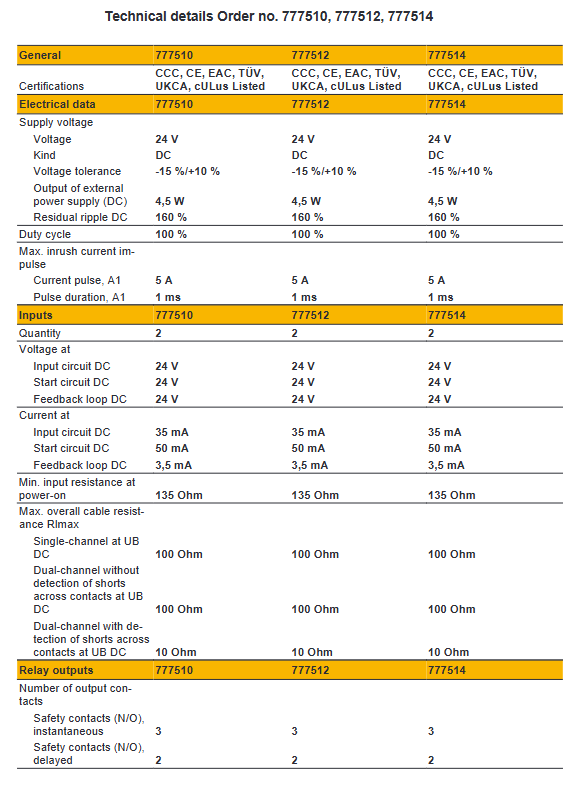
Supply voltage 24VDC, -15%~+10%
Power consumption 4.5W
Input voltage 24VDC
Input current 35mA
Starting circuit current 50mA
output capability
Load type, maximum current, maximum power
AC1(240V) 8A 2000VA
DC1(24V) 8A 200W
AC15(230V) 5A –
delay parameter
Delay model, delay range, accuracy
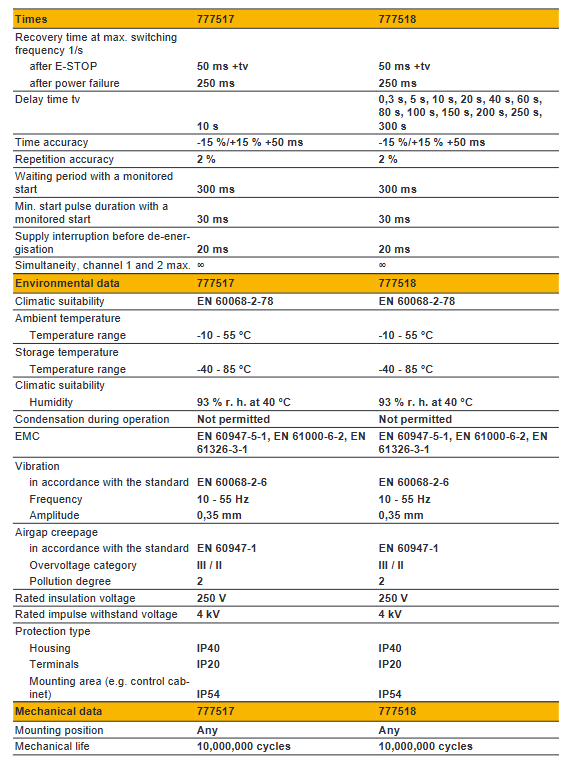
Fixed delay of 0.5/s/10s ± 15%+50ms
Adjustable short delay of 0.1~3s ± 15%+50ms
Adjustable delay of 0.3~300s ± 15%+50ms
Security feature data
Contact type PL category SIL PFH D life TM
Instantaneous contact PL e Cat.4 SIL3 2.31E-09 20 years
Delay<30s PL d Cat.3 SIL3 2.64E-09 20 years
Delay ≥ 30s PL c Cat. 1 SIL1 2.87E-09 20 years
Installation and maintenance
Install
35mm DIN rail installation, housing protection IP40
Control cabinet protection ≥ IP54
Wiring requirements
Wire diameter: 0.25~2.5mm ², torque 0.5Nm
The output front-end must be equipped with a 10A fast melting fuse
maintenance cycle
PL e/SIL3: Check once a month
PL d/SIL2: Check once a year
Fault type
Contact adhesion → unable to restart
Input short circuit/open circuit/ground fault → contact disconnection
Power supply abnormality → POWER light not on
Key issues
Question 1: What are the core differences in safety levels between the instantaneous and delayed contacts of PNOZ XV3P?
Answer: Instantaneous contact reaches the highest level PL e/Cat.4/SIL3; Delay<30s, contact is PL d/Cat.3/SIL3; Delay ≥ 30s, the contact only has PL c/Cat.1/SIL1, and the longer the delay, the lower the safety level.
Question 2: How to achieve early cancellation of the delay function of PNOZ XV3P and what scenarios is it applicable to?
Answer: The delay can be terminated in advance by disconnecting the Y39-Y40 reset circuit; Suitable for safety scenarios that require fast interrupt delay and immediate output cut-off, such as emergency reset operations.
Question 3: What is the key difference between the dual channel with contact short circuit detection mode and the ordinary dual channel mode?
Answer: The short circuit detection mode can identify input contact adhesion/short circuit faults and forcibly disconnect the output; Ordinary dual channel only monitors open circuit/ground faults and does not have the ability to detect contact short circuits, providing higher safety.