Pilz PNOZmulti Classic/Mini Safety Mini Controller
1. Product positioning and series division
PNOZmulti is a Pilz modular configurable safety controller, which falls between traditional safety relays and large safety PLCs, and is divided into two main series:
PNOZmulti Classic: Standard Edition, supports ≥ 4 security features, and has strong scalability
PNOZmulti Mini: Compact, supports ≥ 3 safety features, smaller size
The two modules are not interchangeable and both meet the highest level of mechanical safety.
2. System architecture and core principles
Structure: Basic unit+expansion module, jumper connection
Security architecture: Dual MCU cross monitoring, mandatory guidance relay/safety semiconductor output
Working mode: Software defined security logic, chip card storage program
Expansion method: Left side link/bus, right side I/O expansion
3. Hardware module system
(1) Classic Basic Unit
Model positioning features
PNOZ m0p basic model is non expandable, with 6 security features
PNOZ m1p universal extension supports up to 12 extension modules
PNOZ m2p press specifically supports cam, single stroke, and automatic mode
PNOZ m3p burner dedicated flame, air pressure, ignition, safety valve control
(2) Mini Unit
Model positioning features
Mm0p base compact non expandable
Mm0.1p extended support sigma output module
Mm0.2p multi machine link type with built-in Multi Link interface
(3) Expansion module
Input module:
PNOZ mi1p: 8-way secure input
PNOZ mi2p: 8-channel standard input
PNOZ ma1p: 2-channel analog input (voltage/current)
Output module:
Safe semiconductor: 4-channel x 2A, turn off delay of 30ms
Safety relay: 2/4 channels, turn off delay of 50ms
Link module:
Ml1p: Dual machine secure link
Ml2p: Up to 4 distributed PDP67 modules (IP67)
Speed monitoring:
Ms1p~ms4p: 1-2 axes, supports incremental/HTL/SinCos encoders
Fieldbus:
Profinet, EtherCAT, CANopen, Modbus TCP, CC Link, etc
4. Security performance (core level)
Highest security level:
PL e / Cat.4(EN ISO 13849-1)
SIL CL3(EN IEC 62061)
Typical PFH ᴰ: 2.90E-10
Task cycle: 20 years
Single channel: PL d/Cat.2/SIL2
Dual channel: PL e/Cat.4/SIL3
5. Software configuration system
Tool: PNOZmulti Configurator graphical drag and drop
Process: Select hardware → Draw logic → Define IO → Download to chip card
Features:
Macro Definition and Reuse
Multi level password protection
Multilingual interface
Diagnosis and simulation
6. Installation and wiring specifications
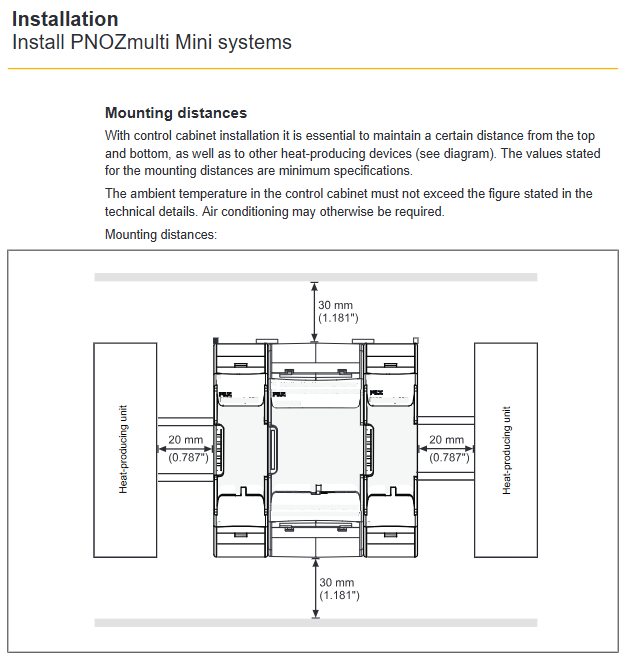
Installation: 35mm DIN rail horizontal installation, ventilation duct up and down
Distance:
Up and down: ≥ 30mm
Left and right: ≥ 20mm
Protection: Module IP20, installation cabinet ≥ IP54
Power supply: 24V DC, ripple ≤ 5%
Wiring: Spring/screw terminals, 0.25~2.5mm ² cable
Shielding: Analog/Communication Line Double End Shielding Grounding
7. System Expansion Rules
Classic scalability
Left side: 4 extensions+1 bus
Right side: 8 I/O modules
Distributed: Up to 16 PDP67 (IP67)
Mini expansion capability
Left side: 4 links+1 communication+1 bus
Right side: 1 sigma output module
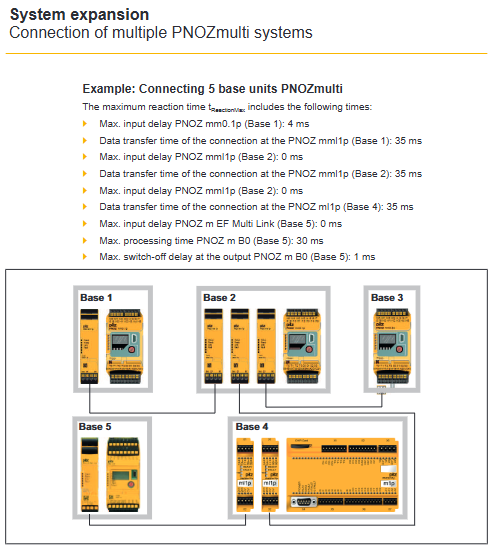
8. Reaction time calculation
Maximum response time=input delay+output delay
Maximum input delay: 4ms
Semiconductor output: 30ms
Relay output: 50ms
Link module: Add 35ms
9. Diagnostic system
Panel LED: PWR/RUN/DIAG/FAULT
Error stack: Hardware/wiring/configuration/communication failure
Diagnostic words: status bits and fault codes
Bus: Upload diagnostics through Fieldbus
Visualization: Supports PASvisa system
10. Certification and Compliance
Universal: CE, UKCA, cULus, T Ü V
Standards: EN ISO 13849-1, EN IEC 62061, EN 61010-1
EMC:EN 61131-2、EN 55011
Key issues
Question 1: What is the core difference between PNOZmulti Classic and Mini? What scenarios are suitable for each?
answer:
Classic: Strong scalability, up to 12 expansion modules, supporting analog quantity, multi axis speed monitoring, and press/burner specific functions, suitable for complex equipment, multiple safety points, and high expansion requirements.
Mini: Small size, minimal expansion (up to 1 output module), lower cost, suitable for small single machine, compact devices, and simple scenarios with 3-6 safety functions.
Question 2: How does the system achieve the highest security level PL e/Cat.4/SIL CL3? What are the key hardware designs?
answer:
The core relies on a dual channel architecture: dual MCU mutual monitoring+dual channel input+redundant safety output.
Key hardware:
Dual CPU cross detection, single CPU failure does not affect safety
Forced directional relay/safety semiconductor output
Input short circuit detection, output cross monitoring
Independent power supply and grounding design
Question 3: How to calculate the reaction time of PNOZmulti system? What is the total latency of a typical configuration?
answer:
Calculation formula: Total t=Maximum input delay+Maximum output shutdown delay
Typical example: Basic unit input+secure semiconductor output
Input delay: 4ms
Output delay: 30ms
Total reaction time: 34ms