Hirschmann RS20/RS22/RS30/RS32/RS40 Series Industrial Rail Switch Installation Manual
The overall architecture and model rules of the five major product lines
Product line positioning differentiation
Is the core positioning of the series PoE uplink specification
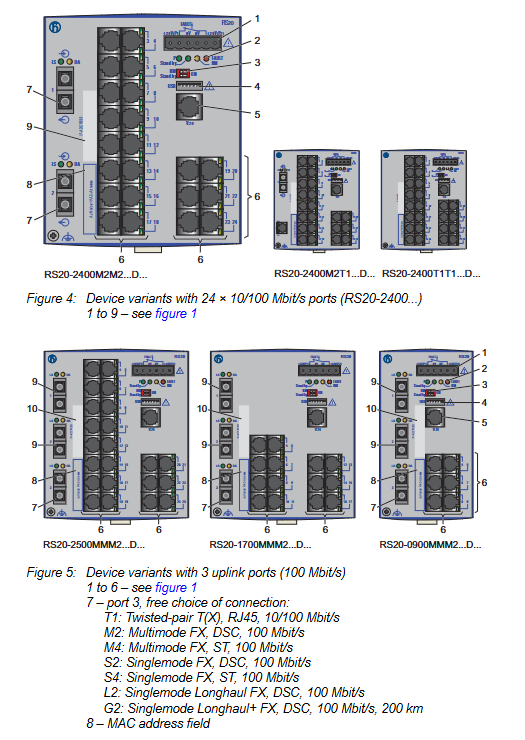
RS20 pure 100Mbps industrial switch, no Gigabit ports, no 2/3 100Mbps uplink (RJ45/DSC fiber)
RS22 RS20 PoE version, 100Mbps basic 4-port IEEE802.3af PoE 2/3-channel 100Mbps uplink
RS30 with Gigabit Upstream 100Mbps Switch without 2/4 Gigabit SFP Combo Upstream
RS32 RS30 PoE Gigabit model 4-port AF PoE 2/4-channel Gigabit SFP Combo uplink
RS40 full gigabit switch, all Combo multiplexing ports without 4 sets of gigabit Combo (RJ45/SFP multiplexing)
Complete segmented definition of model code
Series code (RS20/22/30/32/40);
Number of 100Mbps ports (04/08/09/16/17/24/25);
Number of gigabit ports (00 without gigabit/02 with two gigabit);
Upstream interface types: T1 (RJ45), M2/M4 (multi-mode DSC/ST), S2/S4 (single-mode), O6/ZZ (SFP Gigabit/100Mbps), CC (Gigabit Combo);
Temperature range: S (standard 0~60 ℃), T/E (-40~70 ℃ three proof wide temperature);
Power supply: D (universal AC/DC), P (PoE specific 48V DC);
Certification level: A universal, H railway/power/classification, B explosion-proof complete set;
Software: E Enhanced Edition, P Professional Edition.
Port specification classification
100Mbps electrical port: 10/100M RJ45, supporting automatic negotiation, automatic line sequence, and automatic polarity; The last 4 ports of RS232/32 support AF PoE, 48V phantom power supply, and a maximum of 15.4W per port;
Gigabit Combo port: RJ45 and SFP are multiplexed, and when SFP is inserted, the electrical port is automatically disabled; Support Gigabit/100Mbps SFP hybrid insertion;
Fiber optic interface: Fixed DSC/ST 100Mbps optical, pluggable SFP (multimode/single-mode/long-distance/bidirectional BiDi), only compatible with optical modules of the same specifications;
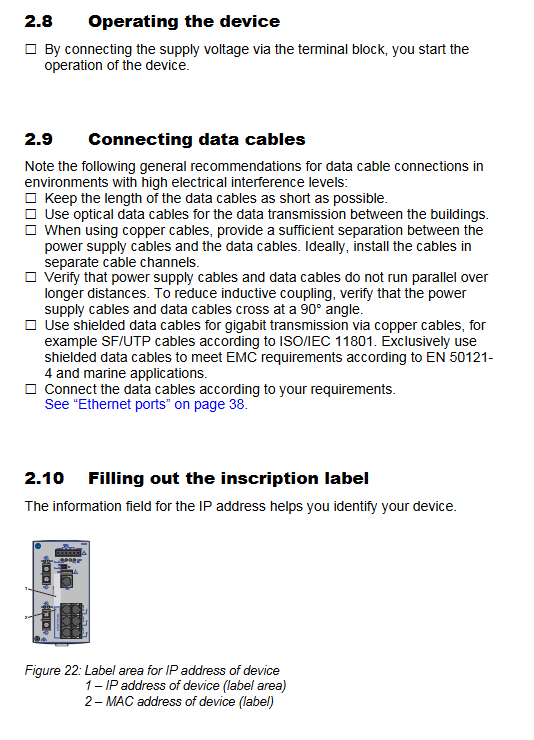
Universal hardware interface for the whole machine: 6-pin power supply+FAULT relay terminal, 2-pin DIP ring network dialing, V.24 RJ11 local serial port, USB-A ACA configuration port, IP/MAC label area.
Whole machine management method
Local: V.24 serial port (9600 8N1 CLI), ACA22-USB configuration USB drive (backup/upgrade firmware);
Remote: Web HTTPS, SSH, Telnet;
Batch operation and maintenance: HiDiscovery, Industrial HiVision, supporting SNMP monitoring.
Core hardware functions
Dual redundant power supply, passive FAULT fault relay, HIPER Ring high-speed ring network RSTP、 Hardware DIP ring network dialing, port link monitoring, temperature detection, and overall hardware self-test.
LED indicator light and DIP dialing function
1. Global whole machine indicator light
P power supply: green=dual power supply, yellow=single power supply, off=no power supply;
FAULT red light is always on: there is a fault (power failure/chain breakage/abnormal ring network/overheating);
RM Ring Network Manager: Evergreen=Primary Device (Redundant Port Closed), Yellow Flash=Backup/Communication Interruption, Off=Ring Network Closed;
Stand by: Always on to enable loop coupling backup;
ACA interaction: Sync flash once=save configuration, 2 times=read, alternate flash=USB drive failure.
2-port indicator light
LS green light: always on link connected, 1 cycle flash=port standby, 3 flashes=port closed;
DA yellow light flashing=transmitting and receiving data, constantly off with no traffic.
3 2-digit DIP dip code (RM/Stand by)
Factory default dual ON, dialing priority lower than web software configuration; It can quickly open the ring network manager, couple switches, specify ring network ports, adapt to on-site quick debugging, and does not require logging into a webpage.
Complete installation, wiring, and power on operation process
Unboxing verification: Check the host, power terminals, magnetic ring (PoE high-power model), safety instructions, and inspect for transportation bumps;
SFP installation: Power off operation, insert the original SFP into the slot for locking, remove the locking buckle, and cover it with a dust cap when idle;
DIN/wall mounted installation
DIN rail: snap on vertical fixation, with reserved ventilation space; Ship installation of shock absorber kits;
RS232/32 optional wall mounted board, vertically fixed to a flat wall surface;
Prioritize connecting the protective grounding wire before connecting all cables;
Terminal wiring distinguishes between two types of models
RS20/30/4 universal 6-pin terminal: dual redundant AC/DC power supply+FAULT passive relay; Relay reports power loss, port disconnection, ring network failure, self-test fault;
RS232/32 PoE model: dedicated 48V DC terminal, must be paired with RPS90 LV/HV PoE power supply, maximum 90W PoE output of the whole machine;
Install matching magnetic rings on the power cables and arrange them closely to the terminals to suppress EMC interference;
Data Cable Routing Specification
Prioritize fiber optic cross cabinet in industrial environments; Separate strong and weak electrical conduits to avoid long-distance parallelism and cross 90 ° to reduce coupling; Railway/ship mandatory shielding of network cables; Cat5e twisted pair cable with a maximum length of 100m;
Power on self-test: After power on, the whole machine performs a self-test for about 60 seconds, and all LEDs flash in a loop. After the self-test is completed, it enters the ready state.
Factory default basic configuration
IP address: default DHCP automatic acquisition, static backup 192.168.1.1;
Account: admin (password private, read-write); User (public, read-only); It is recommended to change the high-strength password for the first login;
V. 24 serial port parameters: 9600 baud, 8 data bits, 1 stop bit, no checksum;
Port: Automatic negotiation of electrical ports, default full duplex for fiber optic cables;
Redundancy: DIP enables ring network by default, web RSTP is enabled, and link alarms are disabled by default.
Disassembly steps
Power off the entire machine, unplug the network cable and fiber optic cable USB、 All terminals;
Disconnect the ground wire first, and then remove the remaining cables;
Use a screwdriver to press down on the DIN buckle and lift it up to remove the switch;
Unlock and unplug SFP, and cover all optical ports with dust-proof protective caps.
Maintenance and temperature monitoring
The consumable parts are only FAULT relays, and the contact resistance is regularly checked in high-frequency on-off scenarios;
Regularly clean the dust in the ventilation duct to avoid dust accumulation, overheating, and derating;
Web/CLI can read the internal temperature of the device, which is about 20 ℃ higher than the environment. If it exceeds the specifications, it needs to be shut down for cooling;
The official website continuously updates firmware, fixes vulnerabilities, and adds network functions;
PoE models will automatically reduce output power in high temperature environments, with PoE output dropping to 60W at temperatures above 60 ℃.
Core technical parameters
1 Physical specifications
Divided into 4-port/8-port/16 port/24 port narrow/wide body, RS232/32 Po models have a thicker thickness; The whole machine has IP20 protection and weighs between 400 and 1200g;
2 Power supply parameters
Universal model: 9.6~60VDC/18~30VAC dual redundancy, power down buffer>10ms;
PoE model: 47~54VDC input, maximum 90W PoE output of the whole machine; RPS90 low voltage (24-48V input)/high voltage (90-230V AC/DC) power supply;
3 Environmental conditions
Standard S: 0~60 ℃; T/E wide temperature range: -40~70 ℃ (the upper limit of Po explosion-proof models is reduced to 50 ℃); Storage -40~85 ℃; Humidity of 10~95% without condensation, maximum altitude of 2000m;
4 transmission distance
Twisted pair Cat5e 100m; 100Mbps multimode 4-5km, single-mode 30km; Gigabit SFP divided into 550m (multimode), 20km/80km/140km long short distance single-mode;
5 supporting accessories
ACA22-USB configuration USB flash drive, full range of SFP optical modules (standard/EEC wide temperature), wall bracket, ship shock absorber kit, rail power supply, spare terminals, HiVision network management software.
Industry Certification Checklist
Safety: UL508, EN62368; Explosion proof ATEX/IECEx/UKEX/North American Class I Div.2; Electromagnetic FCC Class A; Industry specific: Railway EN50121, Ship DNV, Power IEC61850, Substation IEEE1613; Environmental RoHS.