DEIF TCM-2 thyristor control module
Basic Information
Model: TCM-2 Thyristor Control Module, DEIF New Energy Wind Power Special Controller
Core application scenarios: onshore/offshore wind turbines, asynchronous motor soft start equipment, focusing on grid connected control of wind turbines
Advantages of Product Core Environment Reliability
TCM-2 follows the strict design standards of DE marine/offshore equipment and is suitable for harsh working conditions:
Working temperature range: -25 ℃~+70 ℃, far exceeding the temperature range of conventional industrial controllers;
High anti vibration structure design, perfectly adapted to the turbulent vibration environment of offshore wind power and onshore wind turbine cabins;
3. The whole machine has strong durability and is specially designed for long-term unmanned wind turbine working conditions.
Two operating modes
TCM-2 supports two architectures: independent single machine autonomous operation and CAN bus slave control, adapting to different wind power control system solutions:
Stand alone mode
By only connecting a small number of standard industrial analog/switch signals, the complete set of thyristor real-time voltage regulation and grid connection control logic can be autonomously executed without the need for real-time intervention from the upper level main controller, making it suitable for simple wind turbine electrical control solutions.
CAN bus slave mode
Connect the upper level main process controller through the CAN bus, and receive real-time adjustment instructions from the upper level. TCM-2 only performs thyristor power adjustment and is compatible with the entire wind power integrated control system.
Core innovation: Adaptive cut in algorithm for wind turbines
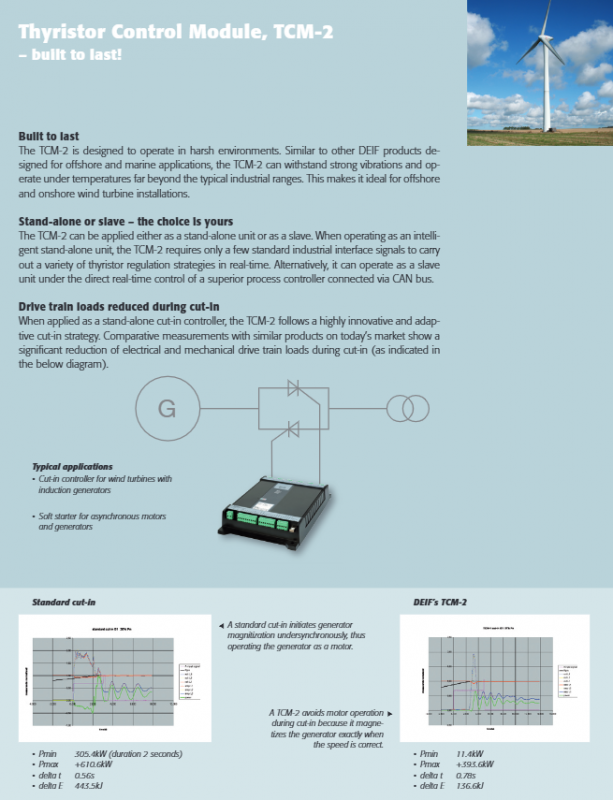
This is the most core technological highlight of TCM-2, used for grid connection and closing control of asynchronous wind turbines, significantly reducing the impact load of the transmission chain:
1. Defects of ordinary traditional entry solutions
The traditional approach would complete the excitation of the generator before the speed is synchronized, causing the generator to briefly operate in the state of an electric motor and generate a huge impact power:
Minimum impact power Pmin: 30.4kW
Peak impact power Pmax:+610.6kW
Duration of impact Δ t: 0.56s
Total impact energy Δ E: 443.5kJ
The huge instantaneous load severely damages transmission components such as gearboxes and main shafts, shortening the lifespan of the fan.
2. TCM-2 adaptive cut in optimization principle
Accurate matching of speed timing, excitation is only completed at the moment when the generator reaches synchronous speed, completely avoiding reverse impact of motor operating conditions:
Minimum impact power Pmin: only 11.4kW
Peak impulse power Pmax:+393.6kW
Duration of impact Δ t: 0.78s (slight elongation, smoother load)
The total impact energy Δ E has decreased to 136.6 kJ, which is about 69% lower than the traditional solution
Significantly reduce the mechanical stress on the main shaft, gearbox, and blades, lower maintenance and replacement costs, and extend the service life of the entire fan.
Standard application scope
Wind turbine grid connection controller (core application): soft grid connection control for cage type asynchronous wind turbines;
Asynchronous motor/generator soft starter: Various high-power induction motors start smoothly to suppress starting surge current.