Euresys Coaxlink Full Series CoaXpress Image Capture Cards
Basic Overview
The official multi in one datasheet from Euresys includes the complete range of Coaxlink Mono/Duo/Quad/Otto CXP image acquisition cards, along with specifications for I/O expansion modules; All products comply with the CoaXpress 1.0/1.1/1.1.1/2.0 standards and are compatible with the GenICam/GenTL industrial vision universal protocol, targeting scenarios such as AOI, 3D inspection, roll printing, robot vision, and high-speed video recording; The document includes hardware parameters, interfaces IO、 Onboard processing, software, accessories, certification, global sales outlets, all parameter manufacturers reserve the right to change without notice, in compliance with RoHS3, REACH, and WEEE environmental standards.
Full range product model classification and core positioning
(1) CXP-12 High Speed Series (12.5Gbps Single Channel Rate, Micro BNC Interface)
Coaxlink Mono CXP-12(3621-LH)
Single channel CXP-12, PCIe3.0 x4, Passive fanless cooling, with a maximum bandwidth of 1.25GB/s for a single camera; Suitable for small devices with a single ultra-high resolution/high frame rate camera.
Coaxlink Duo CXP-12(3622)
Dual channel CXP-12, PCIe 3.0 x4, fan cooling, total camera bandwidth of 2.5GB/s; Dual camera synchronous detection scene.
Coaxlink Quad CXP-12(3603)
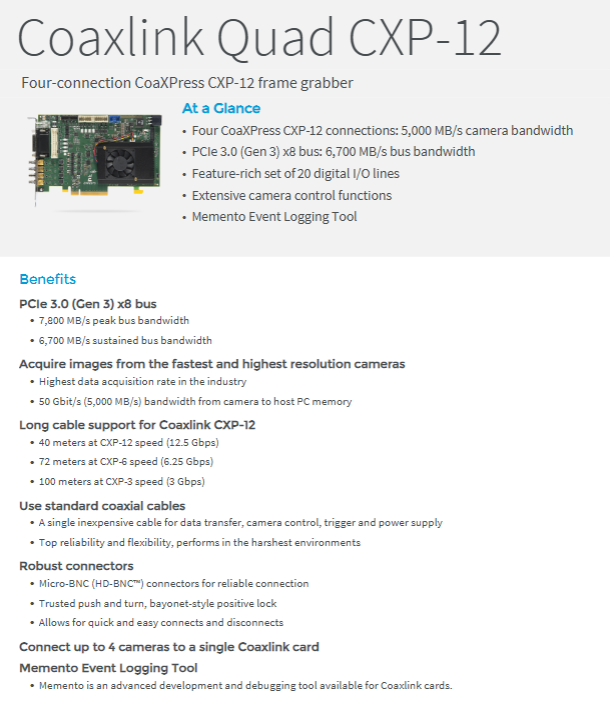
Four channel CXP-12, PCIe 3.0 x8, fan cooling, total 5GB/s bandwidth; Equipped with Xilinx Kintex UltraScale FPGA, supporting secondary development of Custom Logic user FPGA, customizable image processing logic, and supporting high-speed production line inspection of planar/linear arrays.
Coaxlink Quad CXP-12 JPEG(3620)
Same as the 3603 hardware, it has 4 independent JPEG hardware encoders onboard, with a maximum of 250M pixels/s per channel. It synchronously outputs the original image and compresses two streams of JPEG data, greatly reducing the CPU load of the host. It is used for multi camera video recording and online monitoring.
(2) CXP-6 Medium Speed Series (6.25Gbps, DIN 1.0/2.3 Snap on Coaxial Interface)
Coaxlink Duo (1631): Dual channel CXP6, PCIe 2.0 x4, mid-range dual camera economical solution.
Coaxlink Quad (1632): Four channel CXP6, PCIe 2.0 x4, universal four camera standard acquisition card.
Coaxlink Quad 3D-LLE (1637): Four channel CXP6, dedicated 3D laser line extraction hardware, built-in peak/centroid/maximum value three sub-pixel extraction algorithms (up to 1/256 pixel accuracy), up to 19000 contours per second, no host operation required, dedicated to laser contour 3D scanning.
Coaxlink Quad G3 (1633): PCIe 3.0 x8 upgraded version with increased bandwidth, divided into fan standard version and fanless LH silent version, with stronger long-term adaptability.
Coaxlink Quad G3 DF (1635): G3 with data forwarding DF function, four input channels on the card+four CXP forwarding ports, images can be split to multiple PCs for distributed visual processing.
Coaxlink Octo (3602): Eight channel CXP6, PCIe 3.0 x8, up to 8 cameras per card, multi camera large-scale detection equipment, supporting Custom Logic.
Coaxlink Quad CXP3 (1638): Four channel low-speed CXP3 (3.125Gbps), with the advantage of supporting coaxial cables up to 100 meters, providing a long-distance production line vision solution.
(3) Supporting I/O expansion module
3614 HD26F Standard IO Expansion Module: Expand a complete set of 20 universal IO channels (4 differential inputs, 4TTL bidirectional, 8 isolated DI, 4 isolated outputs), compatible with the Octo/Quad series.
3612 TTL-RS422 expansion module: IO supports TTL/5V CMOS/high-speed RS422 differential signals, with a maximum differential IO of 10MHz, dedicated for high-speed encoder acquisition.
Universal core hardware capability (shared across the entire series)
1. Bus and transmission performance
The bus is divided into PCIe 2.0 x4/PCIe 3.0 x4/PCIe 3.0 x8 specifications; PCIe 3.0 version has a continuous bandwidth of 3300MB/s (x4), 6700MB/s (x8), and a peak of 7800MB/s.
DMA hardware decentralized aggregation, 32/64 bit addressing; Supports direct GPU transfer, compatible with NVIDIA CUDA and AMD DirectGMA, zero copy memory, reducing latency and CPU usage.
2. CoaXpress transmission and PoCXP power supply
Supports CXP1~CXP12 full speed, coaxial cable length:
CXP12:40m; CXP6:72m; CXP3:100m
PoCXP coaxial power supply: single channel output 24V/17W, automatic protection against short circuit and overload; An external 6Pin PEG 12V auxiliary power supply is required. Single coaxial transmission of images, camera control, triggering, and power supply simultaneously, simplifying wiring.
3. On board image preprocessing FPGA
1GB high-speed onboard cache, built-in hardware processing unit:
Multi bit image unpacking (10/12/14 bit to 16 bit), byte order conversion, R/B channel swapping;
Monochrome input LUT lookup table calibration;
Bayer to RGB interpolation (linear/median/5×5 gradient algorithm);
Line scan camera flat field calibration (supported by some firmware);
Real time statistics of data stream frame rate, line frequency, and bandwidth.
4. Industrial IO system (core visual synchronization matching)
IO hardware type
DIN high-speed differential input: compatible with RS422, supports 5MHz orthogonal encoder AB phase decoding;
TTLIO bidirectional 5V level;
IIN isolated input: 250VAC/250VDC isolated, compatible with 5/12/24V sensors, up to 50kHz;
IOUT isolated contact output: 30V/100mA, driving light source and solenoid valve.
IO Toolbox (Programmable Logic)
Built in hardware timing unit, no CPU intervention required:
LIN edge detection, QDC orthogonal encoder 32-bit counting, reverse motion compensation (line scan anti duplication acquisition);
DIV division, MD multiplication, DEL event delay, UAS timing scheduling;
Can generate hardware triggers for exposure, line scan start stop, and light source synchronization.
Hardware filtering
All inputs can be configured with 50ns~10 μ s glitch filtering, supporting polarity reversal; Onboard 1A 12V power output to peripherals.
5. Multi card/multi camera synchronization C2C Link
Dedicated synchronous ribbon cable/cross PC adapter to achieve multi acquisition Kana level synchronization:
Same motherboard with multiple cards: synchronization delay<10ns;
Cross PC networking:<265ns;
The maximum networking capacity is 32 PCs, with a maximum synchronous triggering frequency of 2.5MHz.
6. Trigger and camera control
area scan camera
Hardware/software dual trigger, programmable trigger delay, trigger dilution; Accurate exposure control, strobe light timing adjustment, supporting exposure and readout overlap modes.
Line scan camera
Continuous collection of infinite rolls and segmented collection of fixed lengths; The encoder follows dynamic speed regulation, and the pixel aspect ratio is programmable (0.001~1000 times scaling); Reverse motion automatically pauses collection without duplicate images.
Characteristic Differentiation Function Model Description
CustomLogic(Quad CXP12 / Octo)
FPGA opens up about 70% of logic resources, and users use Vivado to develop custom visual processing logic for onboard execution without consuming host computing power.
3D-LLE Laser Line Extraction (Quad 3D-LLE)
Pure hardware completes sub-pixel positioning of laser contours, outputs a 16 bit height map, supports single/dual laser occlusion removal, and comes with Easy3D calibration tool.
DF Data Forwarding (Quad G3 DF)
Four input images can be forwarded to other acquisition cards through an additional four CXP interfaces, achieving multi host distributed parallel image processing.
JPEG hardware compression (Quad CXP12 JPEG)
Four independent JPEG encoders with adjustable picture quality from 1 to 100, synchronously outputting original images and compressed streams for real-time storage and remote monitoring.
Memento debugging tool (standard across the entire range)
Event logging tool, accurate timestamp recording of all camera, capture card, driver, and application events, with logic analyzer view, essential for development/on-site troubleshooting.
Full platform support for software ecosystem
Operating systems include Windows 7/8.1/10 (32/64), Linux x86/x86_64, ARM64, and macOS 64 bit.
develop interfaces
C++/. NET EGrabber Advanced API;
Standard GenTL GenICam driver, compatible with third-party visual software such as Halcon, OpenCV, CVB, etc.
supporting tools
Genicam Browser (camera parameter visualization), GenTL Console (command-line debugging), Memento event analyzer.
Unified specifications for machinery, heat dissipation, and interfaces
The full range of half length PCIe low profile cards have a standard height of 111.15mm and a thin low profile to fit industrial control small chassis;
Passive fanless LH model (quiet and dustproof) and air-cooled fan model (high-performance model) for heat dissipation solution;
Onboard multi class connectors: CXP camera port, 26pin external IO, onboard internal IO expansion, 6pin PEG auxiliary power supply, C2C synchronous ribbon socket; Dual color LED indicator card, camera link, FPGA operating status; RECORDY firmware recovery dial switch.
Environment and Certification
Working temperature: 0-55 ℃, storage: -20~70 ℃, humidity: 10~90%, no condensation;
EMC Class B emission/anti-interference certification, FCC, KC, UL94 V-0 flame retardant PCB;
Compliant with RoHS 3, REACH, and WEEE waste recycling regulations.
Optional matching accessories
Cable category: C2C synchronous ribbon cable, cross PC synchronous adapter, DB25/HD26 IO adapter cable;
IO expansion module: 3614 standard isolated IO, 3612 RS422 high-speed differential IO module;
Various CXP standard coaxial cables (matched with CXP3/CXP6/CXP12 rates).
Typical application industries
Electronic manufacturing: AOI, 3D SPI, BGA solder joint detection, flat/solar panel line scan detection;
General industry: part size measurement, surface defects, robot vision positioning;
Printing industry: Continuous defect detection of rolls;
Video field: high-speed motion shooting, high-definition traffic monitoring, machine vision video storage.