Atlas Copco Power Focus 6000 Pocket Guide
Power Focus 6000 (PF6000) Handheld Tightening Control System Brief Technical Manual, the entire system consists of PF6000 controller, IAM intelligent application module, Tensor-STR tightening tool, STR dedicated cable, and various accessory communication interfaces; It is an upgraded platform for PF600, supporting virtual workstations, FMS authorization management, multiple tightening strategies, fieldbus, ToolsTalk 2 configuration software, and ToolsNet8 data platform.
Overall system architecture
Power Focus 6000 Controller: The whole machine won the Red Dot Design Award; The 7-inch resistive touch screen, as the core of the entire system, executes tightening programs, IO processing, and communication interaction.
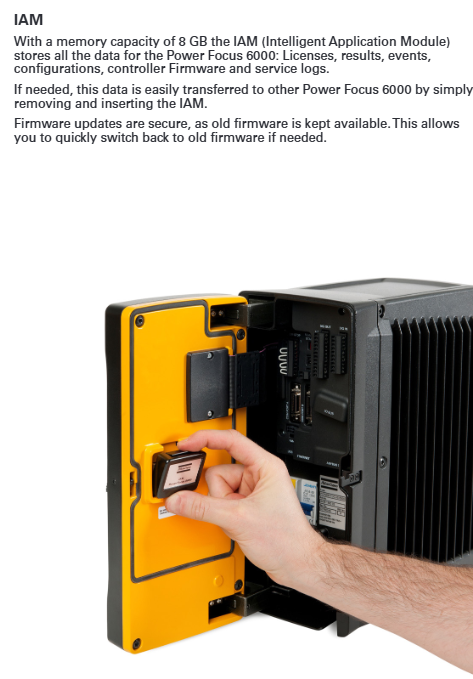
IAM intelligent application module: 8GB pluggable storage module, saving tightening results, event logs, configurations, firmware, and licenses; Support cross controller migration of whole machine configuration; Dual firmware partition, upgrade failure can be rolled back to old version with one click; Divided into three versions: Critical Control, Process Control, and Process+Control.
Tensor-STR tool: a new generation handheld tightening gun, including ETD straight handle, ETV elbow, ETT, ETP pistol style; ETD/ETV has IP54 protection.
STR special cable: flat patented cable, high flexibility, resistant to repeated bending.
Peripheral accessories: Stack light, socket selector, operation panel, barcode scanner, I/O expansion module; Supports Open Protocol, Profinet IO, EtherNet/IP, DeviceNet fieldbus; Integrate with upper level software ToolsTalk 2 and ToolsNet8.
PF6000 controller hardware specifications
Power supply: single-phase 100-120V/200-240V AC, automatic voltage recognition, overall power of 1500W;
Environmental conditions: indoor use, altitude ≤ 2000m; working temperature 5-50 ℃; The highest humidity is 80% (31 ℃), and it linearly decreases to 50% RH at 50 ℃;
Dimensions: Height 316mm x Width 146mm x Depth 293mm; Weight 10.8kg;
Display: 7-inch resistive touch screen, resolution of 480 × 800, LED backlight lifespan of 70000 hours;
Communication: Dual port 10/100M Ethernet; Wi‑Fi 802.11a/b/g/n; Bluetooth 2.1+EDR; 2-channel high-speed USB; Anybus CC fieldbus interface;
IO interface: 4-channel digital input, 4-channel digital output (24V); I-O bus; Auxiliary input and output; Class3 emergency stop circuit; Tool cable interface; IAM slot;
Audio: Built in mono speaker.
Overview of Controller Software Menu
The local touch screen of the controller is completely consistent with the web HMI interface menu, and the web page can be remotely configured. Menu grouping:
Tightening menu: Manage and edit tightening program Pset;
Batch Sequence menu: Multi step bolt tightening batch process;
Sources menu: Configure Pset call sources, signal sources such as barcode scanners, etc;
Tool menu: Tool information, calibration, motor tuning, maintenance settings;
Virtual Station menu: core functions, binding tools, tasks, protocols, peripheral accessories;
Controller menu: firmware upgrade, configuration import/export, hardware information;
Accessories menu: I/O expansion, stack light, socket selector, barcode scanner configuration;
Reports menu: Tightening history, event logs, NOK defect rate statistics;
Settings menu: Network, PIN password, language, time unit Wi‑Fi、 Event display.
Basic programming Pset tightening program
Creating a Pset requires setting a target torque/angle, with options including soft start, self tapping screws, and torque compensation; Choose tightening strategy; Torque upper and lower limits and angle monitoring limits can be set.
Open Protocol
Industry standard Ethernet communication MID message protocol, MID is a 4-digit message ID; cross platform, compatible with PLC, Linux, and Windows; Implement remote control of the controller and result subscription; Backward compatibility with older versions of MID.
FMS Functionality Management System
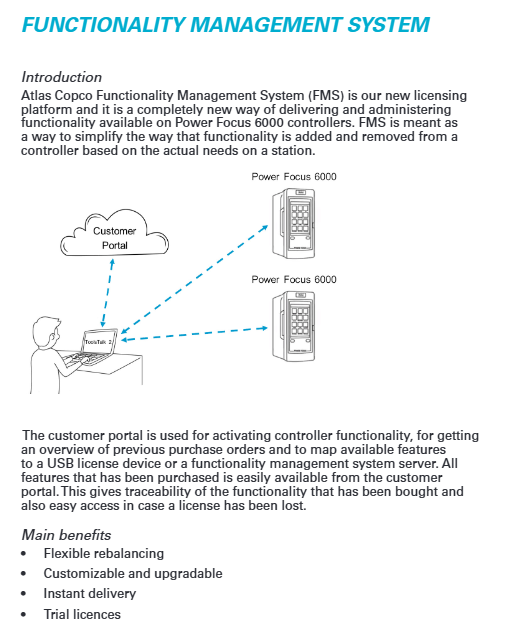
FMS is a new authorization platform for PF6000, used to open virtual workstations and advanced function licenses, with two distribution modes:
Server mode (network environment): Customer portal website purchases licenses and distributes them to various controllers through ToolsTalk 2; Licenses can be flexibly allocated between workstations and support trial authorization.
USB-FMS encryption dongle (no network factory): Download the license file to the USB-FMS device, insert the controller to enable the function; The license can be migrated back and forth between the controller and the USB drive.
Advantages: on-demand procurement, reconfigurable authorization, and provision of procurement traceability records.
Tightening strategy (core process)
1. TurboTight ® (Only Tensor-STR tool available)
The iconic strategy of PF6000 only requires setting the target torque to complete the configuration.
Principle: Dynamic real-time calculation of rotational speed, utilizing tool inertia to reduce the reactive force transmitted to the operator’s hand;
Benefits: Shorten cycle time, eliminate production line bottlenecks; Reduce worker fatigue and work-related injury risks; Lower tool temperature rise, energy saving of about 10%, and extended tool life;
Optimization key point: Rundown complete should be as close as possible to the contact point to prevent torque overshoot, and high rigidity bolt connections are particularly important.
2. Two Step Tightening
From the first stage to the first torque, pause for a set delay (default 50ms) before executing the final tightening; Inhibit short-term looseness of joints and improve the hand feel of handheld tool operation;
3. Quick Step Tightening
First, rotate at high speed until the first torque is reached, then reduce the speed to complete the final tightening; Reduce the pre tension force dispersion without any pause delay in between.
4. Three Step Tightening (Joint Adjustment Strategy)
Tighten to the first torque → Reverse one adjustment angle (default 180 °) to release stress → Tighten again to the target torque; Used for multi-layer contact surfaces to overcome embedding relaxation and reduce pre tension dispersion.
5. Rotate rotation strategy
Mainly used for testing demonstrations, rotating a specified angle with minimum torque.
General monitoring and auxiliary functions
Target torque limit: Set maximum and minimum torque, and if the result exceeds the direct judgment NOK;
Target angle limit: Monitor the angle range from the specified torque point and set the maximum/minimum angle;
Torque Compensation: Compensates for the torque consumed during the twisting stage, improving the accuracy of controlling the actual clamping force;
Soft Stop: Smooth deceleration when reaching the target torque, avoiding the impact of 50-300ms hard stop, and improving the handheld operation feel.
Virtual Station Virtual Workstation
PF6000 core innovative features.
Concept: A virtual workstation serves as a logical assembly unit, with binding tools, tightening tasks (Pset/Batch), communication protocols, stack lights/barcode scanners/I/O accessories. A physical controller can run multiple virtual workstations.
Ability: Manage Pset selection, VIN frame number processing, batch sequence; Support Open Protocol and fieldbus; Manage a complete set of workstation peripherals; Configure support for copy and paste.
Authorization: The basic IAM comes with at least one virtual workstation, and more workstations require FMS authorization to be activated.
Value: Reducing hardware and wiring, making it easier to rebalance and adjust production line workstations.
Tensor-STR Tool Series
Model classification
ETD: straight handle type; ETV: Bend type; ETD/ETV has an IP54 protection level;
ETT: No IP protection, no gyroscope;
ETP: pistol style.
Compatibility: The STR tool can connect to the old Power Focus4000, but the TurboTight function is not available and the maximum speed is limited.
Modular hardware design (no soldering, connector disassembly, easy maintenance)
Handle module: built-in main control circuit board, vibration feedback motor, gyroscope (angle sensing accuracy of 1 °), improved wear-resistant cable connector; The trigger can be disassembled for maintenance.
HMI human-machine interaction module: red, green, blue LED status lights, speaker, lockable swivel ring; Optional EHMI small display panel.
Motor module: modular with the same diameter, high power is achieved by lengthening the body; Built in RFID tags; Reinforced aluminum bearing seat.
Torque sensor: High precision in the 20-100% nominal torque range, reducing motor signal interference.
Gears and corner heads: specially made alloy steel spiral bevel gears; Reserved installation interface for reaction block at the corner.
Tool accessory bus
The tool body has two peripheral bus interfaces, which can simultaneously mount two accessories: 2D barcode scanner, work lighting, various triggers, EHMI small display screen, TLS tag, button module, etc.
Certification and Maintenance
Compliant with the Machinery Directive 2006/42/EC and EMC electromagnetic compatibility; Support ATEX explosion-proof; RoHS/WEEE;
ETD/ETV IP54 dust and splash proof; ETT/ETP without IP protection;
Maintenance cycle: Tighten annually or 250000 times, whichever comes first; The cycle needs to be shortened under heavy load conditions.
Cable system
STR flat cable is a patented design:
The bending radius of the flat structure is much smaller than that of traditional round cables, and it is resistant to repeated bending;
Cable Twist torsional stress dispersion design disperses bending stress and reduces fatigue damage at joints;
Internal Kevlar tensile core, capable of withstanding tensile forces and protecting internal wires;
Accessories: cable balancer, cable clamping bracket; Provide multiple cable versions (extension cords, 90 ° elbow connectors, spiral cables, sheaths).
Upper level supporting software
1. ToolsTalk 2 (Controller Configuration Management Software)
User permission audit: All modified complete logs are recorded to track the operators;
Factory hierarchical structure management, batch management of multiple PF6000 controllers;
Batch firmware upgrade: Dual partition firmware, preloading new versions, unified activation, and the ability to roll back old versions;
Offline editing of Pset, complete parameter verification before issuing to the controller; Program version backtracking.
2. ToolsNet 8 (Data Collection and Analysis Platform)
Collect tightening results and curves, support Open Protocol docking with third-party tightening devices; Server caching prevents database crashes and data loss;
Report filtering, grouping, and exporting to Excel;
Production alarm: trigger email notifications based on events/statistical trends;
Dashboard: Real time SPC statistics, NOK ranking, tool maintenance reminders;
Traceability: Check tightening records by time/VIN frame number; Track the number of cycles and maintenance status of the tool.
Supported fieldbus
PF6000 supports Profinet IO, EtherNet/IP, and DeviceNet, implemented through the Anybus-CC module; Used for real-time interactive control of PLC.