Alcatel 1660 SM Release 5 Optical Multi Service Node
1660 SM belongs to the Alcatel OMSN (Optical Multi Service Node) series of optical multi service nodes, which is a single box SDH multi service transmission equipment. Release 5 version adds STM-64 (10G) interface and enhanced cross matrix. The device supports both traditional PDH/SDH TDM services and Ethernet, ATM, and MPLS packet services, targeting metropolitan and regional transmission networks. It can be used as an ADM add/drop multiplexer, line terminal multiplexer, and small cross connect device, adapting to linear, ring, and mesh network topologies.
Core advantages of the product
Integrity: The OMSN product family covers all transmission scenarios from the user side, urban areas, and long-distance submarine cables, with extremely high module reuse.
Simplicity: Relying on a small number of standardized hardware modules to achieve rich networking, with few types of spare parts.
Looking towards the future: In addition to traditional TDM transmission, an Integrated Service Adapter (ISA) business adaptation board is integrated to achieve data business aggregation, exchange, and forwarding without the need for additional data network overlay.
Backward compatibility: Optical interfaces, DCC data communication channels, and network management can all communicate with existing old devices without any constraints on network upgrades.
Cost advantage: Sharing hardware boards and chassis across devices, reducing spare parts inventory and personnel training costs; Single box completes multiple sets of traditional equipment functions, reducing TCO.
Unified management: Ethernet, ATM, SDH, and WDM use the same network management system.
Hardware flexibility: 16 business slots, supporting complex configurations; The high-order VC cross matrix is equivalent to a maximum of 384 × 384 STM-1, while the low order is equivalent to 256 × 256 STM-1; Multiple STM-64 rings and multiple sets of MS-SPRing rings can be terminated simultaneously.
Multi level reliability: supports MSP linear multiplexing segment protection, MS-SPRing bidirectional shared ring protection, and SNCP subnet connection protection; The board, power supply, and matrix can all have 1+1 redundancy; Distributed DC-DC on the board, with no single point of failure in the power supply.
Easy operation and maintenance: centralized control architecture, business cards without local processors; Support local/remote software downloads, with hardware modules extensively shared with the OMSN series.
Openness: Supports direct connection of color optical ports to WDM devices without the need for external wavelength conversion; Support AU-4 cascading; Capable of SDH-SONET conversion.
Typical application scenarios
Supports G.652/G.653/G.655 fiber optic cables:
Local/metropolitan edge ring network
Regional network backbone network
Point to point link with add/drop/regeneration
International gateway, cross-border transmission
Ultra long distance transmission with integrated optical amplification
Multi service nodes at the edge of urban areas for data services
Overall architecture and subsystems
The whole machine is divided into seven subsystems: SDH VC cross connection subsystem, clock reference subsystem, equipment control subsystem, business port subsystem, ISA matrix switching subsystem, integrated CWDM coarse wave subsystem, auxiliary overhead subsystem, and power subsystem.
1) SDH VC Cross Connection Subsystem
Unblocking matrix: high-order HO: 384 × 384 STM-1 equivalent; Low order LO: 256 × 256 STM-1 equivalent, capable of processing 16128 VC12.
Support connection types: one-way point-to-point, two-way point-to-point, point to multipoint SNCP Drop‑and‑Continue、MS‑SPRing Drop‑and‑Continue。
Support AU-4 cascading (AU4-4C/AU4-16C/AU4-64C); Compatible with ETSI standard AUG mapping.
Protection: 1+1 matrix protection; Support SNCP-I intrinsic and SNCP-N non-invasive; Up to 2 sets of STM-64 grade 2 fiber MS-SPRing; Configurable recoverable/non recoverable modes.
Support non-invasive path cost monitoring POM for all high and low order VCs.
2) Clock Reference Subsystem (SETS, G.783)
The clock source can automatically select the source (SSM quality algorithm/manual priority), supporting reference inputs: STM-N optical line, 2M service port, external 2 MHz/2.048 Mbit/s, local internal oscillator.
Working mode: lock, hold over (maximum daily drift 0.37 ppm), free oscillation; The accuracy of the local oscillator is 4.6 ppm.
Output: Internal clock of the network element; 2 external 2 MHz/2 Mbit/s clock outputs for synchronizing other devices.
When performing 1+1 redundancy on the matrix, the clock subsystem synchronizes redundancy protection.
3) Equipment Control Subsystem (SEMF)
Dual processor architecture: EC device controller (DCC, database, external interfaces), SC rack controller (configuration, alarm, performance, protection switching, located on the matrix board). The business board has no processor.
External interface: QB3 CMIP interface interfaces with OMSN network management; Local Craft terminal; Support Q2/RQ2 proxy forwarding, transmitting network management information of surrounding microwave and PDH devices to TMN through SDH-DCC channels without the need for additional networking.
PCMCIA flash stores configurations and software packages; Manage up to 32 DCC channels.
EC failure does not affect business traffic and automatic protection switching, which is completed by SC.
4) Traffic port subsystem
The chassis supports a large number of PDH and SDH boards, representing the following types:
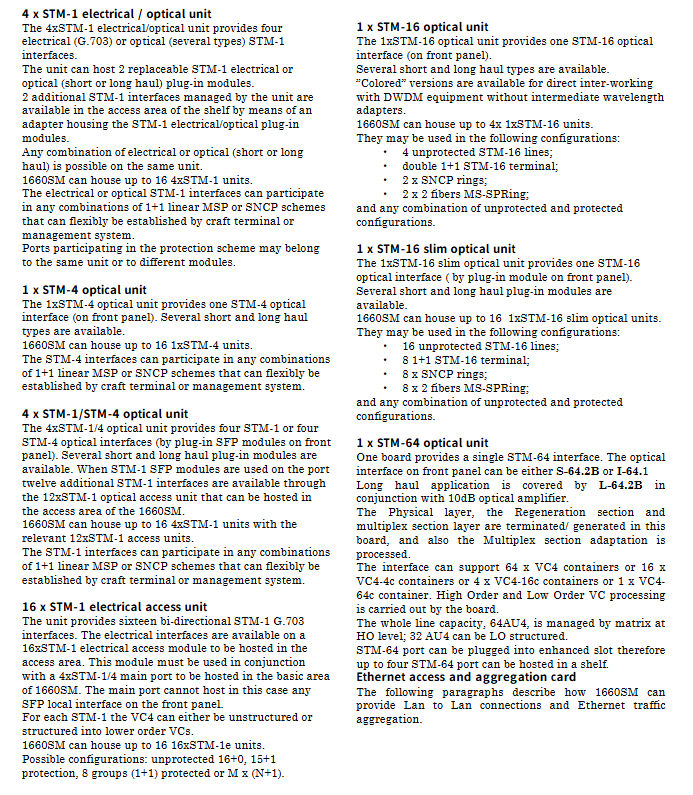
63 × 2 Mbit/s board: G.703, 75 Ω/120 Ω impedance, supports re timing; A single cabinet can hold up to 6+1 pieces.
3 × 34/45 Mbit/s board: software switches between 34M/45M modes.
STM-1/STM-4/STM-16/STM-64 optical interface board: short distance, long distance, JE ultra long distance; STM-16/64 provides Colored wavelength optical ports, directly connected to WDM; Some boards support single fiber bidirectional transmission.
OC-3 (SONET) board: AU3-TU3 conversion, realizing the transmission of SONET VC-3 in SDH network.
5) ISA Integrated Business Adapter Subsystem (Core Multi Business Capability)
The ISA board provides ATM, Ethernet, and RPR packet ring processing for the entire machine, achieving TDM+packet fusion.
ISA Ethernet series
ISA-10/100 BaseT: 11 electrical ports, expandable 14 port access module; GFP mapping Ethernet to SDH VC-12/VC-3/VC-4; Support virtual cascading LCAS; 802.3x flow control.
ISA Gigabit Ethernet: 4 SFP Gigabit optical ports; GFP、 Virtual cascading VC-4-xv, LCAS.
ISA-PREA packet ring edge aggregation card: L2 switching+MPLS, which aggregates multiple Ethernet channels and maps them to SDH containers; 1.6G exchange capacity.
ISA ATM card: three levels of 600M, enhanced 600M, 1200M; Support PVC hard virtual circuits and PNNI signaling Soft PVC; CBR/VBR rt/VBR nrt/UBR/GFR business; UPC/NPC traffic regulation; EPD/TPD/SCD congestion dropout; ATM OAM; Can be used for DSL, UMTS, and RAN backhaul.
ISA-ES Ethernet Switch Board (ES1/ES4/ES16): Layer 2 Switching, Supports MPLS Martini; Based on port/VLAN/DSCP/QoS classification, CIR/PIR traffic control; UNI/NNI interface.
ISA-PR (Packet Ring) packet ring board: 6.4Gbps, based on EoMPLS, providing E-Line and E-LAN operator Ethernet services; Classify flows based on port, 802.1p, MAC, and MPLS labels; Global congestion control.
6) Integrated CWDM coarse wavelength division
STM-16 color SFP, following ITU-T G.694.2 wavelength grid;
OADM add/drop multiplexing module MUX/DEMUX; 4xANY multi rate conversion board, supporting multiple customer signals such as FE, GE, FC, and ESCON to be multiplexed into one STM-16; Dual rate repeater board, complete black and white light ↔ Color wavelength conversion, optical electric optical regeneration.
7) Auxiliary expenses and power subsystem
Cost bytes: Complete processing of RSOH regeneration segment, MSOH multiplexing segment, VC-4/VC-3/VC-12 path costs; EOW engineering service telephone, 64k user channel; V. 11/RS232/G.703 auxiliary interface.
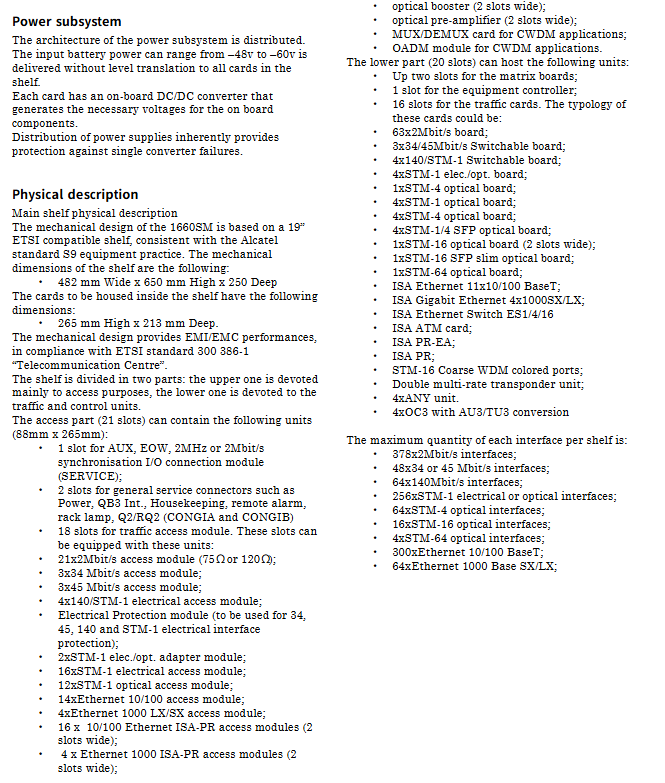
Power supply: Whole machine -48V~-60V DC input; Each board comes with a DC-DC converter, distributed power supply, and natural resistance to single power failure.
Physical specifications of the chassis
19 inch ETSI standard rack chassis; The chassis is divided into upper and lower areas: 21 upper access slots; 20 lower business control slots.
Overall dimensions: 482 mm (width) × 650 mm (height) × 250 mm (depth).
Maximum business capacity: A single box can support up to 378 2M signals; Interface mixing supports PDH, SDH, Ethernet ATM。
Management System
Local Craft terminal PC;
Alcatel OMSN network management system, using the Q interface CMIP protocol;
Q2/RQ2 proxy, proxy management of surrounding microwave and access equipment, multiplexing SDH-DCC channels;
Support local/remote software upgrade and download.