Bently Nevada Orbit 60 Series Integrated Unit Protection and Condition Monitoring System
Product core positioning
The Orbit 60 Series is Bentley Nevada’s next-generation integrated system for rotating machinery protection and condition monitoring. It is designed for online continuous monitoring of key equipment throughout the factory, achieving physical isolation of protection and monitoring functions, data security, and supporting multiple installation methods for racks/bulkheads/panels.
System architecture and core capabilities
System scale
A single SIM (System Interface Module) defines a system that supports up to 68 dynamic channels
Support multi unit chain monitoring, unlimited synchronization of key phase sources
cybersecurity
Compliant with IEC 62443-4-2 Industrial Information Security Standard
The protection network and monitoring network are physically isolated, and CMM is a read-only access
Support TLS encryption, PKI secure boot, and user permission management
Distributed Scaling
The BRG bridging module supports up to 2 cascaded chassis
Single mode optical fiber can transmit up to 2000 meters with attenuation ≤ 6dB
Electrical isolation to eliminate ground loops and noise
Hardware composition
Chassis specifications
Type Slot Size Installation Method
3U 19 universal slot 48.26 × 13.21 × 24.56cm rack/panel/bulkhead
6U 28 universal slot 48.26 × 26.5 × 36.94cm rack/panel/bulkhead
core module
SIM (System Interface Module)
System core, 3 independent Ethernet ports
Equipped with RUN/PRG key lock, reset, and system fault relay
Power consumption: typical 7.6W, maximum 10.9W
PPM (Protection Processing Module)
System computing core, responsible for measurement extraction and alarm judgment
Support redundant configuration, with a utilization rate exceeding * * 90% * * alarm
CGW (Communication Gateway)
2 Ethernet channels, supporting Modbus TCP/EGD/PROFINET
Bidirectional interaction with DCS/PLC, with a fastest update time of 20ms
CMM (Condition Monitoring Module)
Full network data monitoring, read-only and non write, ensuring protection and security
Docking System 1, automatically caching data when disconnected from the network
PIM (Power Module)
Input 21~32VDC, supporting dual redundant hot standby
Overvoltage/overcurrent/misconnection protection, supports hot swapping
Dynamic input: PAV/PAS/PAA/PAD/PVT/KPH, 4-channel/module, supporting up to 120000rpm
Static inputs: AC LVDT, RTD/TC (6-channel), PVD process/discrete variables
Output modules: EMR electromechanical relay (8 channels, 2 slots), SSR solid-state relay (8 channels, 1 slot), REC recorder output (8 channels, 4-20mA/1-5V/0-10V)
Software and Human Computer Interface
Orbit Studio
Graphic configuration, drag and drop logic configuration
Support simultaneous management, configuration replication, and loop verification of multiple systems
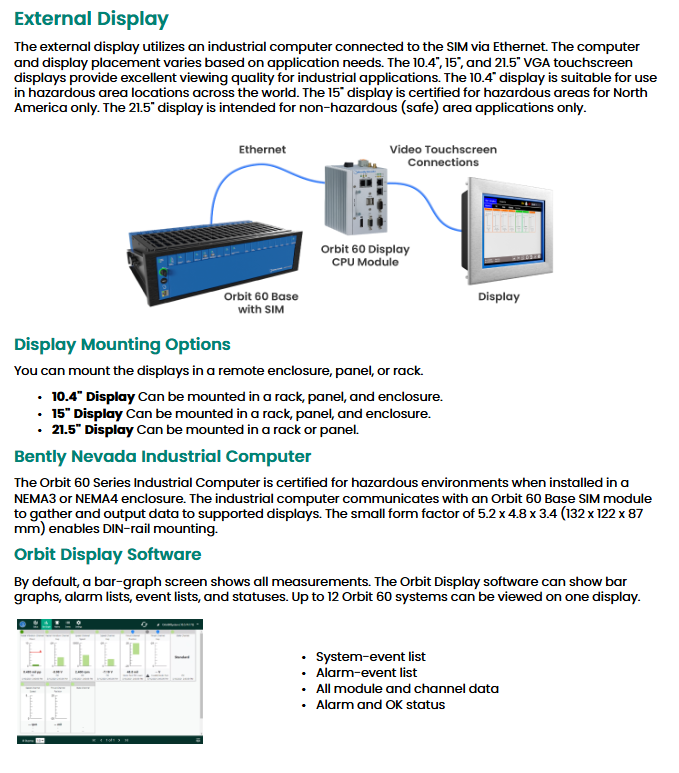
display system
10.4 inches: Explosion proof certification, globally applicable
15 inches: North American explosion-proof certification
21.5-inch: Non explosion proof, high-definition industrial screen
system integration
Integrate System 1 to achieve diagnostic analysis
Support OPC DA/UA external data exchange
Environmental and safety indicators
Parameter specifications
Working temperature -30~+70 ℃ (3U); -30~+65℃(6U)
Storage temperature -40~+85 ℃
Humidity 0~95% RH, no condensation
Functional Safety SIL 2
Explosion proof certification ATEX/IECEx/CSA Class I Div 2
Power consumption 3U maximum 180W; 6U maximum 300W
Engineering and Renovation
Provide 3500 series dedicated adapter, supporting smooth upgrade
Unify external terminal blocks (ETBs) to reduce renovation costs
Support hot plugging, online diagnosis, and remote maintenance
Key issues
Question 1: How does the Orbit 60 system ensure the safety and reliability of its protective functions?
Answer: The system adopts protection and monitoring network physical isolation, and the CMM module is only readable and not writable; The core module supports redundant configuration; Having SIL 2 certification; SIM with hardware key lock to prevent illegal modification; Both BRG bridging and power supply support dual redundancy; All modules are wide temperature, anti-interference, and comply with industrial explosion-proof standards.
Question 2: What are the engineering advantages of the distributed architecture of Orbit 60 compared to traditional systems?
Answer: By using BRG fiber optic bridging, the chassis can be extended up to 2000 meters, significantly extending the on-site wiring distance; Electrical isolation between modules to eliminate ground loops and noise; Can transfer maintenance operations out of hazardous areas; Compatible with 3U/6U hybrid deployment, flexible I/O expansion, reducing overall installation and wiring costs.
Question 3: What sensors and communication protocols does Orbit 60 support, and which upper level systems can it connect to?
Answer: Supports eddy current, acceleration, velocity LVDT、RTD/TC、4-20mA、 A full range of sensors including dry contacts; The communication protocol supports Modbus TCP, EGD, PROFINET; Can access System 1 status monitoring system, various DCS/PLC, SCADA and OPC clients.