OMRON ZX series (ZX-L-N) laser intelligent sensor
Overall positioning of the product
ZX-L-N is an Omron laser based high-precision intelligent sensor used for precise detection of displacement, thickness, size, vibration, etc. It consists of a laser probe and a signal amplifier, supports spot/line spot, reflection/reflection detection modes, and has ultra-high resolution and stable output.
Sensor probe (core model and parameters)
1. Reflective probe (ZX-LD series)
Optical method, spot type detection, distance resolution, model
Diffuse reflection light spot 40 ± 10mm 2 μ m ZX-LD40
Diffuse reflection light spot 100 ± 40mm 16 μ m ZX-LD100
Diffuse reflection light spot 300 ± 200mm 300 μ m ZX-LD300
Diffuse reflection beam spot 40 ± 10mm 2 μ m ZX-LD40L
Diffuse reflection beam spot 100 ± 40mm 16 μ m ZX-LD100L
Diffuse reflection beam spot 300 ± 200mm 300 μ m ZX-LD300L
Regression reflection light spot 30 ± 2mm 0.25 μ m ZX-LD30V
Regression reflection beam spot 30 ± 2mm 0.25 μ m ZX-LD30VL
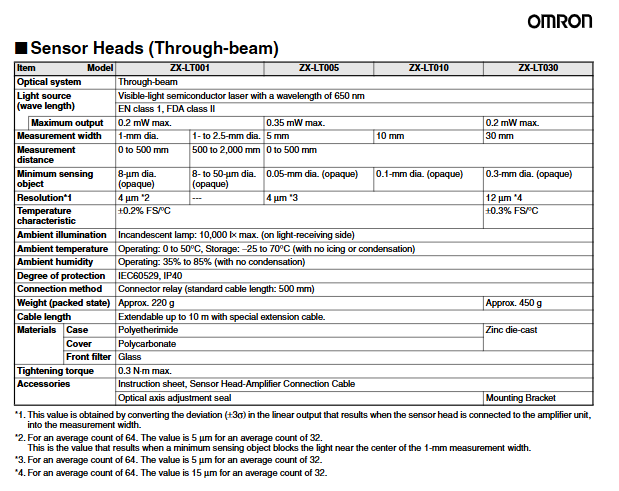
2. Contrast probe (ZX-LT series)
Detection width, detection distance, resolution model
φ1mm 0~2000mm 4μm ZX-LT001
5mm 0~500mm 4μm ZX-LT005
10mm 0~500mm 4μm ZX-LT010
30mm 0~500mm 12μm ZX-LT030 0.5M
3. General parameters of the probe
Light source: 650nm visible light semiconductor laser
Reflective type: Output * * ≤ 1mW * *, EN 2/FDA II
Opposite type: output * * ≤ 0.35mW * *, EN 1/FDA I
Working temperature: 0~50 ℃, storage: -15~60 ℃ (reflection)/-25~70 ℃ (reflection)
Protection level: IP40/IP50
Linearity: Maximum * * ± 0.2% FS**
Temperature characteristics: ± 0.03% FS/℃ (high-precision type)
Amplifier Unit (ZX-LDA11-N/ZX-LDA41-N)
1. Electrical specifications
Power supply: 12-24VDC ± 10%, ripple ≤ 10%
Power consumption: ≤ 140mA (24VDC)
Working environment: 0~50 ℃, 35%~85% RH
Insulation: 500VDC 20M Ω, withstand voltage 1000VAC for 1 minute
2. Output and Function
Linear output: 4~20mA (load ≤ 300 Ω)/± 4V (impedance 100 Ω)
Judging output: 3 channels (HIGH/PASS/LOW), NPN/PNP optional, 30VDC 50mA
Measurement cycle: 150 μ s
Average frequency: 1~4096 adjustable
Core functions: Peak holding, zeroing, teaching, delay, mutual interference suppression, laser anomaly detection
Expansion accessories
Computing unit: ZX-CAL2 (supports A+B/A-B operations, anti-interference)
Communication unit: ZX-SF11 (RS-232C, CompoWay/F protocol)
Software: ZX-SW11EV3/ZX-SFW11EV3 (settings+logs)
Extension cable: ZX-XC1A/4A/8A/9A (1~9m)
Side view accessories: ZX-XF12/ZX-XF22
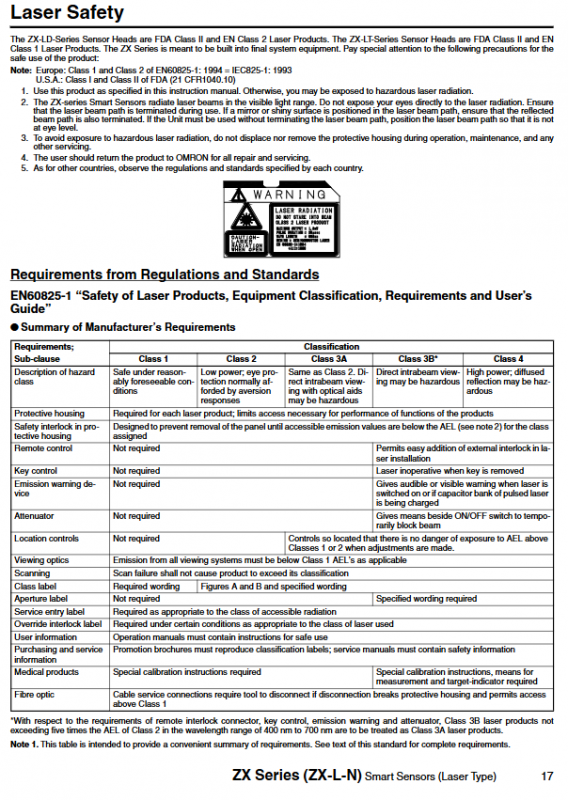
Laser safety and usage regulations
Reflective type: EN Class 2, FDA Class II
Targeted type: EN Class 1, FDA Class I
Do not look directly at the laser, the optical path must be closed
Use alcohol soft cloth to clean the lens, do not use thinner
Preheat with power for about 10 minutes to achieve stable accuracy
Key issues
Question 1: What is the highest resolution of the ZX-L-N series sensor and which model does it correspond to? What are the differences in resolution among different detection methods?
Answer: The highest resolution is 0.25 μ m, corresponding to the ZX-LD30V/ZX-LD30VL retro reflective probe; Due to the detection distance and spot design of diffuse reflection and reflection, the resolution is between 2~12 μ m, and the high-precision mode of short distance regression reflection can reach 0.25 μ m.
Question 2: What are the output types and judgment functions of the amplifier unit, and how do they meet the requirements for different control system connections?
Answer: The amplifier supports dual-mode output of current (4~20mA) and voltage (± 4V/1~5V), with bottom switch switching; Equipped with HIGH-PASS/LOW 3-channel judgment output, with two optional output types of NPN/PNP, it can be directly connected to different systems such as PLC and industrial computer.
Question 3: How to classify the safety levels of ZX-L-N series lasers and what core safety requirements must be followed when using them?
Answer: The reflective type is EN 1/FDA I (safety level), and the reflective type is EN 2/FDA II (low-power visible light); Core requirements: It is forbidden to directly look at the laser, the optical path should be closed to avoid reflection, the protective shell should not be disassembled, and the probe connector should not be plugged or unplugged when powered on.