OMRON CQM1H series modular PLC
Product positioning and core advantages
positioning
Omron CQM1H is a compact modular PLC used for single machine and distributed device control.
Compared to CQM1, I/O, program, and DM capacity have doubled, and speed has increased by 25%.
Core strengths
No bottom plate side insertion structure, flexible installation, space saving
CPU 51/61 supports 2 internal boards with highly integrated functions
High speed processing: basic instruction 0.375 μ s, special instruction 17.7 μ s
Powerful networks: Controller Link, DeviceNet, Profibus DP
Protocol macro: One click docking with serial devices such as barcodes and thermostats
Fully compatible with CQM1 modules and programs, upgrading smoothly
CPU Model and Specifications (Core Table)
Model Maximum I/O Program Capacity DM/EM Built in Input Internal Board Controller Link
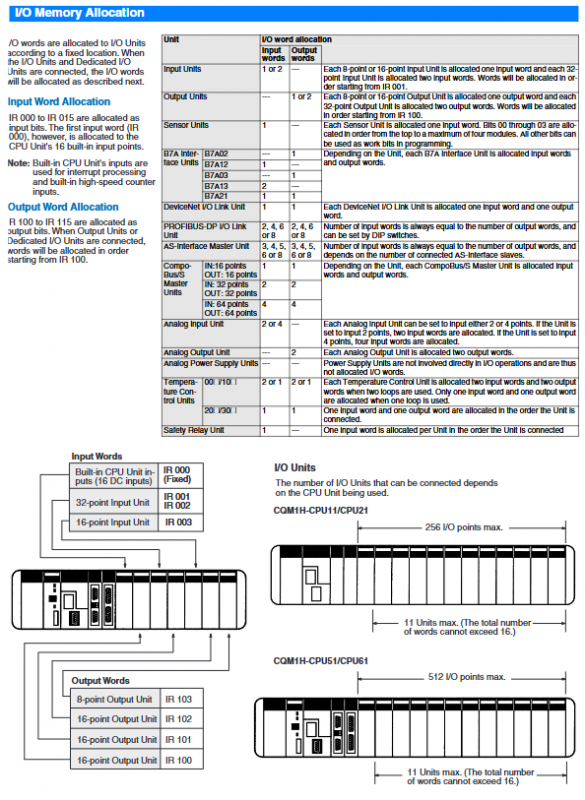
CPU 11 256 3.2K 3K/-16 points not supported Not supported
CPU 21 256 3.2K 3K/-16 points not supported Not supported
CPU 51 512 7.2K 6K/-16 points support 2 blocks support
CPU61 512 15.2K 6K/6K 16 point support 2 blocks support
System configuration rules
Connection method: Side bus connector splicing, without bottom plate
Maximum number of units: 11 (I/O+dedicated units)
Expansion configuration: Expand in two groups through IC101+II101
Power supply: 5V bus ≤ 30W, total current ≤ 3.0A
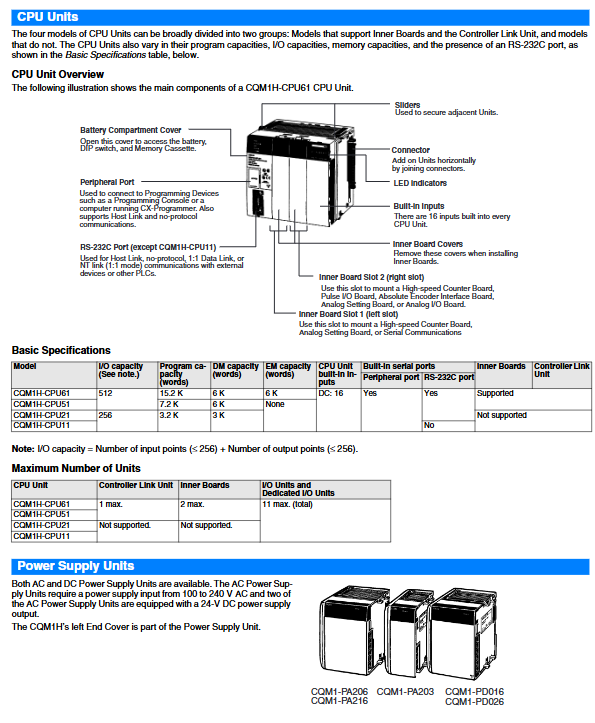
Power supply unit
Model Input/Output 5V 24V Auxiliary
PA203 100~240VAC 3.6A —
PA206/216 100~240VAC 6A 0.5A
PD026 24VDC 6A —
6 types of CPU internal boards (only supported by CPU 51/61)
CQM1H-CTB41 high-speed counting board
4-channel, 500kHz, linear/circular counting
CQM1H-PLB21 Pulse I/O Board
2-channel input 50kHz, 2-channel output 50kHz
CQM1H-ABB21 Absolute Value Encoder Board
2 channels, Gray code, 4kHz
CQM1H-AVB41 Analog Quantity Setting Board
4-channel potentiometer setting, 0~200
CQM1H-MAB42 Analog I/O Board
4 inputs and 2 outputs, ± 10V~0~20mA
CQM1H-SCB41 serial communication board
RS232 + RS422/485, Protocol Macro
I/O and dedicated unit system
1. Basic I/O unit
Input: DC12/24V (8/16/32 points); AC100/200V (8 o’clock)
Output: Relay (2A), transistor (0.1~2A), thyristor (0.4A)
2. Specialized Unit
Analog quantity: AD042 (4 inputs), DA022 (2 outputs)
Temperature: TC001~TC304, thermocouple/platinum resistance, 2/4 loop PID
Motion: LSE01/02 linear sensor interface
Safety: SF200 safety relay unit
Remote I/O: B7A interface unit, up to 500m away
3. Communication unit
CQM1H-CLK21:Controller Link,2Mbps/500m, 32 nodes
CQM1-DRT21: DeviceNet slave, 16 in 16 out
CQM1-PRT21: Profibus DP Slave, 12Mbps
CQM1-SRM21-V1: CompoBus/S main station, up to 128 points
CQM1-ARM21: AS Interface master station, up to 31 slave stations
Instructions and Functions
Instructions: 162, 14 basic+148 specialized
Floating point operations, trigonometric functions, exponential logarithms, protocol macros (PMCR)
Interrupt: 4-channel input interrupt, 3-channel interval timer, high-speed counting interrupt
Data retention: HR, DM, TC power-off retention
Environment and Certification
Working temperature: 0~55 ℃, storage: -20~75 ℃
Humidity: 10%~90% RH (no condensation)
Certification: UL, CSA, CE, NK, LR
Installation: DIN rail
Key issues
Question 1: What are the core differences among the four CPUs of CQM1H? How should the project be selected?
answer
CPU 11/21: Economy type, 256 point I/O, does not support internal board and Controller Link, suitable for small single machines.
CP51: Standard type, 512 point I/O, supports internal board and network, suitable for most devices.
CPU61: High end model, 512 point I/O, 15.2K program+6K EM, suitable for complex logic and multi axis motion.
Simple rule: Choose 21 for small systems, 51 for regular systems, and 61 for complex systems.
Question 2: What is the use of CQM1H’s Protocol Macro? What devices can be connected to?
answer
Function: Directly execute custom serial port protocols through PMCR instructions, without the need for complex programming.
Dockable: devices with RS232/485 such as temperature controllers, barcode readers, instruments, frequency converters, weighing instruments, etc.
Advantage: Significantly simplifies development, completing sending and receiving parsing with one instruction.
Question 3: What is the maximum high-speed count of CQM1H? Which module is applied to? What modes are supported?
answer
Maximum frequency: 500kHz, using CQM1H-CTB41 high-speed counting inner board.
Support modes: phase difference, addition/subtraction, pulse+direction, supporting 1 ×/2 ×/4 × multiplication.
Application: Encoder speed measurement, positioning, length counting, supports interruption of target value and interval comparison.