OMRON CJ series CPU unit operation instructions
Product Overview
The official operating manual for OMRON SYSMAC CJ series (CJ1H-R, CJ1H, CJ1G, CJ1M) CPU units covers safety specifications, unit version management, hardware specifications, system configuration, installation and wiring, DIP switches, PLC settings, I/O allocation, memory areas, operating mechanisms, fault diagnosis, and maintenance processes. It clarifies the functional differences between different unit versions (Ver.2.0/3.0/4.0), compares the performance of CJ1H-R high-speed and standard models, and provides complete guidance from selection, wiring, programming to debugging and maintenance of CJ1M. It is compatible with CX Programmer programming software.
Unit Version Management
1. Version rules
Pre Ver. 2.0: Early No Version Identification
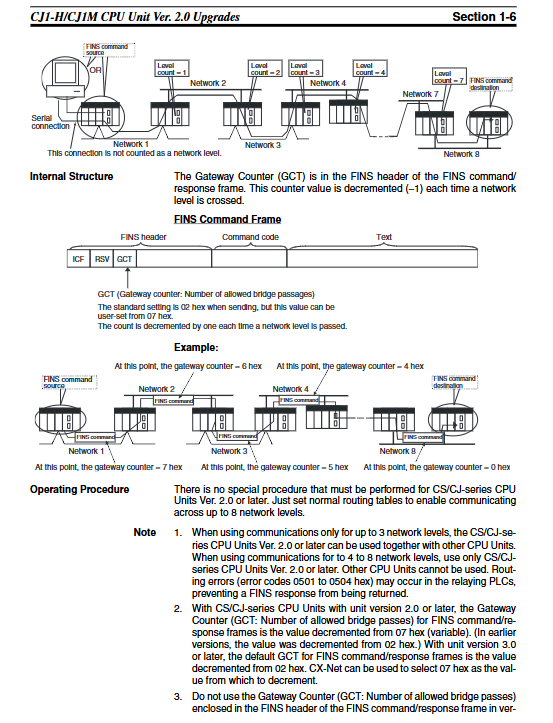
Ver.2.0: Task separate download and upload, password protection, level 8 network communication
Ver.3.0: Function Block FB, Serial Gateway, Annotation Flash, Free Run Timer
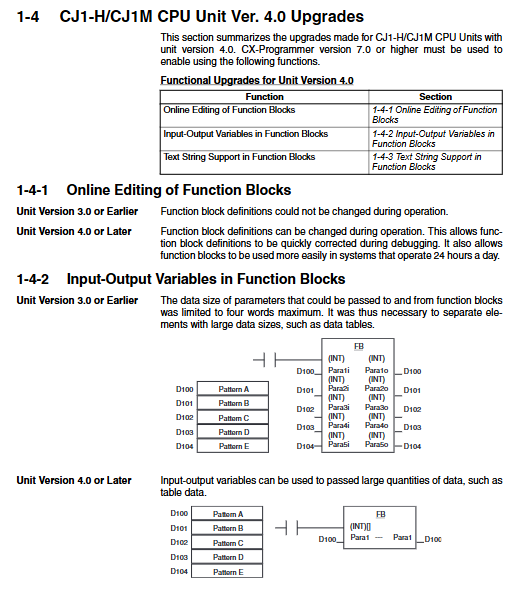
Ver.4.0: FB online editing, input/output variables, string support, ST/SFC programming
CJ1H-R: Starting version Ver.4.0, ultra fast computation
2. Version viewing
Body nameplate: The batch number is marked with Ver. × on the right side ×
Software: CX Programmer → PLC Information or Unit Manufacturing Information
Hardware core specifications
Model Series Basic Instruction Speed Program Capacity Maximum I/O Features
CJ1H-R (high-speed) 0.016 μ s 30K~250K steps 2560 point floating-point operation 0.24 μ s, 0.1ms interrupt
CJ1H/CJ1G 0.02~0.04 μ s 10K~60K steps 2560 point parallel processing, FB support
CJ1M 0.10 μ s 5K~20K steps 640 points built-in I/O, high-speed counting, pulse output
Key specifications
Power supply: 24V DC, power supply unit CJ1W-PA/PD series
Battery backup: 5 years (25 ℃), maintaining DM/EM/HR and clock
Processing modes: Normal mode, Peripheral priority, Parallel synchronous/asynchronous mode
Expansion: Up to 3 expansion racks, 40 units, CJ1M up to 1 expansion rack
Core functional differences
1. CJ1H-R high-speed enhancement
Basic instruction 0.016 μ s, special instruction 0.048 μ s
Floating point operation 0.24 μ s (about 30 times faster than regular type)
New instructions: SINQ/COSQ/TANQ/MOVF/FIORF
Scheduling interruption: starting from 0.1ms, response time of 40 μ s
2. CJ1M has built-in I/O function
Built in: 10 inputs and 6 outputs, 4-channel interruption, 2-channel high-speed counting (100kHz)
Pulse output: 2-axis 100kHz, supports origin search, trapezoidal/triangular control
PWM output: 2-point, adjustable duty cycle
Serial PLC Link: Up to 9 sets of links
3. Programs and Storage
Task: 32 cycle tasks+256 interrupt tasks
Memory: CIO, HR, DM (32K), EM (up to 13 groups), auxiliary area
Backup: Programs and parameters are automatically written to flash memory without the need for battery storage
Installation, wiring, and setup
1. DIP switch (8-bit)
PIN1: Program write protection (ON=prohibit writing)
PIN2: Automatically load program from memory card upon power on
PIN4: Use PLC Setup for peripheral port parameters
PIN5: RS-232C port automatic recognition
PIN8: Must be set to OFF
2. Key items for PLC setup
Minimum/maximum cycle time, interrupt priority, I/O refresh mode
Battery error handling, clock calibration, startup mode
Built in I/O input filtering and pulse output parameters
3. I/O allocation
Two methods: automatic power on allocation and user-defined I/O table
Support: Rack/slot header setting, up to 64 sets
Error detection: The I/O table does not match the actual unit and reports an error
Operation and Diagnosis
1. Status indicator light
RUN (green): Running normally
ERR/ALM (red): constantly on=fatal fault; Flashing=Warning
INH (Orange): Output disabled
BKUP (Orange): In flash backup (cannot be powered off)
PRPHL/COMM: In serial communication
2. Error handling
Self diagnosis: CPU, memory, battery, I/O bus
Error log: up to 20 entries, recording code, time, and details
Fatal error: Stop running, all outputs closed
Non fatal error: Continue running, alarm prompt
Safety and Maintenance
Safety regulations: DANGER/WARNING/CAUTION Level 3 warning
Mandatory requirements: external emergency stop, interlock, limit circuit
Maintenance: battery replacement, lens cleaning, periodic backup
Anti static: The plug-in unit needs to release static electricity
Key issues
Question 1: How does the CJ1H-R high-speed model improve compared to the regular CJ1H/CJ1G core?
answer:
Speed: Basic instruction 0.016 μ s, floating-point operation 0.24 μ s, significantly improving processing speed
Interrupt: Scheduling interrupts support intervals of 0.1ms, with a response time of 40 μ s
Instructions: Add high-speed trigonometric functions, floating-point moves, and dedicated I/O refresh instructions
Clock: Supports high-precision clock pulses of 0.1m/1mm/0.01s
Question 2: What motion control functions can CJ1M’s built-in I/O achieve?
answer:
High speed counting: 2-axis 100kHz, supporting phase difference, pulse+direction, and plus/minus pulse modes
Pulse output: 2-axis 100kHz, capable of positioning, speed control, and origin search
PWM output: 2-point, used for time proportional control of temperature, lighting, and power
Fast response input: capable of capturing 30 μ s narrow pulses without being affected by cycle time
Question 3: What problems can be caused by incompatible unit versions? How to avoid it?
answer:
Problem: Downloading high-level programs (such as FB and new instructions) to low-level CPUs will result in compilation errors, download failures, and runtime shutdowns
Avoidance methods:
Confirm the CPU unit version and match it with the corresponding CX Programmer version
Do not use features higher than the unit version (such as Ver.2.0 without FB)
Upgrade the software to a version that supports the unit version before uploading the program