Elmo Gold Whistle Digital Servo Drive
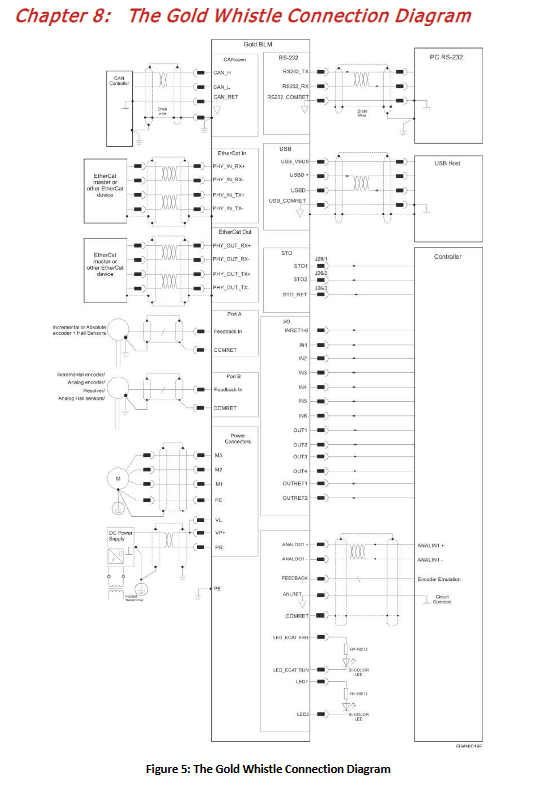
Gold Whistle is an ultra small high-power density PCB board level servo driver launched by Elmo, with a size of only 55 × 46 × 15mm, providing two voltage versions of 100V/200V, continuous power of 80W~1.6kW, efficiency * *>99%, standard STO (SIL3/PL e), dual feedback interface, EtherCAT/CAN/USB/RS-232 full communication, supporting incremental/absolute/sine cosine/rotary encoders, using DC single/dual power supply * *, specially designed for embedded, distributed multi axis high-precision motion control.
Product basic information
Product Model: Gold Whistle (G-WHI)
Document version: MAN-G-WHI Ver.1.400 (2018.04)
Product form: PCB board level direct insertion servo driver
Physical specifications
Size: 55 × 46 × 15 mm
Weight: 55 grams
Installation: PCB soldering/socket installation
Electrical technical parameters
100V series (12~95VDC)
Model: Continuous Current (A) Continuous Power (W) Peak Current
1/100 1.0 80 2.0
2.5/100 2.5 200 5.0
5/100 5 400 10
10/100 10 800 20
15/100 15 1200 30
20/100 20 1600 40
200V series (12~195VDC)
Model: Continuous Current (A) Continuous Power (W) Peak Current
3/200 3 480 6
6/200 6 960 12
9/200 9 1450 18
General characteristics
Efficiency>99%
Output voltage>* * 95% * * bus voltage
Control power supply: 12~95VDC, ≤ 6VA
Safety and functional characteristics
Safe Torque Off (STO)
Standards: IEC 61800-5-2 SIL3, EN ISO 13849-1 PL e/Cat.3
Feedback interface
Port A: Incremental/Absolute Serial/Hiperface/Hall
Port B: Incremental/Cosine/Spiral
Port C: Simulated Encoder Output
communication interface
High speed: EtherCAT
Fieldbus: CANopen
Debugging: USB 2.0, RS-232 TTL
I/O configuration
Digital input: 6-channel TTL
Digital output: 2-channel isolated, 2-channel non isolated
Analog input: ± 10V differential, 1 channel each for single ended
Power supply and wiring
power supply method
100V series: Single power supply (VP+also serves as control power supply)
200V series: Dual power supply (main power supply+independent control power supply VL+)
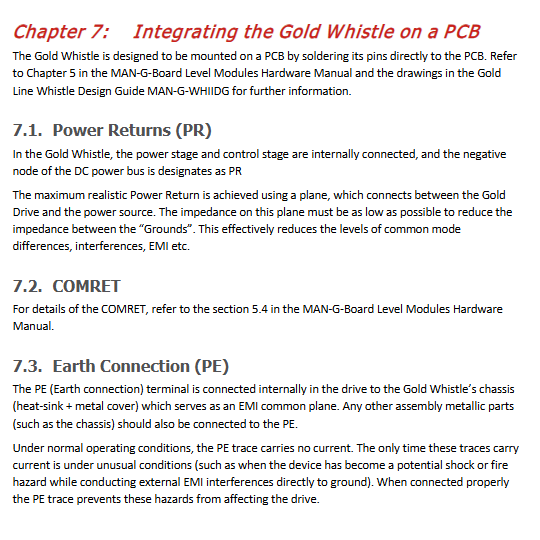
grounding system
PE: Protective grounding (connected to the shell/radiator)
PR: Power Ground
COMRET: Signal Ground
PCB layout
Separate strong and weak electrical areas to reduce interference
Heat dissipation and environment
Heat dissipation index
Thermal resistance: ≈ 10 ℃/W
Overheating shutdown: 86~88 ℃
Natural cooling, with a reserved 10mm heat dissipation space
environmental conditions
Working temperature: 0~40 ℃
Storage temperature: -20~+85 ℃
Humidity: ≤ 95% (no condensation)
Seismic resistance: 15g/11ms, anti vibration 5G
Installation and Debugging
Install
Priority PCB direct soldering, fixed with four corner screws to enhance heat dissipation
debugging software
EASII (Elmo Application Studio) for configuration, tuning, and debugging
Certification standards
UL 61800‑5‑1、UL 508C、CSA C22.2 No.14
CE (Low Voltage Directive 2006/95/EC)
IEC 61800‑5‑2、EN ISO 13849‑1
Key questions and answers
Question 1: What are the core differences in power supply and usage between Gold Whistle’s 100V and 200V versions?
answer:
100V version: A single DC power supply (12~95VDC) can simultaneously drive the power and control parts, making wiring simpler.
200V version: Dual power supply is required, with a main power supply (12~195VDC) and an independent control power supply (12~95VDC), providing stronger safety and anti-interference capabilities.
Question 2: What feedback types does the driver support? What functions can dual feedback interfaces achieve?
Answer: Supports incremental encoders, absolute serial encoders (EnDat/Biss/SI), sine and cosine encoders, rotary encoders, and Hall sensors. Port A is the main feedback, Port B is the second feedback, which can achieve dual loop control (motor+load dual feedback), and Port C can output simulated encoder signals to the upper system.
Question 3: What is the STO security level of Gold Whistle? What are the key requirements for wiring and usage?
Answer: STO has reached the highest levels of SIL3, PL e, and Cat.3. When in use, dual channel independent signals must be connected to ensure that a single fault does not lose its safety function; The driver has been short circuited internally, and the short-circuit wire needs to be removed and a safety relay connected when it is activated.