EBW Series current detection resistor
Product positioning and core technology
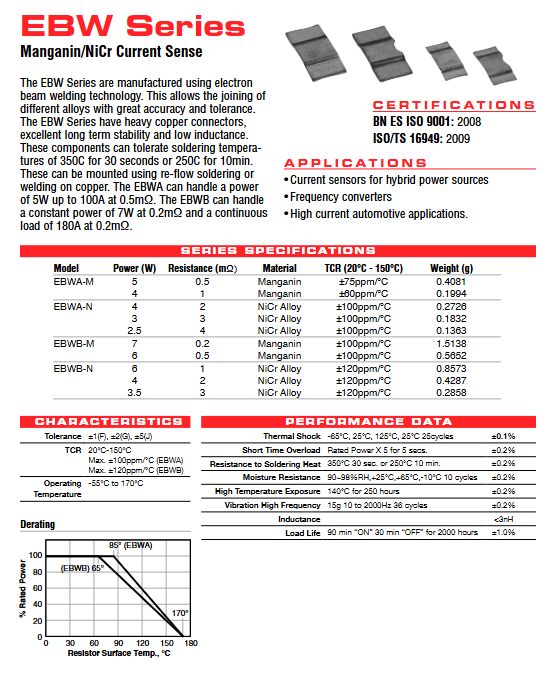
The EBW series is a high current high-precision sampling resistor launched by Ohmite, which uses electron beam welding technology to achieve high-precision connection of dissimilar alloys; Equipped with heavy-duty copper electrodes, it has ultra-low parasitic inductance, high stability, and high current carrying capacity.
Model and specification parameters
Series and Power
Series rated power maximum continuous current resistance range
EBWA 5W 100A(0.5mΩ) 0.5/1/2/3/4 mΩ
EBWB 7W 180A(0.2mΩ) 0.2/0.5/1/2/3 mΩ
Materials and TCR
Model Material TCR (20-150 ℃)
EBWA-M manganese copper ± 60~± 75ppm/℃
EBWA-N nickel chromium ± 100ppm/℃
EBWB-M manganese copper ± 100ppm/℃
EBWB-N nickel chromium ± 120ppm/℃
Key electrical and environmental characteristics
Inductance:<3nH (extremely low parasitic, suitable for high-frequency scenarios)
Working temperature: -55 ℃~+170 ℃
Accuracy tolerance: ± 1% (F), ± 2% (G), ± 5% (J)
Welding heat resistance: 350 ℃/30s or 250 ℃/10min, resistance drift ≤± 0.2%
Reliability performance data
Test project condition resistance change
Thermal shock -65 ↔ twenty-five ↔ 125 ℃, 25 cycles ± 0.1%
Short term overload 5 times rated power, 5 seconds ± 0.2%
Resistance to welding heat of 350 ℃/30s or 250 ℃/10min ± 0.2%
Resistant to humidity and heat of 90-98% RH, with 10 cycles ± 0.2%
High temperature storage at 140 ℃/250h ± 0.2%
High frequency vibration 15g, 10-2000Hz ± 0.2%
Load life: 90min on/30min off, 2000h ± 1.0%
Capacity reduction characteristics
EBWA: * * 85 ℃ * * Start power reduction
EBWB: * * 65 ℃ * * Start power reduction
The power drops to about 20% at 170 ℃
Physical dimensions and packaging
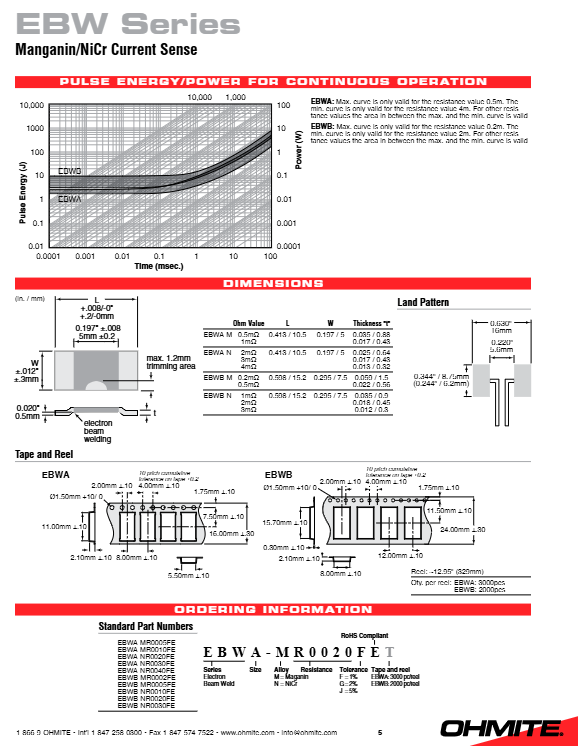
EBWA: 10.5 × 5mm, thickness 0.32-0.88mm, 3000 pieces/roll
EBWB: 15.2 × 7.5mm, thickness 0.3~1.5mm, 2000 pieces/roll
Support reflow soldering and copper substrate soldering
Certification and Application
Certification: ISO9001:2008, ISO/TS16949:2009
Application: Hybrid power supply current sampling, frequency converter, automotive high current equipment
Key questions and answers
Question 1: What are the core differences between EBWA and EBWB?
answer:
Power: EBWA=5W, EBWB=7W;
Maximum current: EBWA=100A (0.5m Ω), EBWB=80A (0.2m Ω);
Resistance range: EBWA minimum 0.5m Ω, EBWB minimum 0.2m Ω;
TCR: EBWA maximum ± 100ppm/℃, EBWB maximum ± 120ppm/℃;
Size: EBWA is smaller (10.5 × 5mm), EBWB is larger (15.2 × 7.5mm);
Starting point for capacity reduction: EBWA=85 ℃, EBWB=65 ℃.
Question 2: Why is the EBW series suitable for high current and high-frequency scenarios? What are the key advantages?
answer:
The core advantage is extremely low inductance<3nH, which can significantly reduce high-frequency switch interference; Electron beam welding ensures the precision of alloy bonding, and the TCR of manganese copper material is as low as ± 60ppm/℃. The resistance value is extremely stable when the temperature changes; Simultaneously supporting a maximum continuous current of 180A, it is resistant to high temperatures, vibrations, and has a long lifespan, fully suitable for high demand scenarios such as power supplies and frequency converters.
Question 3: How does the EBW series perform in terms of reliability at high temperatures?
answer:
Working temperature * * -55 ℃~170 ℃ * *;
After being placed at high temperature of 140 ℃ for 250 hours, the resistance drift is ≤± 0.2%;
Welding can withstand 350 ℃/30s without significant drift;
Full load life test for 2000 hours, drift * * ≤± 1.0% * *;
Maintain high precision within ± 0.2% under thermal shock, vibration, and humid and hot environments, meeting the stringent requirements of vehicle regulations and industrial grade.