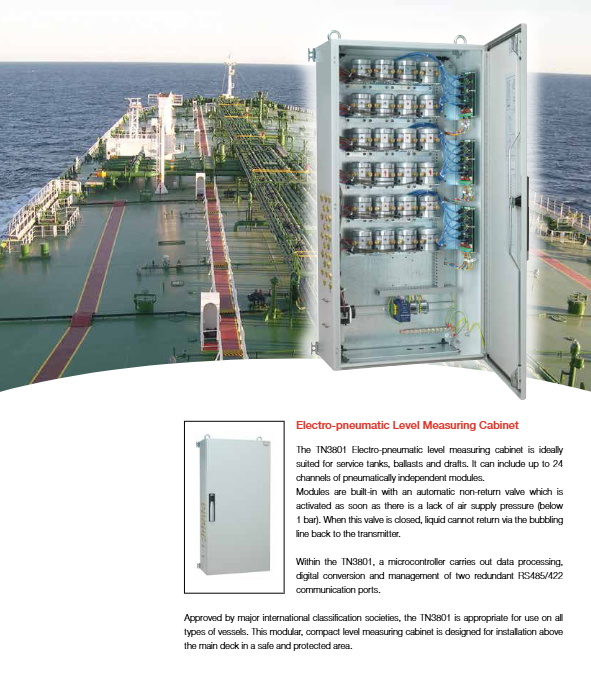
Honeywell TN3801 Electric Pneumatic Liquid Level Measurement Cabinet
Product positioning
TN3801 is an electric pneumatic liquid level measuring cabinet designed by Honeywell specifically for ships. It is mainly used for continuous monitoring of liquid levels in service tanks, ballast tanks, and draft tanks. It adopts a modular design and has been certified by international mainstream classification societies. It can be installed in the main deck safety protection zone.
Core Structure and Safety Design
Channel configuration
Support 8-24 completely independent pneumatic measurement channels
safety protection
Built in automatic check valve: immediately closes when the air source pressure drops below 1 bar to prevent liquid from flowing back through the bubble tube and damaging the transmitter
Control and Communication
Built in microcontroller, responsible for data processing and digital conversion
Configure 2 redundant RS485/422 communication ports, using Modbus protocol
Core Technical Parameters
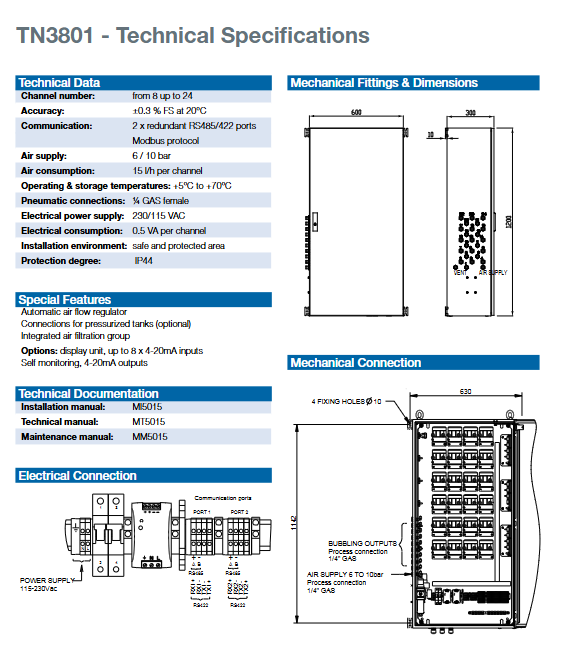
Parameter item value/specification
Number of channels: 8~24 channels
Measurement accuracy ± 0.3% FS (20 ℃)
Communication interface 2 x redundant RS485/422, Modbus
Gas source pressure 6/10 bar
Air consumption 15 l/h per channel
Working temperature+5 ℃~+70 ℃
Pneumatic interface 1/4 “GAS internal thread
Power supply 230/115 VAC
Power consumption of 0.5 VA per channel
Protection level IP44
Installation environment: Main deck safety protection zone
Featured Features
Automatic air volume regulator: stable air output
Integrated air filtration group: purifying air source
Self monitoring function+4-20mA analog output
Optional configuration: display unit, up to 8 4-20mA inputs, pressurized chamber connection interface
Mechanical and Installation
Size: 600 × 300 × 630 mm
Fixed: 4 mounting holes with a diameter of 10mm
Pneumatic output: 1/4 “GAS standard interface
Supporting manuals: Installation MI5015, Technical MT5015, Maintenance MM5015
Key questions and answers
Question 1: What is the core security protection mechanism of TN3801? Under what conditions is it triggered?
Answer: The core safety mechanism is the built-in automatic check valve; When the gas source pressure is below 1 bar, the valve automatically closes to prevent the liquid in the cabin from flowing back to the transmitter through the bubble tube, avoiding equipment damage.
Question 2: What is the communication scheme for TN3801? What are the advantages?
Answer: Using 2 redundant RS485/422 interfaces+Modbus protocol; The advantage is the dual redundancy design to enhance communication reliability, and Modbus is an industrial universal protocol that facilitates access to ship monitoring systems.
Question 3: What are the applicable scenarios, installation locations, and protection levels of TN3801?
Answer: The applicable scenarios are liquid level monitoring in ship service cabins, ballast tanks, and draft tanks; Installation location requires the main deck safety protection zone; The protection level is IP44.