ABB Jokab Pluto Safety PLC
Product positioning and core architecture
Pluto Safety PLC is a modular safety programmable controller launched by ABB, which adopts the original All Supervisor full control architecture:
All units on the bus are mutually master controlled, without any distinction between master and slave
Can directly read all network I/O and locally control output
System response time * * ≤ 55ms**
A single secure bus can connect up to 32 devices at most
Security certification
EN ISO 13849‑1:PL e / Category 4
IEC 61508:SIL 3
EN 62061:SIL 3
EN 954‑1:Cat.4
Model and I/O specifications
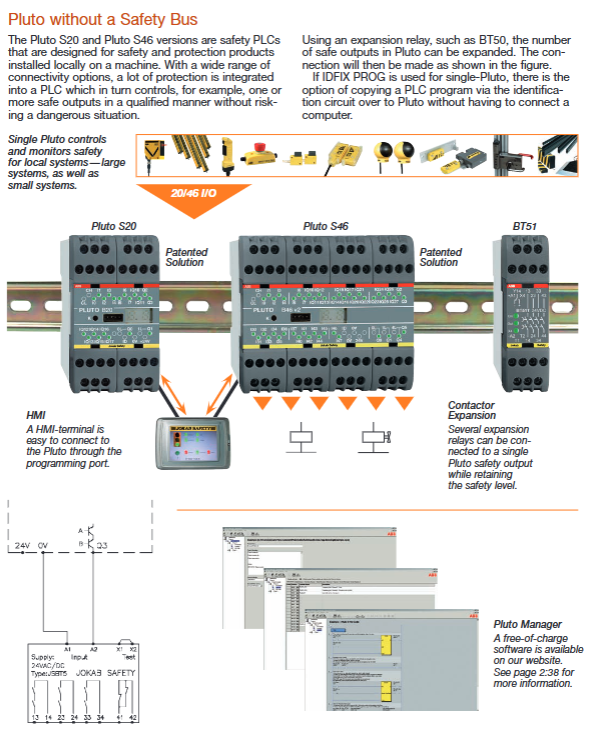
1. Independent type (without safety bus)
Model Total I/O Safety Input Reuse IQ Safety Output Analog Quantity
Pluto S20 20 8 8 4 (2 relays+2 transistors) 1
Pluto S46 46 24 16 6 (4 relays+2 transistors) 3
2. Bus type (with Pluto Bus)
Model Total I/O Safety Input Reuse IQ Safety Output Bus Features
A20 20 8 8 4 has current monitoring
B20 20 8 8 4 has a universal type
B46 46 24 16 6 has large I/O
Input technology (core advantage)
Dynamic signal (A/B/C pulse)
Up to 10 sensors can be connected in series with a single input
Approximately 200 detections per second
Can detect short circuits, wire breaks, and cross faults
Static signal
Used for mechanical switches
Dual channel implementation of PL e
IQ Reusable Terminal
Can be set as safe input/non safe output/simultaneous input/output
Typical for resetting buttons with lights
Output specifications
Relay output: 250VAC/1.5A, AC-15, DC-13
Transistor output: -24VDC/800mA
All safety outputs are independently programmable and diagnostic
Can be externally connected to BT51 expansion relay for capacity expansion
Pluto Bus safety bus
Type: Security protocol based on CAN
Speed: 100~1000kbps automatic detection
Length: Maximum 600m (low speed), 150m (400kbps)
Node: Up to 32 units
Synchronization: Global memory sharing, real-time data interoperability
Gateway products (GATE series)
Model docking bus features
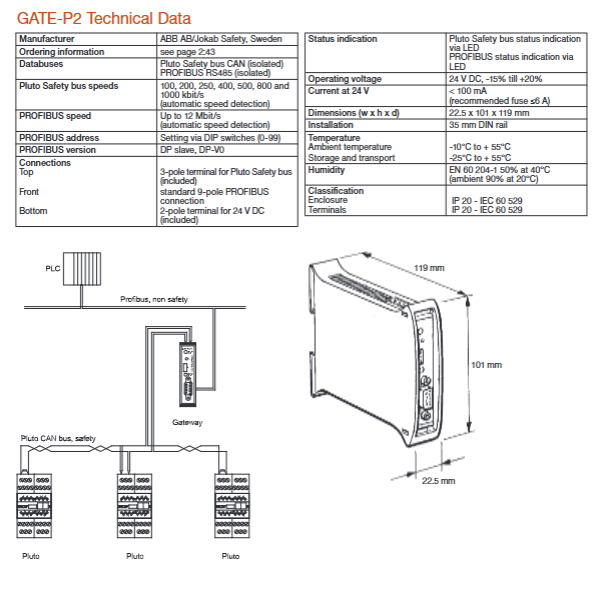
GATE-P2 Profibus DP bidirectional data, DIP addressing
GATE-D2 DeviceNet can be used as a CAN bridge to extend the bus
GATE-C2 CANopen supports PDO/SDO
GATE-E2 EtherNet/IP, Profinet, Modbus TCP with Web configuration
Security Encoder RSA 698
Type: Multi cycle absolute value
Resolution: 25 bits (13 turns+12 bits)
Up to 16 units on a single bus
Used for safe position, safe speed, electronic cam
Pluto Manager software
Free, Windows platform
Programming: ladder diagram
Built in T Ü V certification function block
Dual channel monitoring, dual hand control, shielding, reset, encoder
Support:
I/O configuration
Variable Naming
project management
Bus diagnosis
The program can be copied offline through IDFIX-PROG
Typical applications
Robot unit safety zoning control
Machine safety door, emergency stop, light curtain
Pipeline safety interlock
Multi device distributed security linkage
Key questions and answers
Question 1: What is Pluto’s dynamic input technology? What are the advantages compared to traditional secure inputs?
answer:
Dynamic input is Pluto’s unique pulse detection mechanism, which outputs three types of square wave pulses, A/B/C, and returns convergence judgment after passing through sensors.
Advantage:
Single input can achieve PL e/Cat.4, saving wiring and ports
Single port can connect up to 10 Eden/safety switches in series
Real time detection of short circuits, wire breaks, and cross faults
Stronger anti-interference and faster response
Question 2: What is the difference between the All Supervisor architecture and the traditional safety PLC bus? What value does it bring to the system?
answer:
difference
Traditional: 1 master multiple slaves, slave stations rely on the master station
Pluto: All units are master controllers, visible to each other for network I/O
value
No single point of failure, higher safety
Local output and control, faster response
Flexible expansion, no need to reconstruct the main station for adding or deleting devices
Simplified system design and easier debugging
Question 3: What are the three uses of Pluto’s IQ multiplexing terminal? What scenarios is it mainly used for?
answer:
Three uses:
Safe input: emergency stop, safety door, light curtain
Non safety output: connected to indicator lights and status signals
Simultaneous input+output: The same terminal serves as both an input and an output
Typical scenario:
Reset button with light – the button signal is used as input, and the light is driven by the output, greatly saving I/O points.