OMRON G3PW Power Controllers
Product Overview
Omron G3PW is a single-phase thyristor power controller used for precision temperature control, receiving 4-20mA/1-5VDC analog or switch signals to achieve power regulation.
Model classification:
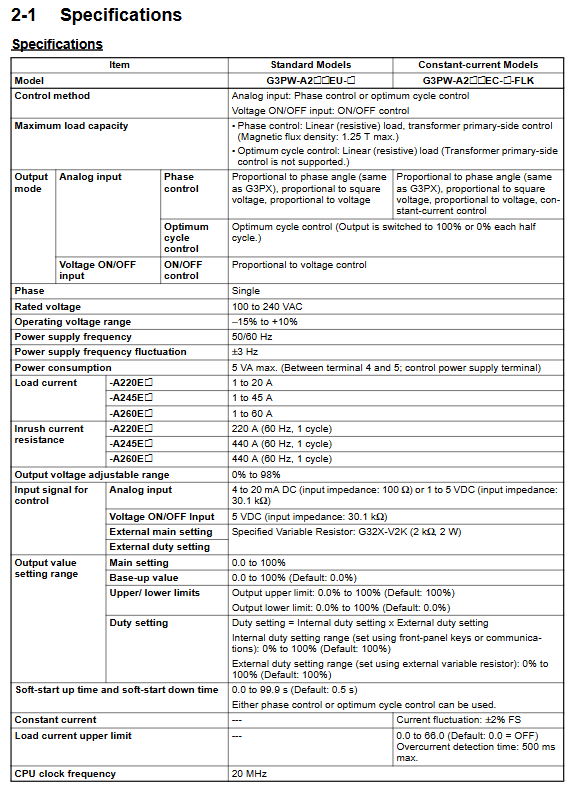
Standard type (EU): No constant current detection
Constant Current (EC): Built in CT, supports constant current, wire breakage detection RS-485
Electrical specifications:
Parameter values
Rated voltage 100-240VAC
Frequency 50/60Hz
Rated current 20A/45A/60A
Control mode: phase/optimal period/on-off control
Communication RS-485 (CompoWay/F), constant current only
Core functions
control mode
Phase control: precise temperature control, suppression of surges
Optimal cycle control: zero crossing switch to reduce noise
On/off control: adapted to switch signal
Protection and regulation functions
Soft start/soft stop: adjustable from 0.0 to 99.9s, default is 0.5s
Output limiting: upper limit 0-100%, lower limit 0-100%
Base value function: 0-100%, maintains the lowest output when inputting 0%
Constant current control: only constant current, fluctuation ± 2% FS
Heater wire breakage detection: based on resistance changes, with an accuracy of 10% FS
monitoring function
Monitoring items: input value, output value, phase angle, load current, total operating time
Alarm: 2-channel open collector output, classified into lethal/non lethal levels
Installation specifications
Environmental Requirements
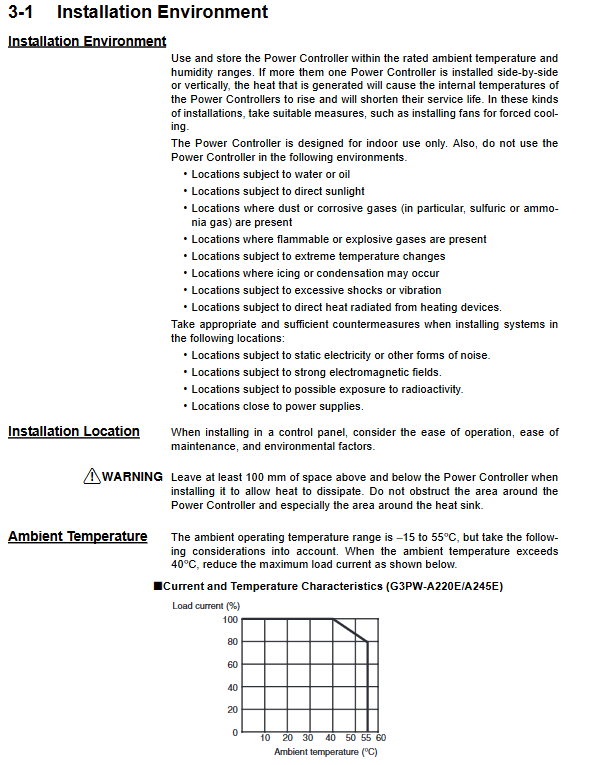
Indoor use only, -15~55 ℃, humidity 5% -95%
Stay away from water, oil, dust, corrosive gases, and sources of vibration
Installation spacing
Leave * * ≥ 100mm * * heat dissipation space on top and bottom respectively
Left and right ≥ 20mm, multiple units arranged side by side require forced air cooling
Fixed requirements
Screw: M5, torque 2.3-2.5N · m
Vertical installation ensures natural convection heat dissipation
Wiring specifications
Power and load wiring
Power supply connected to terminals 4 (N)/5 (L), load connected to T1/L1, same phase matching
Load side equipped with fast fuses: 20A with CR6L-20, 60A with CR6L-75
Control wiring
Analog quantity: 4-20mA (terminal 2/3), 1-5V (terminal 1/3)
Communication: RS-485 (±), maximum distance 500m, nodes ≤ 31
grounding
Grounding resistance * * ≤ 100 Ω * *, use a heat sink to install screws for grounding
Wire gauge and torque
Terminal type, wire gauge, torque
Load terminal (20A) AWG10-18 1.8N · m
Control terminal AWG26-16 0.22N · m
Parameter settings
Initial setting level (long press LVL ≥ 2s)
P02: Output mode (phase/voltage/square voltage/constant current)
P04: Input type (linear/switch quantity)
P10: Load current upper limit (0-66A, constant current)
P14: Wire breakage alarm level
P19-P26: Communication parameters (default 57.6kbps, 7-bit data, even parity)
Adjust setting level (short press LVL)
DTY: Internal duty cycle (0-100%)
BUP: Base Value (0-100%)
SUP/SDN: Soft Start/Soft Stop Time
OLU/OLL: Output upper and lower limits
Safety and fault handling
Safety Warning
Do not dismantle or touch terminals with electricity to prevent electric shock
Prohibited for use in flammable and explosive environments
Tighten terminal screws to prevent sparking
Common Faults
Solution to the cause of code malfunction
E10 SSR short circuit/wiring error check wiring, heater, reset
E40 heater wire breakage, replace heater, re teach
E70 communication timeout check line, resend command
Reset method: panel ENT/RST key, external reset terminal, communication command
Application scenarios
Temperature control of pure metal/non-metal heaters
Primary side power regulation of transformer
Multi unit network: up to 8 units connected to EJ1 temperature controllers, RS-485 networking
Key questions and answers
Question 1: What is the core difference between G3PW standard type and constant current type?
Answer: The core difference lies in detection and communication capabilities:
Constant current built-in CT current transformer, supporting constant current control, load current limitation, and heater wire breakage detection; The standard model does not have this function.
Constant current standard RS-485 (CompoWay/F) communication, can be connected to EJ1 temperature controller/PLC network; Standard type without communication interface.
Constant current mode can monitor real-time load current, while standard mode only monitors output percentage.
Question 2: What are the core safety points for the installation and wiring of G3PW?
Answer: There are three core security requirements:
Heat dissipation: A space of * * ≥ 100mm * * must be left above and below, and vertical installation should ensure natural convection.
Wiring: Load T1 is connected to the N phase of the power supply, L1 is connected to the L phase, and matched in phase; The load side must be connected in series with a fast fuse.
Grounding: Grounding resistance * * ≤ 100 Ω * *, grounded with radiator screws; Do not use live wires or touch terminals.
Question 3: What is the setting and troubleshooting process for the heater wire breakage detection (E40)?
answer:
Setting: Set the constant current P14 as alarm 1/2; Adjust the HBR (threshold=90/number of heaters) and HBL (lower detection limit); Perform TPC/TCC demonstration after stable operation.
Troubleshooting: First check if the heater is open circuited; Confirm again whether the demonstration was successful; If there is a small output false alarm, increase the lower limit of HBL; If there is a large fluctuation, increase the number of P09 detection cycles.
Reset: Use ENT/RST keys, external reset, or communication commands to clear the alarm.