Doric NC500 Neuroscience Acquisition Host
Product Overview
Product positioning: Multi functional integrated scientific research acquisition hardware, which improves the number of channels, sampling rate, and sampling accuracy compared to the previous generation fiber optic photometric host. It can synchronously collect multimodal experimental data in parallel and achieve closed-loop linkage of optoelectronic physiology, microscopy, light stimulation, and behavioral equipment.
Core experimental functions
Multi color multi-point fiber optic photometry: built-in phase-locked and time-division sampling algorithms, high-precision fluorescence signal acquisition;
Third generation micro fluorescence microscope signal acquisition;
Digitized recording of in vivo electrophysiological head end signals;
TTL digital IO realizes synchronous closed-loop control of optical genetic light source, behavioral box, camera, and trajectory tracking equipment;
Manually mark experimental behavior events with panel buttons.
Whole machine interface layout
front panel
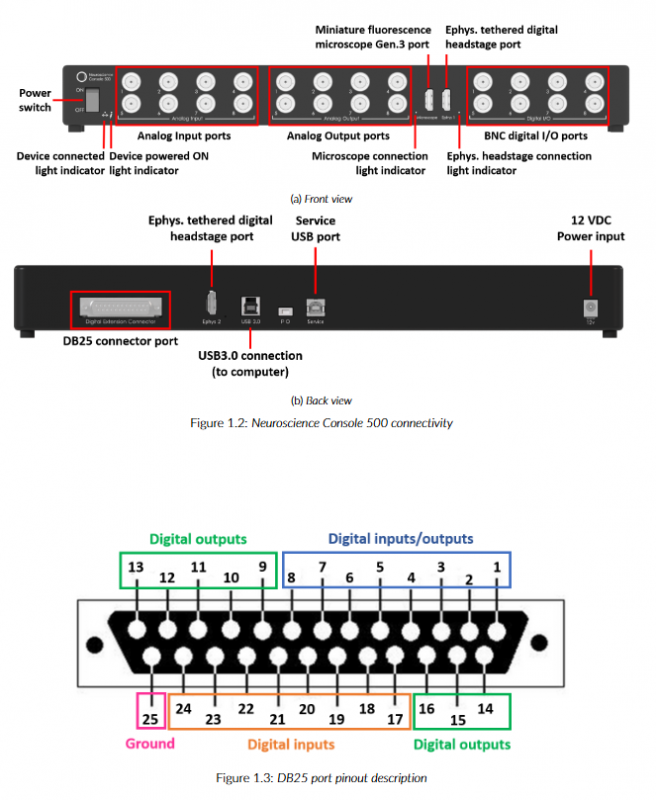
1 × HDMI: third-generation microscope camera interface;
2 x HDMI (one front and one back): digital electrophysiological probe;
8-channel BNC analog input, 8-channel BNC analog output, 8-channel BNC universal digital IO;
DB25 extension interface (with DNC-BKB adapter terminal board);
Power switch, power indicator light, software online light, microscope ready light, electrophysiological ready light.
rear panel
USB 3.0 upper communication port, debugging USB port, 12V DC power input. 4. DNC-BKB adapter accessories: DB25 matching terminal block, can be configured with 8 channels of IO+8 channels of dedicated DI+8 channels of dedicated DO, a total of 24 digital signals, spring compression type wiring, single common ground is sufficient, expanding the convenience of TTL wiring.
Operation steps for machine wiring (recommended installation sequence)
Install Doric Neuroscience Studio software on the computer;
Connect a 12V power supply to power the NC500;
3 USB 3.0 cables connect devices to industrial control/computers;
4. External microscopes and electrophysiological probes as needed;
5 analog/digital cables connected to external stimuli and acquisition devices via BNC/DB25;
6. Start the upper software to identify the device and configure experimental parameters.
Hardware key electrical specifications
1 IO channel parameters
Project parameters
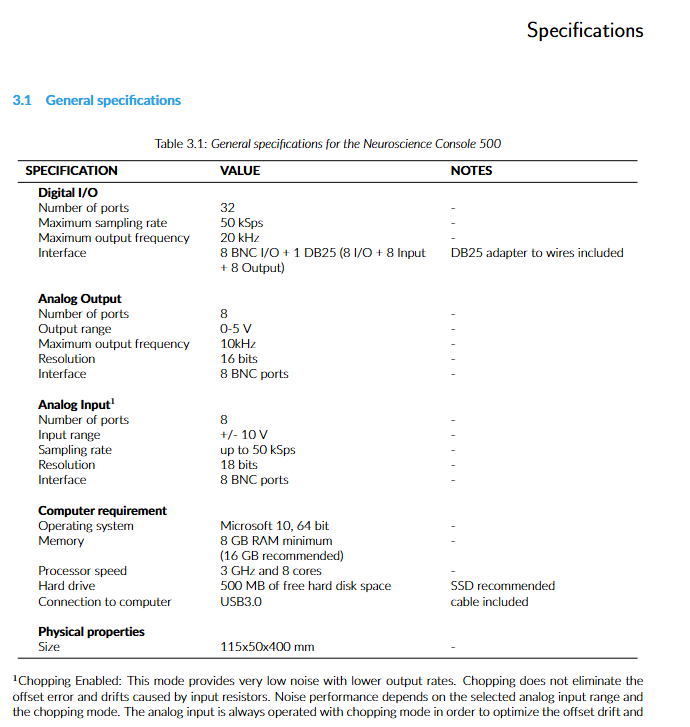
The total number of digital channels is 32 (with 24 branches from 8BNC+DB25)
Digital maximum sampling 50kSps, DO maximum output 20kHz
Analog output: 8-channel BNC, 0~5V, 16 bit, up to 10kHz
Analog input: 8-channel BNC, ± 10V, 18 bit, up to 50kSps
2 Analog inputs (chopper noise reduction mode)
The device defaults to chopper noise reduction to reduce zero drift and noise. The lower the sampling rate, the higher the effective resolution: 0.3kSps can achieve a 20 bit effective resolution and noise of 9.6 μ V; The higher the speed, the greater the noise and the lower the effective number of bits.
3 Minimum Computer Configuration
Win10 64 bit system, CPU 3GHz eight core, ≥ 8GB memory (recommended 16GB), hard disk reserved 500MB space, preferred SSD, USB3.0 communication.
4 Mechanical dimensions: 115 × 50 × 400mm
Environmental Usage Standards
Work: 0~40 ℃, humidity 40%~60% RH, no condensation, indoor use only;
Storage: Same temperature and humidity standards.
Maintenance, warranty, and scrapping
Maintain the whole machine without daily maintenance, prohibit unauthorized opening of the cover, and contact the original factory for repair if there is a malfunction;
The warranty is 12 months after leaving the factory, and damages caused by human factors or exceeding working conditions are not covered by the warranty;
Scraping follows the EU WEEE 2012/19/EU Waste Electronics Directive and cannot be disposed of as household waste. Contact the manufacturer for compliant disposal.