UniOP ePAD03/ePAD04 entry-level HMI
Product Overview
UniOP ePAD03 and ePAD04 are compact, low-cost industrial human-machine interfaces designed for the entry-level market. As upgraded alternatives to the classic MD00 series, they redefine the technical standards for basic industrial HMIs, with comprehensive performance superior to previous generations. This series of devices abandons redundant configurations and focuses on the basic monitoring, data exchange, and device control needs of industrial sites. The body is compact, with low power consumption, while retaining complete industrial level functions, communication expansion capabilities, and environmental tolerance. It can adapt to special production scenarios such as conventional working conditions and extended temperature zones. The overall architecture of the two products is highly consistent, with only differences in hardware clock, event storage, backup battery and other detailed configurations. They are widely used in small single machine equipment, distributed auxiliary workstations, and old automation system renovation projects.
Hardware and environmental parameters
2.1 Electrical and Physical Specifications
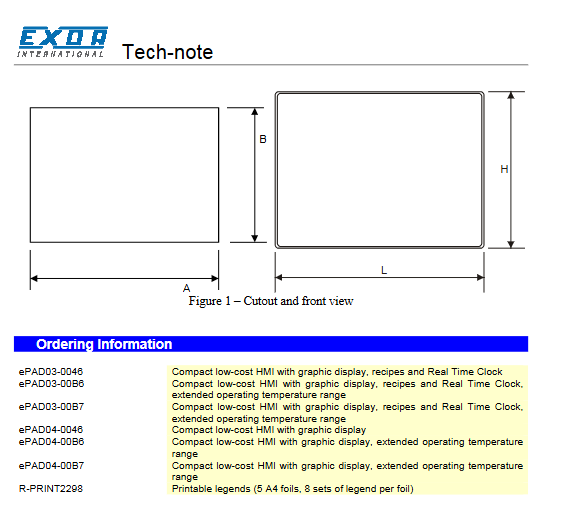
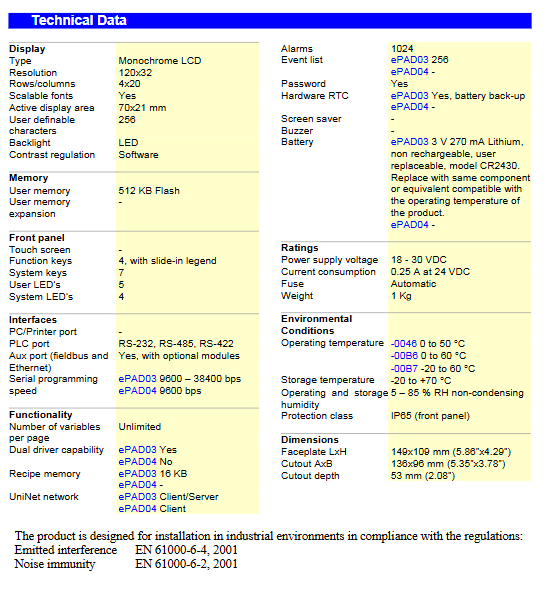
The human-machine interface of this series adopts a wide voltage DC power supply of 18 VDC~30 VDC, perfectly matching the mainstream 24 VDC power supply system in industry. The operating current is only 0.25 A at rated voltage, and the low power consumption characteristics effectively reduce the power load of the control cabinet. The equipment is equipped with automatic fuses, which can achieve overcurrent and short-circuit protection without manual replacement, simplifying the operation and maintenance process. The total weight of the machine is only 1 Kg, the panel size is 149 mm × 109 mm, the cabinet opening size is 136 mm × 96 mm, and the installation depth is 53 mm. The compact structural design is suitable for small embedded installation spaces.
In terms of accessory configuration, ePAD03 is equipped with CR2430 3V non rechargeable lithium battery, which provides power-off endurance for hardware real-time clock, and the battery supports on-site self replacement; EPAD04 has no built-in battery or hardware clock module, further reducing costs and meeting the basic application scenario of no time recording requirements.
2.2 Environmental adaptation and protective performance
The device has multiple versions of temperature zone specifications, with the standard version operating at 0 ℃~50 ℃, the extended version capable of achieving 0 ℃~60 ℃, and the extreme low temperature version supporting * * -20 ℃~60 ℃ * * operation, capable of handling extreme environments such as cold chains, outdoor cabinets, and high-temperature workshops. The storage temperature range of the entire series of products is uniformly -20 ℃~70 ℃, and the humidity requirements for working and storage environments are 5%~85% RH (no condensation). The moisture-proof ability is suitable for most industrial plants.
The front panel has reached IP65 protection level, which can resist dust intrusion and liquid splashing, and is suitable for working conditions with multiple oil stains and dust such as machine tools and packaging machinery. The product strictly follows the electromagnetic compatibility standards of EN 61000-6-4 and EN 61000-6-2, with strong resistance to electromagnetic interference. It can work closely with high-power equipment such as frequency converters and motors to ensure stable operation.
Display and human-computer interaction system
EPAD03 and ePAD04 are equipped with a 120 × 32 pixel monochrome graphic display screen, which supports downloading custom fonts and text scaling functions. The display forms cover numbers, text, bar charts, and graphic images, breaking through the display limitations of pure text panels and presenting simple process graphics and dynamic data.
Standardized industrial buttons and indicator lights for interactive component configuration: The body integrates 4 programmable function keys, matched with pull-out identification strips, making it easy to customize labels based on functions; Equipped with 5 programmable LED indicator lights, it can bind device operation, fault, communication and other status to achieve visual status reminders. The entire set of interactive components has strong durability, and even if the operator wears protective gloves, they can operate accurately, which is in line with the working habits of industrial sites.
Communication architecture and expansion capability
Communication capability is one of the core advantages of this series of products. The equipment is equipped with dual drive communication technology, which can run two sets of communication protocols simultaneously and connect to lower level industrial control devices of different brands and protocols. The device is equipped with over 130 types of industrial equipment communication drivers, compatible with mainstream products such as PLCs, frequency converters, and intelligent instruments on the market.
In addition to basic communication, the device supports optional expansion modules, which can be connected to mainstream industrial buses such as Profibus DP, CANopen, DeviceNet, Interbus, and can also be equipped with Ethernet modules. Ethernet not only supports remote uploading and downloading of programs, but also enables remote transmission and printing of recipe data, alarm information, and historical events. Based on the UniNET network architecture of Ethernet, multiple HMIs of the same series can achieve data sharing, and data exchange can be completed with the UniNet OPC server to adapt to small networked control systems. It should be noted that this series of products does not come with a 20 mA current loop interface and is not suitable for extremely old devices that still rely on this communication method.
Core industrial functional modules
Both devices are equipped with UniOP series universal industrial functions, relying on UniOP Designer 6 software to complete program writing and configuration. The programming logic is intuitive and the entry-level difficulty is low. The alarm system uniformly supports 1024 alarm points, which can monitor equipment abnormalities in real time and push alarm information; Among them, ePAD03 is equipped with a list of 256 historical events, which is matched with a hardware clock to achieve event traceability. ePAD04 simplifies this function and adapts to basic monitoring scenarios.
The device has a built-in formula storage function, and multiple sets of process parameters can be saved and called in batches. With the help of Ethernet, formula data can also be uploaded to the upper computer for convenient data backup and management. The keyboard macro editor can record continuous operation instructions, achieve automated operations such as one click start stop and process reset, and reduce the risk of human error. The eight level password protection function divides multiple layers of operation permissions, effectively protecting process parameters and system configurations, and ensuring production safety. In addition, the device supports multilingual project compilation, and text content can be exported in Unicode format for easy translation and deployment in multilingual scenarios.