Hirschmann MS20/MS30 Modular Industrial Switch Installation Manual
Product overall architecture (modular core design)
1 Product positioning
MS20 (pure 100Mbps modular switch), MS3 (100Mbps+built-in gigabit slot) fanless DIN rail switch, host+pluggable media module combination architecture, port quantity and media (electric/multi-mode/single-mode/SFP/PoE) can be freely selected, supporting HIPER Ring self-healing ring RSTP、 Remote fault alarm.
2 Model coding rules
Product code segmentation definition series, port quantity, optical port type, power supply, temperature width, certification, firmware version:
MS20: Only 100M port; MS30: 100M port+independent gigabit SFP slot;
The middle digit: 08/16/24 represents the maximum number of 100Mbps ports; 02 represents 2 gigabit uplink;
Suffix: S (0-60 ℃ standard temperature range), T/E (-40~70 ℃ wide temperature coating with three protections); A/C/E power supply; B/H/S corresponds to ATEX, railway, ship, and power certification.
3 Hardware Components of the Whole Machine (Three Major Components)
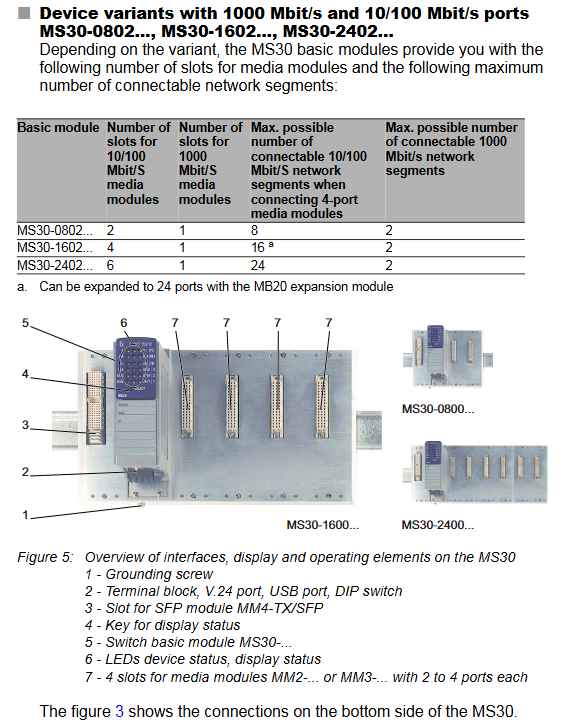
Basic host module: integrated switch chip, management circuit, power terminal, V.24 (RJ11) serial port USB、 4/3-digit hardware DIP dialing, whole machine LED, DIN buckle;
Media Module (MM series, hot swappable)
MM2: 100Mbps fixed optical/electrical module (RJ45, DSC, ST, MTRJ multimode/single-mode);
MM3: Composite module (electric+optical hybrid, M12 industrial interface);
MM4: Gigabit Combo module (RJ45+pluggable SFP, inserting SFP automatically disables the corresponding electrical port);
MM22: IEEE802.3af PoE power supply module, powered by an external 48V power supply;
MM24:4 input and output digital IO modules, external sensors/actuators;
MB20 Expansion Module: Add 2 additional media module slots to the MS20/MS30-16 model to expand port capacity.
4-port media classification and transmission parameters
Twisted pair port
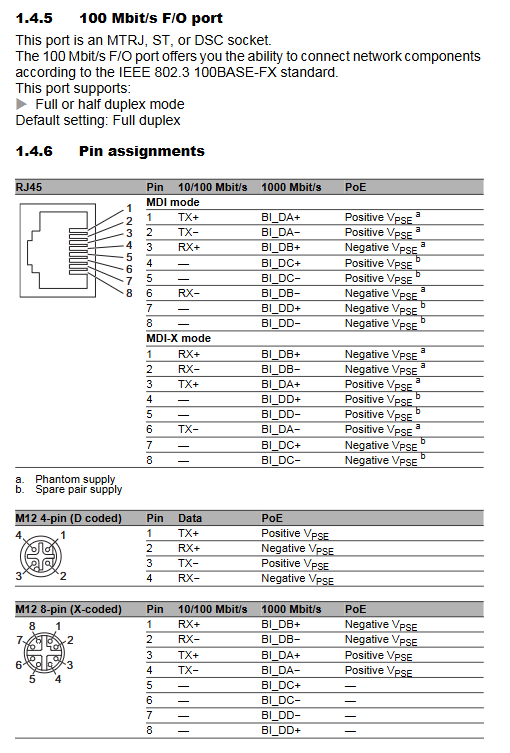
10/100M、10/100/1000M RJ45/M12, Support automatic negotiation, automatic line sequence, and automatic polarity; Cat5e cable up to 100m; PoE module supplies 48V power through idle lines.
fiber optic port
Fixed DSC/ST/MTRJ 100Mbps optical: multimode 4-5km, single-mode 30km;
SFP Gigabit Optical Module: Multi Mode 550m, Standard Single Mode 20km, Long Range LH up to 140km; Bidirectional BiDi Single Fiber Module;
All optical ports default to full duplex at the factory.
5 Local management interfaces
V. 24 RJ11 serial port: 9600 baud, local CLI, ACA11 configuration adapter;
USB interface: Supports ACA21-USB configuration USB flash drive, saving/restoring configurations, firmware upgrades;
Remote management: Web, Telnet, Industrial HiVision, SNMP.
Machine indicator light and SELECT switch button
The host is equipped with a global status light and a media module port light, and the SELECT button on the body switches the port display mode (link/rate/duplex/ring network/PoE, etc.).
Whole machine global LED
P1/P2: Two power green lights, turn off the corresponding power undervoltage;
RM: Ring network manager indicator light, constantly on to enable redundant ports, flashing ring network configuration error;
RUN: Running light, constantly on ready, flashing to start;
RL1/RL2: Two faulty relay red lights, constantly on indicates the presence of an alarm.
Port LED (switch display content through SELECT)
Optional display: link on/off, 10/100/1000 speed, half/full duplex, ring network port, PoE power status, port standby/off.
Hardware DIP dialing function (the basic module is divided into two types of dialing: 4-digit and 3-digit)
4-pin DIP (regular A/C models)
1 RM: Ring Network Manager Switch;
2 Ring Port: Select the media module port used for the ring network;
3 Stand by: Ring network coupling redundancy function;
4 SW priority: Whether the dialing settings are overwritten by software configuration.
3-pin DIP (E-type 6-pin terminal model)
Cancel software priority dialing, only RM, Ring, Standby three groups of functions, with the same logic as 4-pin.
MM24 IO module accessory dialing: controls AUI port SQE and DTE voltage detection.
Complete installation, wiring, and power on process
Open box verification: The host, terminals, labels, manuals, and CDs are complete, and any damage during transportation is checked;
Media module assembly: Both power-off and live can be hot swappable, installed from left to right, and locked with four corner screws;
SFP installation: Remove the dust cap, close the lock buckle, and push it into the slot;
DIN rail installation: snap on vertical fixation, with a reserved 10cm heat dissipation gap; Equipment grounding screw grounding protection ground wire; Optional magnetic ring enhances EMC performance;
There are two types of terminal wiring models:
A/C model: Two sets of 4-pin terminals, independent two-way power supply+two-way fault relay;
Model E: Single set of 6-pin integrated terminals, integrated with dual power supply and dual relays;
The MM22 PoE module has an additional 3-pin 48V power supply terminal, which is only compatible with the original RPS60 power supply;
Digital DI terminal: external 24V industrial sensor, supporting two-wire/three wire sensors;
Cable wiring specifications: Strong and weak current distribution troughs, cross 90 ° to reduce interference, prioritize fiber optic transmission for long-distance transmission;
Power on self-test: The power on self-test automatically lasts for about 60 seconds, and after all LEDs cycle and flash, it enters the ready state;
Factory default basic configuration
IP address: default DHCP automatic acquisition;
Account: admin (read-write, password private), user (read-only, public);
V. 24 serial ports: 9600, 8N1;
Ports: Automatic negotiation of electrical ports, full duplex optical ports;
Redundancy: HIPER Ring turned off, RSTP turned on;
Fault alarm: Both single power supply and port disconnection trigger relay alarm, which can be blocked by network management.
Maintenance and disassembly
routine maintenance
No vulnerable internal components, only faulty relays age with the number of on-off cycles, and contacts are regularly inspected in high-frequency scenarios;
Regularly clean the dust from the ventilation openings; Download the latest firmware upgrade from the official website;
Monitor the internal temperature of the equipment (read by CLI/Web, about 20 ℃ higher than the environment) to avoid overheating and derating.
Disassembly steps
Power off, unplug all network cables, fiber optics USB、 Terminal;
Unlock the DIN buckle with a screwdriver and remove the entire machine upwards;
Open the SFP lock and pull it out, then cover it with a dust cap;
Loosen the four corner screws of the media module and disassemble it in sequence.
Core technical parameters
Structural dimensions: divided into three widths of 08/16/24 ports, plastic/metal body, IP20 protection; Weight 610-1160g;
power supply
A:18–32VDC; C/E:18–60VDC; Dual redundancy, built-in non replaceable slow melting fuse; The overall power consumption is 5-18W;
The maximum PoE output of the MM22 PoE module is 90W;
temperature zone
Standard S: 0~60 ℃; Wide temperature T/E: -40~70 ℃; Storage -40~85 ℃; Humidity 1-95% without condensation; The highest altitude is 2000m, with a decrease in altitude;
EMC: covering static electricity, surge, pulse, and radio frequency in a full range of industrial grades, additionally meeting the requirements of railway EN50121, ship GL, and power IEC61850 anti-interference; Vibration and impact comply with PLC industry standards;
Mechanical: Supports 35mm standard DIN rail;
Accessories list: various MM media modules, full range SFP optical modules, ACA configuration adapters, rail power supplies, spare terminals, HiVision network management software.
Compliance Certification Checklist
Safety: UL508, EN60950; Explosion proof ATEX/IECEx/North American Class I Div.2; Electromagnetic FCC Class A; Industry specific: GL classification, EN50121 rail transit, IEEE1613/IEC61850 substation; Environmental RoHS.