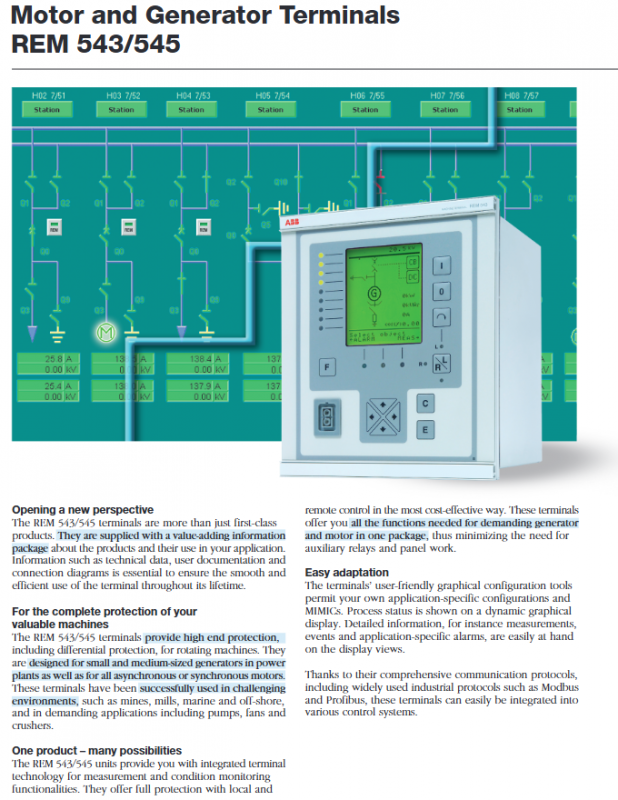
ABB REM 543/545 motor generator protection device
Product positioning and core advantages
1. Integrated design
Integrating protection, measurement, status monitoring, and local/remote control, highly integrated, significantly reducing the workload of supporting auxiliary relays and secondary wiring in cabinets. A single device meets all the needs of motors and generators, with outstanding cost-effectiveness.
2. Supporting value-added data package
The factory comes with a complete set of value-added technical materials, including technical parameters, user manuals, and wiring diagrams, to ensure stable and efficient operation of the equipment throughout its entire lifecycle.
3. Easy to use configuration and human-computer interaction
Equipped with graphical visualization configuration tools, it can customize and adapt to on-site process logic and simulation images (MIMIC);
The dynamic color display screen displays the operating conditions of the equipment in real time, allowing for one click retrieval of measurement data, fault events, and equipment specific alarm information;
By sharing the same configuration, debugging, and monitoring tools with ABB’s full range of 500 series protection relays, multiple products can be used in one learning session, reducing the cost of operation and maintenance learning.
4. Multi protocol communication, easy to connect to automatic control systems
Native support for mainstream industrial bus protocols such as SPA, LON, Modbus RTU/ASCII, Profibus, etc., allowing seamless integration with various PLCs and substation automation systems.
5. Adapt to harsh working conditions
Suitable for small and medium-sized generators in power plants, all asynchronous/synchronous motors, mature applications in high load, high interference and harsh environments such as mines, metallurgical rolling mills, offshore ships, pumps, fans, crushers, etc.
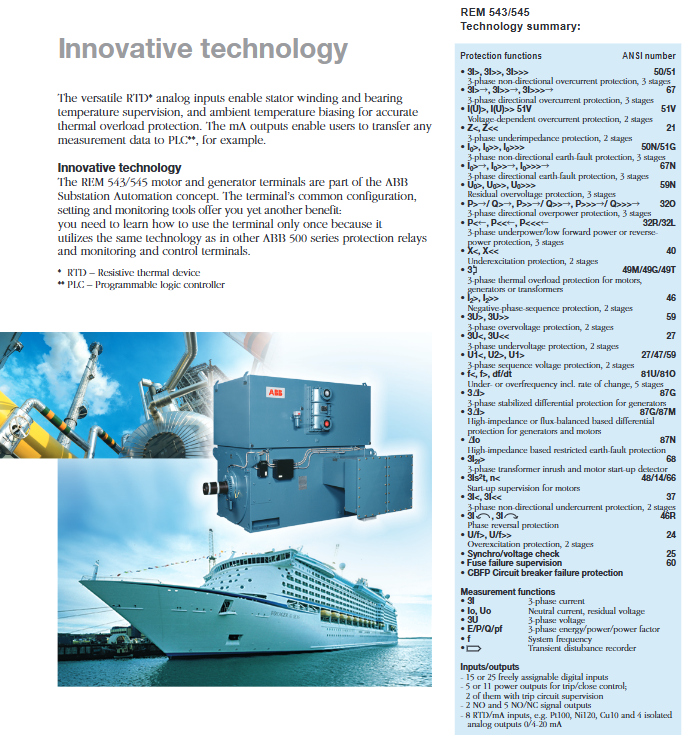
Complete protection function (with ANSI standard number attached)
The equipment covers a complete set of electrical fault, thermal fault, and abnormal working condition protection for motors and generators, classified into major categories:
(1) Current protection
Three phase non directional overcurrent (50/51, 3-stage fixed value), three-phase directional overcurrent (67 50/51, 3-stage);
Low voltage lockout overcurrent (51V, 2-stage);
Three phase non directional grounding fault (50N/51G, 3 segments), three-phase directional grounding fault (67N, 3 segments);
Negative sequence current protection (46, 2 sections), three-phase undercurrent protection (2 sections);
Motor start-up monitoring, three-phase start-up impulse current detection, phase sequence reversal protection;
(2) Voltage and zero sequence voltage protection
Three phase overvoltage (59, 2 sections), three-phase undervoltage (27, 2 sections);
Sequential voltage protection (27/47/59), residual current overvoltage protection (59N, 3-stage);
Overexcitation protection (U/f ratio, 2 segments);
(3) Power, excitation, impedance protection
Forward/reverse power protection (32O/32R/32L, 3-stage);
Low excitation protection (40, 2 sections), three-phase low impedance protection (2 sections);
(4) Frequency protection
Low frequency and high frequency protection+frequency change rate df/dt monitoring (81U/81O, 5-stage constant value);
(5) Thermal overload and temperature monitoring protection (relying on RTD temperature measurement)
49M/49G/49T three-phase thermal overload protection, monitoring the temperature of motor/generator/transformer windings and bearings, compensating for ambient temperature, achieving precise thermal protection;
(6) Differential protection (generator core main protection)
Stable three-phase differential protection (87G);
Differential of high impedance/flux balanced generator and transformer unit (87G/87M);
High impedance limited grounding differential protection (87N);
(7) Unit start stop, synchronization, and auxiliary fault protection
Monitoring of motor start-up duration and speed;
Synchronization/voltage verification function;
Circuit breaker disconnection monitoring and circuit breaker failure protection (CBFP);
Transient disturbance recording function;
Measurement function
Real time collection of comprehensive electrical operation data:
Three phase current, zero sequence current; Three phase voltage, zero sequence residual voltage;
Three phase active/reactive power, electrical energy, power factor;
System frequency;
Built in transient disturbance recorder to capture fault waveforms.
Hardware IO and analog interface
1. Digital input and output
Digital input: 15 or 25 points can be freely configured;
Power outlet: Trip/close control outlet at 5 or 11 o’clock, with 2 channels equipped with trip circuit monitoring (TCS);
Signal relay: 2-channel normally open, 5-channel normally open/normally closed alarm output.
2. Analog Channel
8-channel RTD/mA temperature measurement input: supports Pt100, Ni120, Cu10 thermistor;
4-channel isolated analog output: standard 0/4-20mA, can upload measurement data to PLC.
3. Transformer access circuit
Compatible with traditional CT/PT or electronic current and voltage sensors, with multiple specifications to choose from, with a maximum of 9 transformer inputs:
Current transformers: up to 8 (1A/5A), 1 0.2A/1A dedicated CT;
Voltage transformers: up to 4 units, suitable for secondary voltages of 100-120V;
Support the connection of 9 electronic current/voltage sensors.
Equipment status monitoring (predictive maintenance)
Built in complete online status diagnosis function, supporting regular maintenance and predicting equipment failures:
Circuit breaker related: trip circuit monitoring TCS, circuit breaker wear, opening and closing travel time, operation count counter, long-term shutdown monitoring, spring energy storage control;
Primary equipment monitoring: chamber pressure monitoring;
Circuit monitoring: CT/PT excitation circuit fault monitoring;
Auxiliary equipment and power supply: battery status monitoring, cumulative operating time statistics of the unit;
Planned maintenance reminders to achieve status based maintenance.
Communication and product ownership information
Communication protocols: SPA, LON, Modbus RTU/ASCII, Profibus;
Product ownership: ABB substation automation product line, belonging to the 500 series protection terminal