ADLINK NEON-1000-MDX series AI intelligent camera
Product Overview
Product positioning
Integrated edge AI industrial intelligent camera, CPU+VPU visual inference+industrial image sensor three in one integration, without the need for an external industrial computer, completes image acquisition and deep learning inference locally; Targeting compact production line visual scenes such as industrial quality inspection, object detection, and visual positioning, vertically integrated I/O simplifies wiring and saves equipment installation space.
Core Hardware Platform
CPU: Intel Atom E3930 Dual Core 1.8GHz
Inference Acceleration: Intel Movidius Myriad X MA2485 VPU (specialized deep learning computing power unit)
Memory: 4GB DDR3
Local storage: 32GB eMMC, reserved microSD card slot for expansion
Power consumption: The whole machine is less than 30W; full load (CPU+VPU running simultaneously, 0.6m/s airflow) working temperature is up to 45 ℃
Weight: Excluding lens<700g; overall size 123.3 × 66.81 × 77.5mm
Lens interface: standard C-port; Front end M60 × 1.5 thread, can be connected to external ring light source/strip light source
Comparison of Sensor Parameters for Four Segmented Models
Model Sensitivity Size Resolution Shutter Frame Rate Color
NEON-101B-MDX 1/3 “1280 × 960 Global Shutter 54fps Color
NEON-102B-MDX 1/1.8 “1600 × 1200 Global Shutter 60fps Color
NEON-103B-MDX 1/3.7 “1920 × 1080 Roller Shutter 30fps Color
NEON-104B-MDX 1/2.5 “2592 × 1944 Roller Shutter 14fps Color
Sensor triggering modes: software free running, software triggering, hardware external triggering (DI0).
2.4 Overview of Integrated I/O for the Whole Machine
Dual power supply scheme: 12V DC round hole power supply/locking USB Type-C power supply; Type-C additional output of 3W peripheral power supply
Video output: Type-C multiplexed with DisplayPort, supporting 1080P@30Hz external monitor
Communication: 1 Gigabit Ethernet; 1 UART serial port (integrated 15 pin D-SUB)
Digital IO (4DI+4DO, optocoupler isolation)
DI0: Programmable hardware camera triggers input
DO0: Programmable strobe light source synchronous output
The remaining 3 DI/DO universal signal interactions
Storage expansion: microSD card slot
Debugging port: Micro USB 2.0 OTG
Status indicator lights: power green light, system running orange light
Detailed Definition of Three sided Interfaces for the Whole Machine
Bottom I/O panel (power supply, network port, D-SUB)
Includes DC12V power supply, lockable USB-C, gigabit LAN, 15 pin D-SUB integrated I/O port.
Definition of 15 pin D-SUB pins (core industrial IO)
TX serial port, 9. RX serial port, 7 Serial port GND;
11. DI0 (camera hardware trigger), 12~14: DI1~DI3;
3. DO0 (strobe synchronization), 4-6: DO1~DO3;
2/10 is the IO public area, and the rest is reserved.
IO electrical specifications: serial port baud rate fixed at 115200 8N1; DO open collector output maximum of 100mA, load withstand voltage maximum of 30V; DI input level ≤ 5V.
Top Panel
Power LED, system operation status LED
MicroSD card slot (optional 32GB factory card expansion)
Micro USB 2.0 Debugging OTG Port
Reserved wafer debugging interface (factory specific)
Front end lens surface
C-type lens mounting bracket, standard adapter washer (additional metal washer for 102B model)
M60 × 1.5 external thread, industrial visual light source installation reference
Quick Installation and Wiring Operations
Mechanical installation method
Two fixing schemes, both using M4 × 6mm screws:
Front end installation: 4 M4 screws to fix the lens side mounting holes
Back installation: 4 M4 screws are used to fix the mounting holes on the back of the heat dissipation fins
Digital IO Hardware Circuit
Digital input DI: Built in optocoupler isolation, maximum external signal 5V, series connected 470 Ω current limiting resistor;
Digital output DO: Built in self recovery fuse, open leakage output, can drive relays/strobe lights, maximum 100mA per channel.
Lens assembly steps
Lens → Metal adapter ring → Sealing gasket → Tighten the C-port of the body; Only NEON-102B models must be equipped with matching gaskets.
Two wiring schemes for power supply peripherals
Independent power supply (recommended for industrial scenarios): DC round hole connected to original 12V adapter, USB-C external docking station, monitor, keyboard and mouse;
Integrated Type-C power supply: dedicated Type-C expansion hub with power supply, first-line power supply+video+USB peripherals.
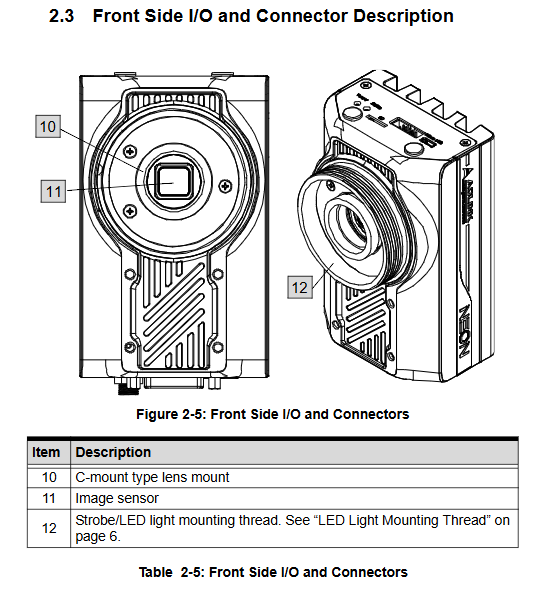
Image acquisition and AI inference software development
Development environment dependencies
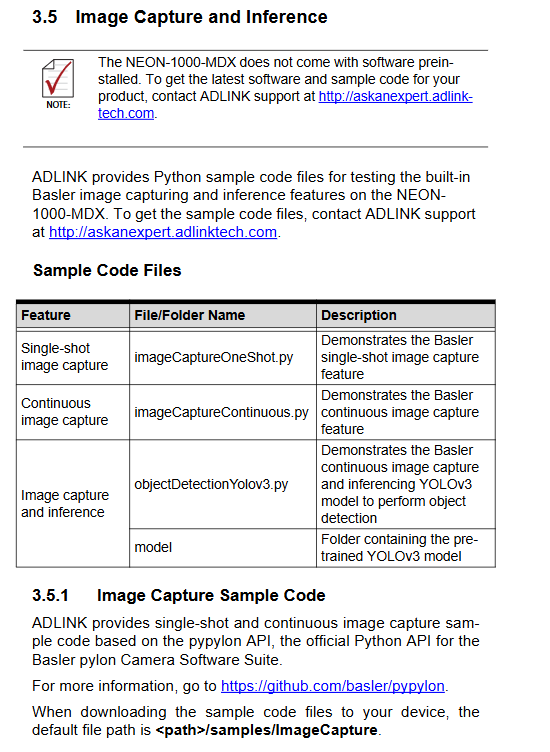
The underlying camera driver is based on the Basler pyramid suite, with Python packaging of the pyramid; AI inference is based on the Intel OpenVINO toolchain and pre trained YOLOv3 detection model. The original factory does not pre install the software, and you need to obtain the source code and model files from Linghua.
Three types of official Python example code
Single frame image acquisition: single shot, window preview;
Continuous stream acquisition: real-time video stream preview, ESC termination program;
Image acquisition+target inference: Real time capture of images and running YOLOv3 object detection to identify targets through frame selection.
Basler Nylon Viewer PC Operation Guide
A complete graphical debugging tool for sensor parameter configuration, online mapping, and parameter file import and export:
Startup path:/opt/ylon/bin/ylonviewer;
Operation process: Software recognizes the local Basler sensor → Open the device → Single shot/continuous image acquisition;
Parameter management: Load/save. pfs camera configuration files, which can adjust exposure, gain, color, and digital IO trigger timing;
API secondary development: Provides complete libraries for C++and Python, supporting dynamic modification of sensor parameters in code.
Chapter on Safety Regulations
Heat dissipation safety: When the body is running at high temperature under full load, it should be stopped and cooled before touching again; Reserve ventilation space around the equipment and prohibit blocking the heat dissipation fins;
Electrical safety: Only use Linghua original factory adapted power supply, and reverse connection and overvoltage are strictly prohibited; Power off the entire machine before wiring;
Maintenance standard: It is prohibited to disassemble the machine by oneself, and only authorized engineers are authorized to repair faults; Built in lithium battery, there is a risk of explosion when replacing the wrong model;
Installation environment: It is recommended to deploy in the computer room/controlled area and restrict unrelated personnel from accessing the equipment; Immediately cut off power and stop using if water enters, falls, or the power cord is damaged.