Atlas Copco SRTT-B Fixed Reaction Torque Sensor
Product Overview
Purpose: Used for testing wrenches, click torque wrenches, and tightening tools, suitable for scenarios where no rotational action is required during the measurement process; When testing shutdown tools, it is necessary to select a connector simulator accessory.
Product features: New generation model, durable mechanical structure; The fixed structure of the patented joint simulator eliminates measurement errors caused by gaps; We have a complete product line of accessories and mechanical joint simulators, which can be used to drive output wrenches/tools; Built in EEPROM memory, storing identification and calibration data, and the measuring instrument can automatically read it.
Core technical parameters
Item Parameter
Torque measurement range 0.5-2000 Nm
Static accuracy (20% -100% range) ± 0.5% applied torque
Overload capacity: 125% of rated maximum capacity
Temperature stability 0.1% full scale/10 ℃
Bridge resistance 350 Ω
Working humidity of 10-75%, no condensation
Working temperature 5-40 ℃
Factory calibration certificate attached; The sensor label is printed with calibration data, and the label data shall prevail during installation, without using nominal parameters.
Definition of connector pins (19 pin connector)
A: Incentive+5VDC; B: Incentive -5VDC; C: Signal+; D: Signal –
G: EEPROM clock; J: EEPROM data; P: Grounding (angle, EEPROM); T: +8/12VDC (EEPROM powered); The remaining pins are not used.
Built in EEPROM for storing content
Storage device identification information, calibration values, full-scale, sensitivity, number of pulses per revolution, serial number, latest calibration date, next calibration date, and calibration source.
List of complete machine models
There are a total of 11 models with a range covering 0.5-2000Nm. The output is divided into half inch square drive, 36mm hexagonal, and 50mm hexagonal, with corresponding order numbers. The weight ranges from 1.4kg to 10.7kg.
Operation and usage process
Selection: Sensor rated capacity ≥ maximum torque of the tested tool.
Installation: The sensor must be firmly fixed on a base that can withstand the test torque, which can be fixed with bolts or clamped on both sides of the base plane, referring to the dimensions on the mechanical drawing.
When the connector simulator is not used for models with a torque of 25Nm or above, the hexagonal socket should be equipped with an adapter; Pull the locking handle locking tool (the handle is only available on hexagonal drive models).
Connect sensors and measuring instruments using 19 core cables:
Paired with ACTA instrument: Calibration data is automatically loaded without the need for manual input.
Other instruments: manually input shunt calibration values and angle pulse parameters; The bridge resistance is 350 Ω, requiring a 43575 Ω resistor.
The tool is directly connected to the sensor socket for testing, avoiding lateral forces that may interfere with the measurement results.
Accessories
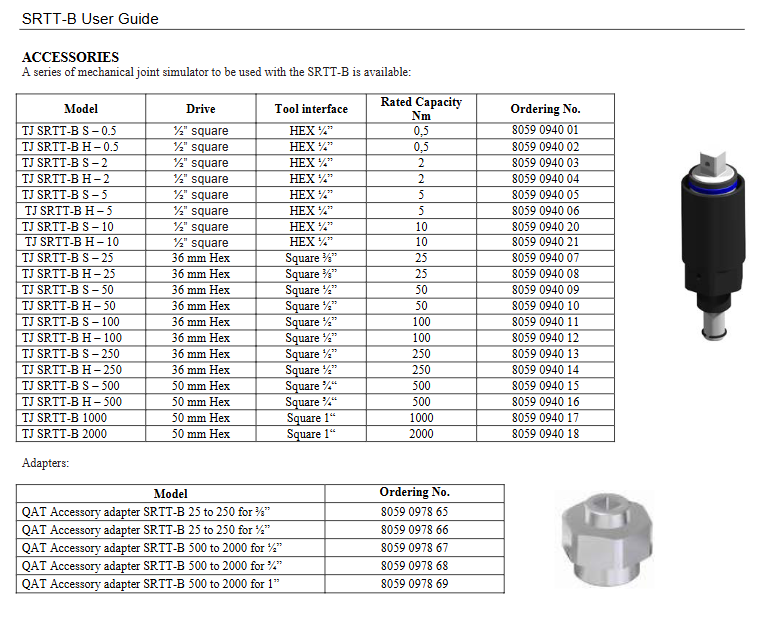
TJ SRTT-B series mechanical joint simulator: compatible with various range sensors, divided into S/H two types, with interfaces including ¼ inch hexagonal, ⅜ inch square drive, ݦ inch square drive, 虚 inch square drive, 1-inch square drive, covering 0.5-2000Nm, with ordering number attached.
QAT adapter: divided into three groups, suitable for 25-250Nm, 500-2000Nm models, providing ⅜ ” ½”、¾”、 Multiple output interfaces with ordering numbers.