OMRON CJ Series PLC (CJ1H-R/H/G, CJ1M, CJ1) Operating Instructions
Product scope and unit version management
Covered models
High speed type: CJ1H CPU @ @ H-R (Ver. 4.0/4.1/4.2)
Standard type: CJ1G/H-CPU @ @ H, CJ1G CPU@@
Loop control type: CJ1G CPU @ @ P (built-in loop control board)
Compact: CJ1M CPU @ @ (with built-in I/O and pulse functions)
Unit version rules
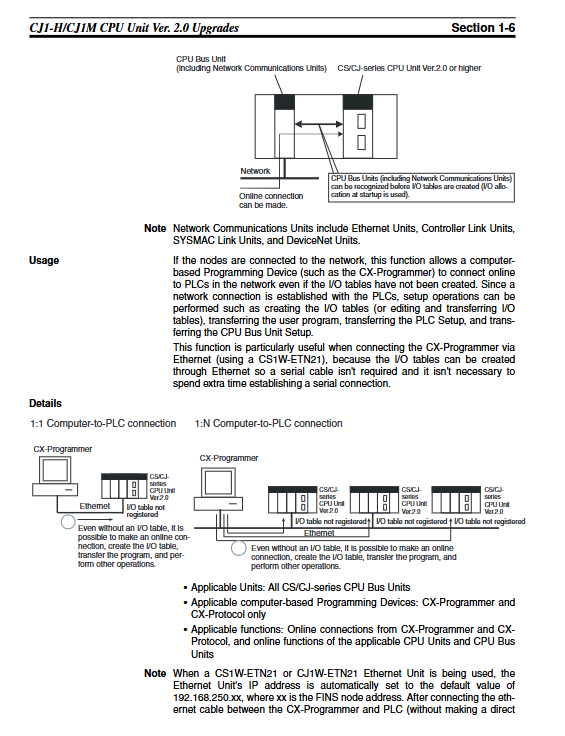
Ver.2.0: Task independent download and upload, 8-level network communication, I/O slot header setting
Ver.3.0: FB Function Block, Serial Gateway, Annotation Flash, Simple Backup Expansion
Ver.4.0: FB online editing, input/output variables, string support, ST/SFC programming
CJ1H-R: Basic instruction 0.016 μ s, floating point operation speed increased by 70 times, newly added high-speed timer
Core Performance Parameters (Key Tables)
Model Basic Instructions Special Instructions Program Capacity Maximum I/O Expansion Rack
CJ1H-R 0.016 μ s 0.048 μ s 250K step 2560 point 3
CJ1H 0.02 μ s 0.06 μ s 60~120K step 2560 point 3
CJ1M 0.10 μ s 0.40 μ s 5-20K step 640 point 1
CJ1 0.08 μ s 0.29 μ s 10~60K step 1280 points 3
System architecture and installation
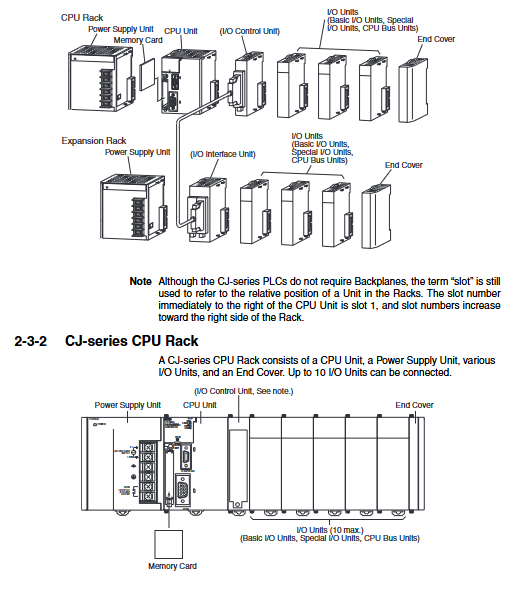
structure
No backboard side plug connection, DIN rail installation, cannot be fixed with screws
The mainframe can have up to 10 units and up to 40 units
Expansion rules
CJ1H/CJ1G/CJ1: Up to 3 expansion racks
CJ1M: Up to 1 expansion rack
Power supply unit
Model: CJ1W-PA203/206/216 (AC), PD026 (DC)
5V bus current: maximum 6A
Memory Area System
Regional abbreviation, capacity, power outage maintenance purpose
Core I/O CIO 6144 word No External I/O, Internal Relay
The HR 512 word retention area is for status maintenance
System flags, errors, and clocks in the AR 448 character section of the auxiliary area
Data memory DM 32768 words are parameters, formulas, and data
Extended memory EM up to 13Bank for large capacity data and file storage
Timer counter TC 8192 word SV maintains timing and counting
Programming and Functional Architecture
programming paradigm
Multi tasking: 32 loop tasks+256 interrupt tasks
Language: ladder diagram, ST structured text, SFC sequential function diagram
Function block FB: supports online editing, string, array variables
High speed function
Interrupt: timed interrupt starting from 0.1ms, input interrupt, high-speed counting interrupt
High speed counting: up to 100kHz, 4-axis
Pulse output: 100kHz, 2-axis, supports origin regression and triangle control
communication skills
Network: Ethernet, Controller Link, DeviceNet
Serial port: RS-232C, supports serial gateway, protocol macros, and protocol free communication
Penetration: Up to 8 levels of network cross network access
Protection and Security
program protection
Machine password, task password, no backup, no rewriting allowed
Network protection
FINS write protection, can release specified nodes
hardware protection
Overcurrent, Overvoltage, Overheating, Battery Low Voltage, Unit Abnormality
Fault diagnosis and maintenance
diagnosis
Error log: Record the last 20 faults
Status lights: POWER/RUN/ALARM/ERROR
Auxiliary Zone Sign: Accurately locate the type of fault
maintain
Flash backup: Program/parameter battery free storage
Easy backup: One click backup to storage card
Battery life: 5 years at 25 ℃
Key issues
Question 1: What is the core improvement of CJ1H-R high-speed CPU compared to ordinary CJ1H? What scenarios are applicable?
answer
Speed: Basic instruction 0.016 μ s (25% faster), floating-point operations 70 times faster
Processing: I/O refresh, interrupt response, and FB startup are all accelerated by more than twice
Function: Added 0.1ms timed interrupt, high-speed trigonometric function, 1ms timer
Scenario: Millisecond level response devices such as high-speed packaging, flying shears, electronic camshafts, and high-frequency data acquisition.
Question 2: What are the core differences between unit versions Ver.2.0/3.0/4.0? What are the limitations of upgrading?
answer
Ver.2.0: Task loading and downloading separately, 8-level network, slot address setting
Ver.3.0: FB Function Block, Serial Gateway, Annotation Flash Memory
Ver.4.0: FB online editing, string ST/SFC
Restriction: High version programs cannot be downloaded to low version CPUs and will report compilation errors.
Question 3: What are the two modes of CJ series I/O allocation? What situations are applicable to each?
answer
Automatic allocation: power on automatic recognition unit, suitable for rapid construction, on-site renovation, and small projects
Fixed I/O table: manually specified address, suitable for standardized equipment, batch production, and safety systems
Switching: Select in the PLC settings, and after modification, it needs to be powered off and restarted to take effect.