Schneider TSX 47-10/20/25 series modular sequential PLC
Product positioning and architecture
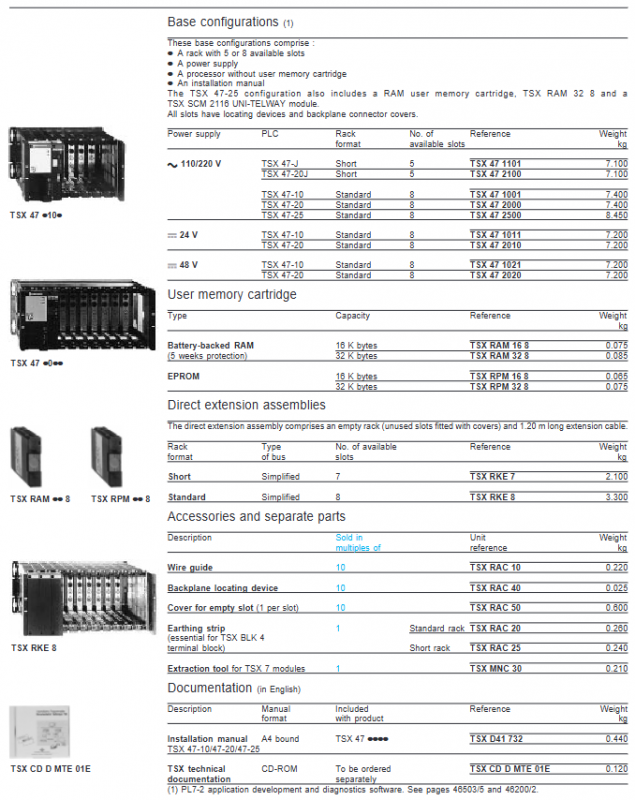
TSX 47-10/20/25 is a modular sequential control PLC with two rack structures:
Short rack: 5 slots, suitable for TSX 47-J/20J
Standard rack: 8 slots, suitable for TSX 47-10/20/25
Scalability: Can be directly expanded with a rack, up to a maximum of 16 slots
Comparison Table of Core Specifications
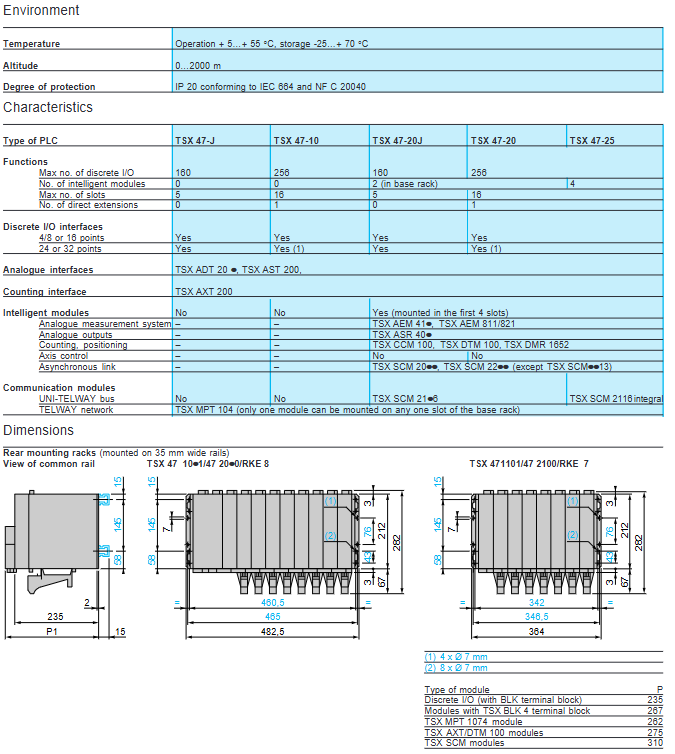
Maximum Discrete I/O Rack Slot Number Intelligent Module Direct Expansion
TSX 47-J 160 5 0 0
TSX 47-10 256 16 0 1
TSX 47-20J 160 5 2 0
TSX 47-20 256 16 2 1
TSX 47-25 256 16 2 1
Memory structure
Internal RAM
Capacity: 2KB, battery backup for 5 weeks
Partition: bit memory, word memory, system bit, fault bit
User program card (plug-in type)
Type: RAM (backup for 5 weeks)/EPROM
Capacity: 8/16/32KB
Constant area fixed: 2KB
Software and Programming
Programming languages: PL7-2, ladder diagram Grafcet
Task Structure:
Main task: Non periodic, 150ms watchdog
Quick task: optional, cycle 5-10ms, only ladder diagram
Communication: Supports UNI-TELWAY bus (TSX 47-25 with built-in SCM2116)
Power Supply and Installation
Power supply model:
TSX SUP40:110/240V AC
TSX SUP41/42:24/48V DC
Installation: 35mm DIN rail
Protection level: IP20
Environment: Working temperature * *+5…+55 ℃**
Expansion and Accessories
Expansion rack: TSX RKE7 (short), RKE8 (standard)
Accessories: Terminal, grounding strip, coding tool, empty slot cover plate
Documents: Paper manual, technical CD (TSX CD D MTE 01E)
Key issues
Question 1: What is the maximum number of discrete I/O points supported by TSX 47 series PLC? Which models can reach the maximum value?
Answer: Supports a maximum of 256 discrete I/O points; The models that can reach the maximum value are TSX 47-10, TSX 47-20, and TSX 47-25.
Question 2: What is the program storage solution for TSX 47? What are the contents stored in internal RAM and external program cards respectively?
Answer: Adopting dual storage of internal RAM and plug-in program card; Internal RAM stores process data, bit/word variables, system status, and battery backup for 5 weeks; The program card stores user programs and constants, with a capacity of 8-32KB and optional RAM or EPROM.
Question 3: What are the dual task structures of TSX 47? What are their respective roles and refresh cycles?
Answer: Dual task main task and fast task; The main task is a non periodic task used for sequential logic, with a watchdog of 150ms; the fast task is an optional periodic task used for high-speed signal processing, with a cycle of 5-10ms, and only supports ladder diagram programming.