Nidec Unidrive M700/M701/M702 frequency converter
Basic compliance and document positioning
Manufacturer and Qualification
Producer: Nidec Control Techniques Limited (UK)
Compliance System: ISO 14001, RoHS, REACH, WEEE, Conflict Mineral Management
Authoritative certifications: CE, UL/cUL, RCM, EAC, the original English version is the legal original document
Product positioning
Series: Unidrive M700/M701/M702 Universal High Performance AC Inverter
Drive objects: asynchronous induction motor, permanent magnet synchronous motor, linear motor
Core differences:
M700: Ethernet+Single Channel STO
M701: RS485 (Modbus RTU)+Single Channel STO
M702: Ethernet+Dual Channel STO
Safety regulations (mandatory requirement)
Core safety function: Safe Torque Off (STO)
Level: SIL 3, Cat 4, PL e, compliant with EN 61800-5-2, EN ISO 13849-1
Function: Cut off the motor torque output and achieve category 0 stop
Channel: M700/M701 single channel; M702 dual channel
Response time: Typical 8ms, maximum 20ms
Electrical safety
After power failure, wait for * * ≥ 10 minutes * * to release the capacitor charge
The control circuit is based on insulation, and external SELV equipment must be isolated
Grounding: 3 types of independent grounding, single ended grounding of shielding layer
Mechanical safety
Except for STO, all functions cannot be used for personal safety protection
Prohibited installation in hazardous environments, maintenance requires permission control
Core specifications of the product
operation mode
Open loop vector/V/F
RFC-A (Asynchronous Flux Control, with/without sensors)
RFC-S (Synchronous Flux Control, with/without sensors)
Regen (regenerative rectification mode)
Key rated parameters
|Project | Key Values|
|Voltage level | 200V, 400V, 575V, 690V|
|Switching frequency | 2~16kHz (automatic frequency reduction for safety)|
|Current rating | Dual rating for heavy/light load|
|Thermal protection | I2t low-speed thermal protection (15%/50% base speed switching)|
|Feedback support | AB, UVW, SinCos, EnDat, Hiperface, SSI, BiSS, Resolver|
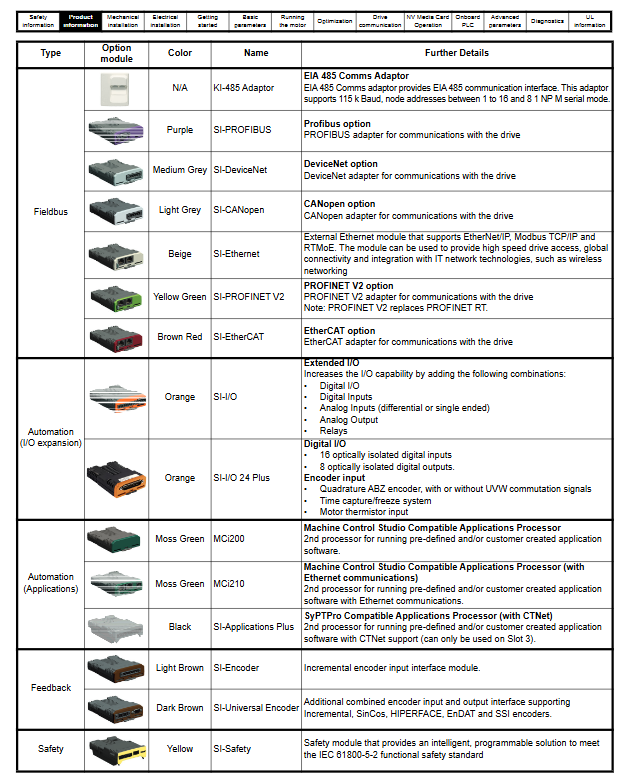
|Expansion | Up to 3 optional modules, supporting bus I/O、 Encoder|
Installation and wiring
Mechanical Installation
Module installation sequence: Slot 3 → 2 → 1
Large modules can only be installed in slot 3
Keyboard supports hot swapping (in non keyboard mode)
RTC keyboard battery: CR2032, low battery prompt for replacement
Electrical installation
24V power supply: 19.2~28V, maximum 40~60W
Analog I/O: ± 10V/4~20mA, 12 bit resolution
Digital I/O: 24V logic, IEC 61131-2 Type 1
STO wiring: dual 24V, low state ≤ 5V to ensure safety
communication
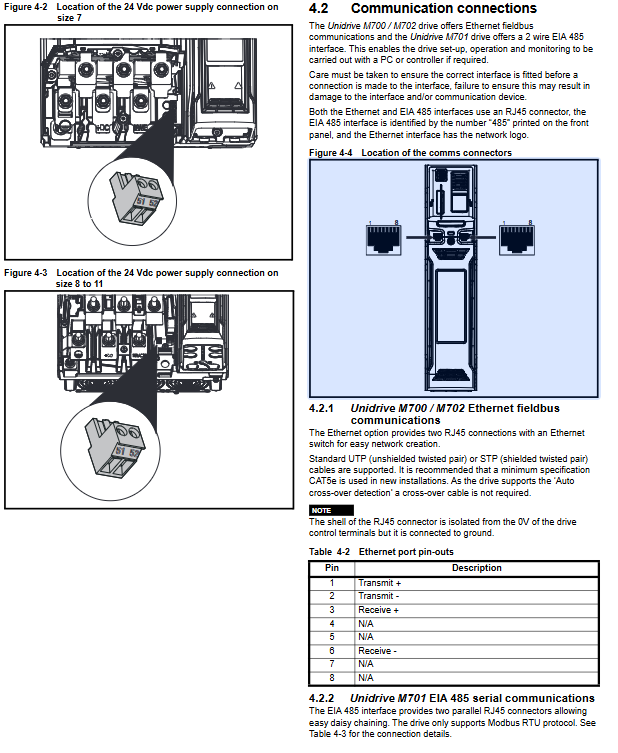
M700/M702: Dual RJ45 Ethernet, supporting CAT5e
M701: Dual RJ45 RS485, Modbus RTU only
Operation and Menu System
human-machine interface
Keyboard: Two line LCD, directional keys+confirm+exit+start stop
Status display: Prohibit/Ready/Run/Trip
Quick access: Long press Enter to directly jump to parameters
Menu Architecture
Menu 0: Basic Common Parameters (Acceleration/Deceleration, Limiting, Reference Source)
Menu 1~21: Advanced features (speed, torque, I/O, PLC)
Menu 24+: Ethernet configuration (M700/M702)
Security Lock: Password Lock for Read and Write Permissions, Level 5 Access Control
key operation
Save parameter: Pr mm.000=1001
Restore default: 1233 (50Hz)/1244 (60Hz)
Change control mode: 1253/1254+reset
Motor debugging and operation
Quick Start Process
Input motor nameplate parameters (voltage, current, frequency, speed, number of poles)
Set maximum speed/frequency, acceleration/deceleration time
Configuration feedback (closed-loop)
Perform self-tuning
Enable STO and provide running instructions
Self tuning mode
Static setting: available with load, measure resistance/inductance
Rotation tuning: Recommended for no-load testing, measuring power factor/saturation characteristics
Setting code: 1=stationary, 2=rotating
Control method
Open loop: V/F, open-loop vector, low-frequency torque boost
RFC-A: Asynchronous closed-loop/sensorless, zero speed full torque
RFC-S: Permanent magnet motor closed-loop/sensorless, high-precision positioning
Advanced features
communication bus
Ethernet: Modbus TCP, EtherNet/IP, Profinet IO, RTMoE
RS485:Modbus RTU, Baud rate 300~115200
IP configuration: DHCP automatic/static, dual port switch
NV storage card
Function: Parameter backup, copying, program download
Operation: Save to files 1-3, load, compare, format
Onboard PLC
Standard: IEC 61131-3
Tool: Machine Control Studio
Function: Logic control, timer, counter scope
Diagnosis and fault handling
status indicator
Ready: Ready to run
Prohibit: STO not enabled/prohibited
Trip: Fault shutdown, displaying fault code
Typical faults
Overcurrent, Overvoltage, Overload, Overheating
Communication loss, abnormal feedback, I/O failure
Motor thermal insulation and brake resistor overheating
troubleshooting tool
Fault History Record
Real time monitoring: current, torque, speed, bus voltage
Non default parameter filtering, target parameter filtering
Certification and Application Licensing
STO certification
T Ü V certification, applicable to the highest level of mechanical safety
Elevator certification: Complies with EN 81-20 and can be used for elevator drive
UL Certification
File number: FSPC.E171230
Applicable: industrial drive, fan, water pump, material conveying
Key questions and answers
Question 1: What are the core hardware and functional differences among M700/M701/M702?
Answer: The core differences among the three are concentrated in communication interfaces and secure channels:
M700: Ethernet communication+single channel STO, supporting EtherNet/IP, Profinet, etc
M701: RS485 (Modbus RTU)+single channel STO, used for upgrading and replacing traditional serial ports
M702: Ethernet communication+dual channel STO, meeting the highest level of safety circuit requirements
The control algorithms, motor compatibility, and parameter structure of the three are completely consistent.
Question 2: What are the usage restrictions and correct wiring principles for the STO safety torque shutdown function?
answer:
Usage restrictions: Only used for cutting off torque, not isolating high voltage; Maintenance must be powered off and locked; No personal safety protection is allowed for any function other than STO.
Wiring principle:
M702 must use dual channel independent wiring to avoid single point failure failure
Low level must be * * ≤ 5V, ≤ 0.5mA * * to meet SIL3/PL e
Dedicated grounding, shielded cable, separated from power line by ≥ 100mm
The maximum response time is 20ms and cannot be used for real-time safety control other than emergency stop
Question 3: What are the minimum necessary parameters and steps for a frequency converter to start quickly and run stably?
answer:
Required parameters (5)
Pr 00.044 motor rated voltage
Pr 00.046 motor rated current
Pr 00.047 motor rated frequency
Pr 00.045 motor rated speed
Pr 00.002 maximum speed/frequency limit
The simplest steps
Correctly complete the power and STO wiring
Write the above 5 parameters
Perform rotation self-tuning (Pr 00.040=2)
Set acceleration and deceleration time (Pr 00.003/004)
Save parameter (1001) and reset
Enable STO → give running instructions