Rockwell Trusted T8111 TMR Processor
Product positioning and core architecture
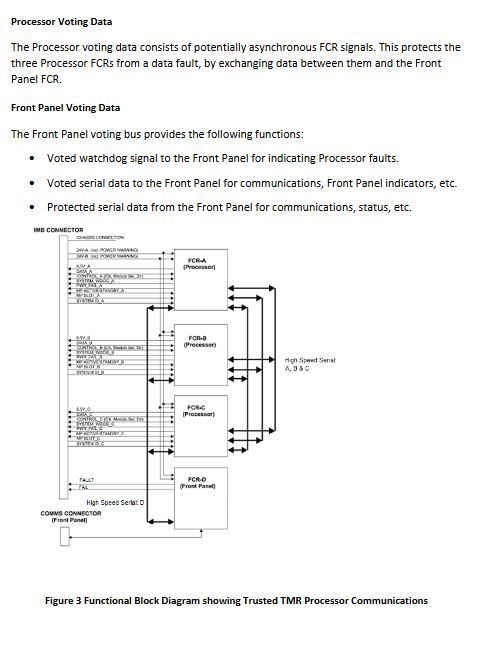
T8111 is the main controller module of the trusted security control system. It uses the third mock examination redundancy (TMR) and hardware to achieve fault tolerance (HIFT) architecture. The three-way processor is synchronized in lockstep, and three out of two (2oo3) voting to achieve 3-2-0 seamless degradation.
Core processor: NXP PowerQUICC II
Fault isolation: 3 independent FCRs+front panel FCR-D
Operating mechanism: synchronous execution, real-time voting, fault isolation
Key functional characteristics
Fault tolerance and security
Architecture: TMR 3-2-0, hardware HIFT
Certification: IEC 61508 SIL3
Fault: automatic recognition, undisturbed switching, timestamp fault recording
Communication and synchronization
Front panel: RS232 diagnostic port
Rear: 2-channel RS422/485, 1-channel RS485
Timing: IRIG-B002/B122
Maintenance and operation
Hot swappable, no need to re run the program for replacement
Active/Standby seamless switching
Support online programming, fault reset, and maintenance mode
Programming and Systems
Language: IEC 61131-3
Protocol: Modbus RTU
Event cache: SOE 1000 entries
Electrical and Mechanical Specifications
Parameter indicators
Backplane power supply 20-32 VDC
Power consumption 30 W
Maximum program storage of 960 KB
The power-off clock stays for 8 hours
Operating temperature 0-60 ℃
Storage temperature -25-70 ℃
Humidity 10-95% RH (non condensing)
Weight 1.89 kg
Size 266 × 93 × 303 mm
Interface and front panel
External interface (PL1 48Pin)
Fault relay, failure relay
3-channel serial port, IRIG-B signal
24V power supply, alarm signal
relay output
Fault Relay: Release in case of system failure
Fail relay: Release when dual circuit failure occurs
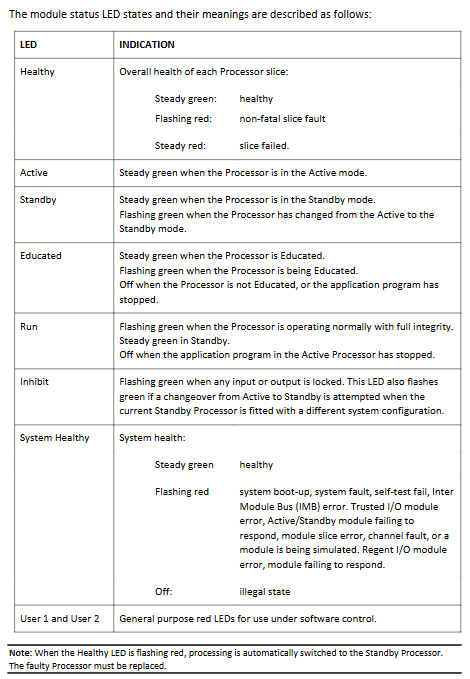
Status LED
Healthy: Slice status (green on/red flashing/red on)
Active/Standby: primary/backup status
Educated: Synchronization completed
Run/Disable: Run and Disable
User1/User2: Programmable indicator lights
Operating components
Fault Reset: Clear the fault
Maintenance key switch: Run/Main mode
Configuration and software
System Configuration (System. INI)
Rim_interval: TMR interface polling interval
Discrepancy_val: TMR channel difference threshold (default 2000ms)
Dualdistrepancy_val: Dual channel threshold
Scan time, IO parameters, communication parameters
Complex IO Definition (TTMRP)
Analog quantities: module temperature, voltage, scan count
Switching values: power status, IRIG status, health status
Clock: Read and write year/month/day/hour/minute/second
scan time
Total scanning time=input+output+program+communication
A typical small system takes about 27.76ms
Installation, maintenance, and troubleshooting
Install
Anti static operation, check appearance and pins
Insert the slot and fasten the ejector
active-standby switchover
Automatic backup for main processor failure
Pull out the main module ejector and force switch
New module insertion automatically synchronizes
fault diagnosis
Front panel LED+fault relay
RS232 diagnostic port log
SOE events and FCR status
Key questions and answers
What is the relationship between the TMR 3-2-0 working mechanism of T8111 and SIL3?
Answer: 3-2-0 refers to the three-way processor of the module, and normal three-way synchronous voting is required; Downgrade to 2-channel operation after one fault; If there is another malfunction, the system will shut down safely. This hardware fault-tolerant architecture meets the highest single device requirements of IEC 61508 SIL3 for safety control systems.
How to implement Active/Standby switching and under what circumstances will it be prohibited?
Answer: Switching is triggered by active fault, manual disconnection, and command; Newly inserted backup machine automatically synchronizes. Switch to scenarios where the Inhibit light is disabled: IO is forced, configuration is inconsistent, and education has not been completed (Educated).
What are the two formats for IRIG-B time synchronization and what are the configuration points?
Answer: Supports IRIG-B002 (RS422/485) and IRIG-B122 (1kHz amplitude modulation). The configuration needs to be enabled in the software, select the corresponding format, and match the wiring level; No year information, manual setting of the year is required for the first time.