UniOP ePAD05&ePAD06 Industrial HMI
Overall positioning and overview of the product
UniOP ePAD05 and ePAD06 are economical and compact entry-level industrial human-machine interfaces (HMI). As complementary products to the ePAD03/ePAD04 series, they feature small size, high cost-effectiveness, complete support for digital input functions, and are suitable for various small and medium-sized automation equipment and cost sensitive projects. Both models offer a wide temperature expansion version, which can operate in extreme temperature environments and is suitable for both conventional industrial sites and special working conditions; The overall positioning is to replace traditional large-sized, high cost HMIs, achieve device miniaturization and low-cost upgrades, and continue the mature software and hardware architecture and universal functional system of the UniOP series.
Core appearance, display, and human-computer interaction configuration
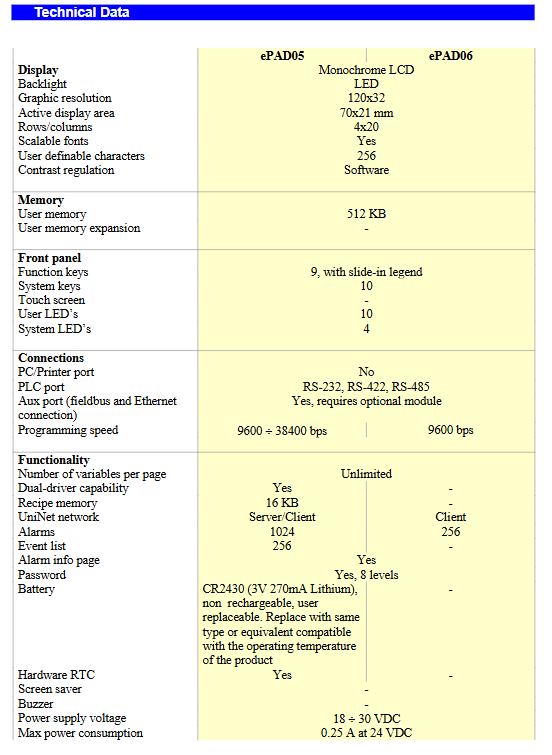
The two devices of the display system adopt a monochrome graphic LCD display screen with a physical resolution of 120 × 32 pixels; Supports font download, text scaling, and can display numbers, text, bar charts, and dynamic graphic objects to meet the basic needs of industrial data visualization.
Panel interaction component
Function keys: Standard 9-way programmable function keys, paired with pull-out identification strips, and optional special printing label accessories for convenient on-site function labeling and management;
Status indicator light: Integrated with 10 programmable user LEDs, it can customize the binding of device operation, fault, communication, mode and other statuses, achieving intuitive lighting prompts;
No touch screen design, pure physical button scheme, suitable for industrial environments with dust, oil stains, and wearing protective gloves.
Hardware electrical, structural, and environmental parameters
1. Power supply and power consumption
Power supply specifications: General industrial wide voltage DC power supply, voltage range 18-30 VDC;
Power consumption: Maximum operating current of 0.25 A at 24 VDC standard voltage, low-power design;
Protection configuration: Built in overcurrent protection device with circuit safety protection capability.
2. Physical dimensions and installation
Whole machine weight: 1 Kg;
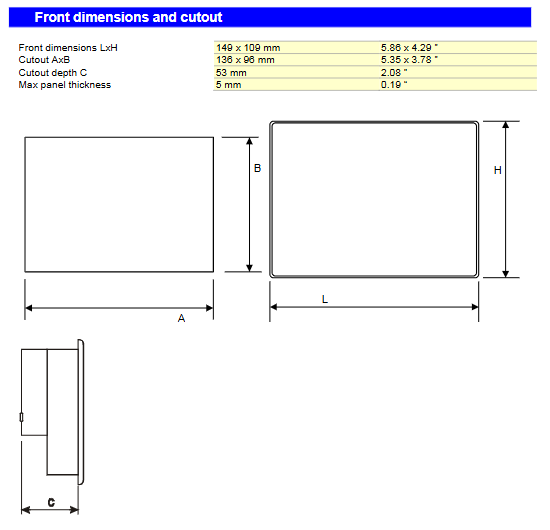
Panel dimensions: 149 × 109 mm;
Cabinet opening size: 136 × 96 mm;
Installation depth: 53 mm, maximum compatible panel thickness 5 mm;
Adopting standard embedded installation, compact structure, suitable for small control cabinets and equipment operation panels.
3. Environmental adaptability and protection level
Protection level: The front panel reaches IP65, which can prevent dust, water spray, and oil splashes, and is suitable for harsh industrial conditions;
temperature range
Standard version: 0 ℃~+50 ℃
Medium temperature expansion version: 0 ℃~+60 ℃
High and Low Temperature Extreme Edition: -20 ℃~+60 ℃
Unified storage temperature: -20 ℃~+70 ℃
Humidity: The working and storage environment should have a humidity range of 5% to 85% RH, with no condensation required;
Electromagnetic compatibility: Complies with international standards EN 61000-6-4 (radiated interference) and EN 61000-6-2 (anti-interference), with strong resistance to industrial electromagnetic interference.
Communication interface, speed, and scalability
The basic hardware interface comes standard with PC/printer interface and PLC dedicated interface. The PLC port natively supports three mainstream serial communication types: RS-232, RS-422, and RS-485; Equipped with auxiliary expansion ports, optional modules need to be added to connect to industrial buses and Ethernet.
communication rate
EPAD05: Programming communication speed 9600~38400 bps;
EPAD06: Fixed programming rate of 9600 bps.
Communication core characteristics
Drive resources: Built in communication drivers for over 130 types of industrial equipment, compatible with mainstream industrial control devices such as PLCs, frequency converters, and intelligent instruments;
Dual drive capability: ePAD05 supports dual drive communication and can simultaneously interface with lower level devices of two different protocols; EPAD06 does not have this feature;
Network architecture: ePAD05 supports UniNET network server/client mode; EPAD06 only supports UniNET client mode;
Expansion module: optional fieldbus modules such as Profibus DP, DeviceNet, CANopen, Interbus, and Ethernet modules can be used to achieve bus networking, remote programming, and data transmission.
Functional module differentiation comparison (ePAD05/ePAD06)
There is a significant gradient difference in the functional configuration between the two models, and the core differences are as follows:
Page variables: The entire series supports an unlimited number of single page variables, making it easy to display multiple sets of process parameters and equipment status in a centralized manner.
Recipe storage: ePAD05 is equipped with 16 KB of independent recipe storage space, supporting recipe saving, calling, and management; EPAD06 has no formula function.
Alarm and Events:
Both support 1024 alarm points and independent alarm information pages;
Equipped with a list of 256 historical events, it can record device operation, alarm, and operation logs.
Clock and spare battery:
EPAD05: Built in hardware real-time clock (RTC), paired with removable CR2430 (3V/270mA) non rechargeable lithium battery, maintains clock operation after power failure, battery can be replaced on site;
EPAD06: No hardware clock, no backup battery.
Universal standard features
Both models are equipped with a keyboard macro editor and eight level password protection; Support programming and configuration through UniOP Designer software, with simple and easy-to-use operation logic; It can achieve key macro recording, multi-level permission control, prevent parameter errors, and standardize on-site operations.
Software and Additional Features
Configuration software: equipped with UniOP Designer programming software, powerful and intuitive to operate, suitable for project development, program upload and download, and online debugging;
Display capability: Supports dynamic graphic elements, multi format data display, combined with scalable fonts to enhance information readability;
Additional accessories: Provide printable label paper accessories for standardized production of functional button identification.
Product model definition and selection direction
Mainstream models
EPAD05-0046: Standard version graphical HMI with real-time clock;
EPAD05-00B7: Wide Temperature Expansion Graphic HMI with Real Time Clock;
EPAD06-0046: Standard version basic graphic HMI, no clock, no formula, no dual driver.
Selection Recommendation
Select ePAD05: suitable for projects with formula management, time recording, multi protocol parallel communication, and full-featured network networking requirements, balancing conventional and wide temperature conditions;
Select ePAD06: It is a simple automation equipment that focuses on extreme low cost, only requiring basic monitoring, simple communication, and single protocol docking.