Basler BE1-87B high impedance bus differential relay
Chapter 1 General Information Product Overview
1. Core positioning of the product
Core application: High impedance differential protection for high/medium/low voltage busbars, also suitable for differential protection of parallel reactors;
Core advantage: Ultra high speed action
1.5 times action current: action<7ms (within half a week);
6 times or more fault current: action<5.5ms;
Quick tripping minimizes the range of bus fault burnout to the greatest extent possible.
Hardware specification classification
Single phase model: S1 pull-out housing;
Three phase model: M1 pull-out/19 inch horizontal rack installation;
standard features
Differential voltage imbalance alarm (CT disconnection alarm);
Independent current and voltage dual threshold criteria;
Electronic latch fault LED, panel reset;
Panel simulation trip test, CT circuit integrity test button;
Power loss monitoring contact;
Optional 2ms/20ms fixed delay jumper to avoid out of zone faults and lightning arrester disturbance misoperation.
Complete model example of Style coding rules for 2 models: BE1-87B S5AA1YN0N0F, segmented definition:
S: Single phase sensing; G: Three phase sensing
5: CT secondary 5A input; There is also a 1A specification available
A: Panel with CT test button cover plate; B No test cover plate
A1: 20ms delay; A2: 2ms delay
Y: 48/125 AC/DC universal power supply; Z: 125/250 AC/DC power supply
Post coding: various optional functions, F-half embedded/P-protruding housing
3 Basic Electrical Parameters Quick Overview
Voltage action setting (VDIFF): 50~400V RMS, step size 50V; internal SCR trigger peak=2.83 x set effective value;
Current action setting: 0.25~2.5A RMS, step size 0.25A; monitoring current peak value;
Unbalance alarm voltage: set value of 10%~80%, 10% level, slow action to prevent false alarms;
Input impedance: not triggered 5k Ω (60Hz, -40 °); After SCR conduction, the low impedance is approximately 0.05 Ω;
Fixed holding timer: 200ms to prevent instantaneous return of tripping contacts;
Chapter 2: Controls and Indicators Panel and Internal Components
1. All components on the front panel (with consistent single-phase/three-phase layout, only three-phase channels A/B/C)
Power LED: The power supply lights up normally;
CT OV alarm LED: The CT circuit imbalance exceeds the threshold and lights up, accompanied by 13/14 alarm contacts;
Alarm Voltage knob: Alarm threshold (10%~80% VDIFF);
Pickup Voltage knob: differential voltage action threshold of 50~400V;
Pickup Current knob: differential current action threshold of 0.25~2.5A;
Trip LED (Locked): The internal bus fault lights up, but it remains on even after power failure and restoration;
Reset button: manually reset the trip/alarm indicator light;
Trip Test hidden button: Press the insulation rod to simulate internal faults and verify the trip circuit;
CT Test button: Equipped with a dedicated test source, it checks whether the CT secondary circuit is short circuited.
Intentional Delay Jumper for 2 Circuit Boards
1-2 Short circuit: No additional delay;
2-3 Short circuit:
A1 model: ≥ 2 times current delay 20ms, less than 2 times 25ms, used for busbar with fuse to avoid rapid melting of the fuse;
A2 model: ≥ 2 times the current delay of 2ms, less than 2 times 7ms, to avoid transient disturbance and false tripping caused by lightning strikes.
Chapter 3 Installation Specification
1. Receipt and Storage Maintenance
Check the model upon arrival, inspect for transportation damages, and immediately contact the carrier for any damages;
Temporarily store equipment in moisture-proof and dust-proof original boxes; Backup relays are powered on for 30 minutes per year to extend the lifespan of electrolytic capacitors;
No regular preventive maintenance is required, only periodic functional verification is needed, and any malfunctions should be reported to the manufacturer’s after-sales service.
2. Mandatory safety requirements for installation
Before the withstand voltage test, the terminal plug and the body must be unplugged, otherwise the protection will fail;
Confirm that there are no fault conditions on the busbar before extraction to prevent serious short circuits caused by lack of differential protection;
Grounding: Cabinet grounding terminal ≥ 12AWG copper wire independent grounding bar, each protective unit is separately grounded;
The coil driven output circuit must be connected in parallel with reverse diodes to suppress EMI (Rev G added);
Conventional secondary wiring ≥ 14AWG copper wire;
Solid state non rotating components, no mandatory vertical installation requirements, can be fixed at any angle.
3 Shell and Hole Drawings Provide three types of shell complete sets of dimensions (inches+millimeters):
S1 single-phase shell: semi embedded, protruding installation panel opening, backplate terminal, side view;
M1 three-phase shell: semi embedded/protruding complete installation dimensions;
19 inch horizontal rack installation opening;
Installation dimensions of CT dedicated testing power supply (part number 9282300014).
4 Secondary wiring specifications
CT differential circuit: Each phase’s multiple CT branches are connected in parallel with the same polarity to the differential junction point, and connected to the corresponding phase terminal of the relay;
Trip circuit: The 86 lock relay contacts are connected to the relay input, and after a fault, the SCR is short circuited to prevent continuous high current damage;
Power circuit: Connect the 15/16 terminals to the nameplate AC/DC power supply; 11/12 are the normally closed alarm contacts for power loss;
Alarm output: 13/14, closed when CT is unbalanced/disconnected;
Trip contacts 17/18 and 19/20 have two independent trip outputs;
CT testing dedicated terminal 7/10, external 30/60V diagnostic test source.
5 CT test power supply wiring with built-in 100 Ω/50W current limiting resistor, dual input 120/240V, dual output 30V/60V gear, used to verify whether there is a short circuit in the CT secondary.
Chapter 4 Application, Principles and Setting Calculation
1 Typical application scenarios
Multi segment busbar differential protection (standard usage for three-phase models)
Each incoming and outgoing line CT is connected in parallel with the same transformer ratio, and all switches of the busbar are tripped by short-circuit action in the area; Reliable and error free operation of faults outside the area; Can be used in conjunction with the 86 blocking relay.
Parallel reactor protection
Single phase ground only fault protection for a single unit; The three-phase model can achieve complete phase to phase and grounding differential.
Key points for setting lightning arrester matching: When the busbar is equipped with lightning arrester, it is recommended to set the current threshold at 2.5A to avoid instantaneous leakage of lightning arrester causing misoperation.
2. Mandatory requirements for CT selection
Prioritize all CT with the same transformation ratio, same accuracy, and circular fully distributed iron core;
All CT secondary windings are connected to full taps, and mixing different taps is prohibited (if mixing is necessary, the CT full winding overvoltage must be calculated, formula 4-4);
3 CT cannot be connected in parallel with other loads or equipped with secondary voltage limiting devices;
4. It is allowed to mix CT with different transformation ratios, but strict calculation of insulation withstand voltage is required.
3 Core Working Principles (High Impedance Differential Logic)
Out of zone fault: The fault branch CT is deeply saturated, the secondary impedance is extremely low, and the vast majority of the differential current is diverted from the saturated CT. The voltage at both ends of the high impedance relay is lower than VDIFF, and the protection does not operate;
Fault within the area: All CTs output fault current to the differential circuit, causing high instantaneous voltage at both ends of the high impedance relay, exceeding the SCR trigger threshold. After conduction, the secondary circuit switches to low impedance. If the differential current exceeds the current threshold, it trips;
Double criteria: Only when the differential voltage exceeds the limit and the differential current exceeds the limit, will the trip be output, and no action will be taken under a single condition, greatly improving the ability to prevent misoperation;
4 SBS bidirectional switch: The SCR can still be triggered when the relay loses power, and the fault state is hard protected.
4 Complete Set of Setting Calculation Formulas (Core)
Minimum setting value of differential voltage (Formula 4-5, maximum fault verification outside the zone)
\(V_{DIFF}=1.25\left(R_{S}+P R_{L}\right) \frac{I_{F}}{N}\)
P: Take 1 for three-phase faults and 2 for single-phase grounding;
IF: Maximum out of zone fault current at one time; N: CT transformation ratio;
Rs: CT secondary+lead resistance; RL: Cable resistance from combiner box to CT;
After calculation, take the 50V gear up.
CT mixed use full winding overvoltage verification (Formula 4-4, to prevent CT insulation breakdown)
\(V_{F}=\frac{2.83 \cdot V_{DIFF} \cdot N_{1}}{N_{2}}\)
N1=total turns of CT, N2=turns of tap used; VF needs to be lower than CT withstand voltage.
The minimum internal fault current (sensitivity calculation formula 4-6) is used to verify whether high resistance grounding faults can reliably operate.
4 CT testing circuit voltage and current calculation, complete calculation with supporting examples.
5. Four elements of current threshold setting: 1. Ensure reliable operation of faults in the smallest area (key focus of high resistance grounding system);
The leakage of the 2-busbar lightning arrester does not cause misoperation;
3. The induced voltage of the external fault magnetic field does not meet the current criterion;
During CT testing, the test current should be lower than the operating value to avoid calibration errors and tripping.
6 CT disconnection detection logic panel CT Test button connected to 30/60V test voltage:
CT circuit intact: The test voltage generates sufficient voltage difference at the relay end, the CT OV light is on, and the alarm contact is closed;
CT secondary short circuit: All voltage drops to test 100 Ω resistance, no output alarm, CT fault is determined.
Chapter 5 Testing Complete Test Process
1 CT circuit integrity test (with dedicated testing source)
1. Connect the test source to terminal 7/10, and press and hold the CT Test button on the panel for up to 1 minute;
2 separate phase testing, prohibit simultaneous pressurization of multiple phases;
3 lights on=CT pathway intact; No indication=secondary short circuit, cable/CT needs to be checked.
2 Factory acceptance standardization test
1. Power status test: When powered on, the 11/12 contacts are disconnected, and when powered off, they are closed, meeting the fault safety design requirements;
Calibration of Voltage Knob Scale: Remove the control board and use an expansion card to read the corresponding DC reference voltage. The 50~400V range corresponds to 1~8V DC;
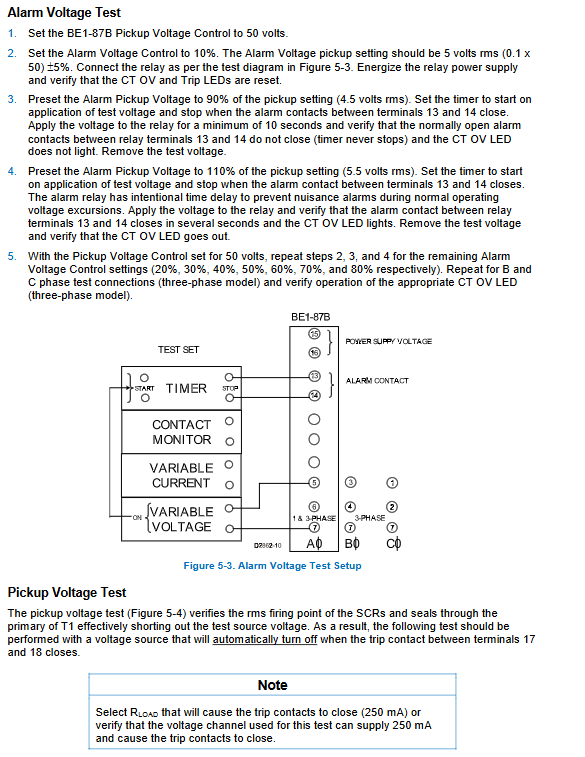
3. Unbalance alarm test: Apply 1.1 times the alarm voltage, and the alarm contacts will close with a delay; Less than 0.9 times inactive; Full gear retest;
4. Differential voltage action test: Apply 2 times the VDIFF effective value (equivalent full offset peak), SCR conducts, and trips with a current of 0.25A or above;
5. Differential current action test: fix VDIFF, slowly increase the current to the set value on the panel, and trip the light to lock;
6. Power loss holding test: After tripping, turn off the power and then turn it back on. The Trip light remains on and needs to be manually reset;
7 Action time test: Apply 3 times the action current, with no delay model ≤ 7ms; with 20ms jumper, the actual measurement is about 24ms;
Switching and retesting 2/20ms delay curves with 8 delay jumpers.
3 Requirements for Test Fixtures
Adjustable AC voltage source, adjustable current source, high-precision timer, circuit board expansion card, digital multimeter.
Chapter 6: Complete Technical Specifications
Impedance and action characteristics
Untriggered high impedance: 5100 Ω @ 60Hz;
SCR conduction low impedance: 0.05 Ω;
Action accuracy: Voltage/current ± 5% set value; The error within the frequency range of ± 5Hz is ≤ 8%.
2 Power specifications
Y-type (48/125V AC/DC), Z-type (125/250V AC/DC), DC power consumption 7.5W, AC maximum 20VA.
3 output contact capacity
Communication: continuous 7A, short-term 30A (0.2s);
DC 250V: Long term 7A, breaking only 0.3A; inductive load breaking 0.1A.
4. Environmental and Type Testing
1. Temperature and humidity: wide temperature range for operation and storage;
2. Impact and vibration comply with IEC 255;
3. Voltage resistance: Input to ground 2121VDC, input/output 1500VAC;
4 EMC: Surge, RF, static 8kV contact/15kV air discharge all pass IEEE/IEC standards;
5 UL508 certification, no UL approval for contacts above 250V;
6 Short term withstand voltage: Input can be continuously applied at 300Vac for 60 minutes.