ALSTOM MiCOM C264 Modular Substation Controller
Product Overview
1. Product positioning
Alstom MiCOM C264 is an integrated modular substation controller that integrates measurement and control, protection, communication, automation logic, event recording, and other full functions. It is suitable for high and low voltage substations, and can replace multiple independent devices such as RTU interval controllers, feeder protection devices, voltage regulators, event recorders, protocol gateways, etc. with one device. More than 30000 units have been deployed worldwide, meeting the needs of old station renovation and new digital substations.
2. Core design advantages
1. Modular and scalable architecture: I/O, communication, and functional modules can be optionally selected and adapted for modification and expansion;
2. Compatible with both old and new communication: Supports both traditional serial ports and modern industrial Ethernet standards such as IEC 61850;
3. Local human-computer interaction: Backlit graphic LCD panel, supporting local control, inspection, and fault viewing;
4. High reliability redundancy solution: supports dual redundancy of the entire machine/fiber optic Ethernet to avoid critical function interruptions;
5. Dual programmable logic: Fast event driven PSL (<5ms)+standard IEC61131-3 PLC, compatible with fast and slow automation logic;
6. Engineering simplification: multifunctional integration, reducing on-site wiring, equipment procurement, personnel training, and maintenance workload.
3. One machine with multiple roles (can be undertaken individually or in combination)
Remote terminal unit RTU, interval measurement and control device, feeder protection controller, substation automation main processor, SOE event sequence recorder, automatic voltage regulator AVR, power measurement center, load shedding controller, multi protocol converter, intelligent IED data gateway.
Core application function module
(1) Interval/substation interlocking logic
Provide two interlocking implementation methods:
1. Logical equation configuration;
2. Topology interlocking based on pre-defined rules of a single topology;
Interlocking logic is deployed nearby to enhance operational safety, and the interface displays locking conditions in a visual manner. Before operation, restrictions can be intuitively checked.
(2) Trip circuit monitoring
There are two modes: two-line and four line:
-Two wires: only monitor the circuit on and off when the circuit breaker is closed;
-Four wires: both open and closed states can be monitored;
Single phase circuit breakers can independently monitor the integrity of the tripping circuit in separate phases.
(3) AVR automatic on load voltage regulation
Adapt to IEC61850 digital substation, with a maximum control of 4 parallel voltage regulating transformers per unit:
1. Composite compensation of far and near end voltage;
2. Return adjustment function;
3. Minimize the circulating current of parallel transformers and implement master-slave regulation mode;
4. Optimize the gear control of the tap.
(4) Segmented automatic reclosing
A single interval is equipped with a set of reclosers, and the whole machine supports up to 12 intervals, single-phase/three-phase reclosing, and up to 4 independent delay reclosing logics; It can be triggered by built-in protection or external protection input.
(5) Synchronous verification (synchronous)
Adapt to manual/automatic closing logic, verify the voltage amplitude, phase, and frequency difference on both sides; Including locking, coupling mode, and no voltage/no current bus logic, a single device only supports single isolation synchronization.
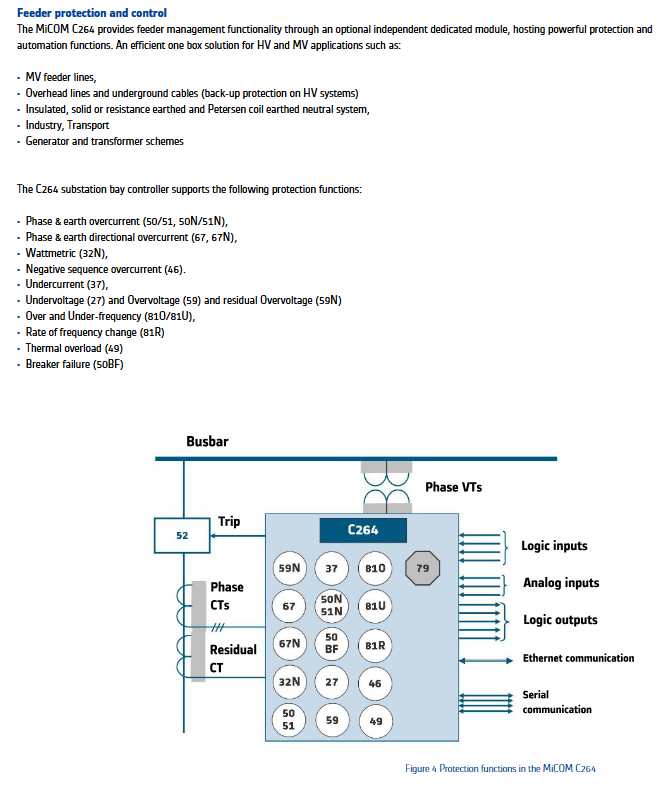
(6) Full set of feeder protection function (optional independent module)
Covering scenarios such as medium voltage feeders, overhead/cables, generators, transformers, etc., supporting various grounding systems, with complete protection models (ANSI standards):
Overcurrent/grounding overcurrent (50/51, 50N/51N), directional overcurrent (67/67N), active grounding protection 32N, negative sequence overcurrent 46, undercurrent 37, undervoltage 27/overvoltage 59/residual overvoltage 59, high and low frequency 81O/81U, frequency change rate 81R, thermal overload 49, circuit breaker failure 50BF.
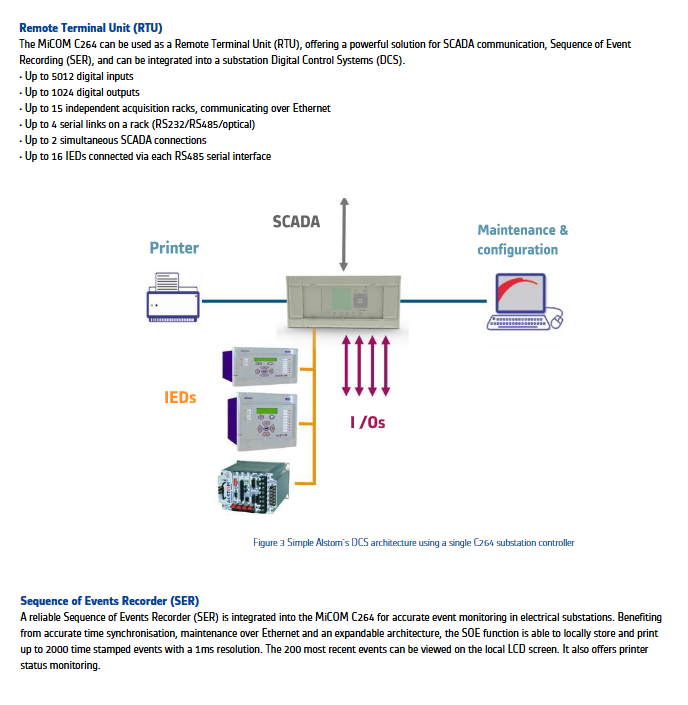
(7) RTU remote terminal function
Compatible with SCADA and substation DCS systems, with massive point processing capabilities:
-Digital input: maximum 5012 points; Digital output: maximum 1024 points;
-Up to 15 independent collection racks are interconnected via Ethernet; Single rack 4-channel serial port (RS232/485/fiber optic);
-Supports 2 parallel SCADA connections, with a maximum of 16 IED devices mounted on a single serial port.
(8) SOE Event Sequence Record
High precision time-series event storage, 1ms time scale resolution, non-volatile storage of up to 2000 events, local LCD can view the last 200 events; Support Ethernet remote maintenance, local printing, printer status monitoring, and rely on IRIG-B/SNTP to achieve precise clock synchronization.
(9) IED gateway and data concentrator
Unified collection of analog signals (CT/PT direct acquisition), digital hard contacts, and multi serial port IED data, unified standardization with unique identification, data station reuse, centralized processing of tap positions, measurement values, fault recording, fixed values, and other information.
(10) Waveform recording (FWR fast+SWR slow dual-mode synchronous operation)
1. FWR high-speed waveform recording: highest sampling rate, records instantaneous fault waveforms, stores 8 analog signals+128 digital signals, up to 9.6 seconds;
2. SWR slow wave recording: Long term RMS effective value recording, with a period of 1 cycle to 1 hour, storing 5000 sets of data;
Triggering conditions: input displacement, exceeding limit, manual summoning; The file is stored in the standard COMTRADE 2001 binary format and can forward 5 sets of fault recording files uploaded by IEDs.
(11) Power quality monitoring
Calculate the total harmonic distortion (THD) and total demand distortion (TDD) of voltage and current, with a maximum analysis of the 15th harmonic.
(12) Programmable automation logic
1. PSL high-speed logic: event driven, no fixed scanning cycle, execution time<5ms, used for fast interlocking and instantaneous fault action;
2. Standard PLC: Compliant with IEC61131-3, with a scanning cycle of 50ms to a few seconds, suitable for complex long-term automation, SIPS system integrity, and load shedding logic.
(13) Self diagnosis and operation web service
Power on self-test of the whole machine+continuous background monitoring, actively sending alarms and triggering watchdog contacts for software and hardware failures; Built in web server, the browser can directly view hardware, communication, I/O status, and download event logs.
Hardware I/O, human-machine, storage, and performance parameters
1. Complete capability of I/O system
-Number input into 5 categories: single point/double point/multi-point/system internal point/logical combination; All 1ms time scales support anti shake, multiple filtering, forced blocking/fault detection;
-Three control modes for digital output: single SBO, multiple SBO, direct output, compatible with switch and tap changer equipment;
-Binary counter: saves accumulated values when powered off, supports periodic/on-demand uploading;
-Encoding collection: supports binary BCD、 Gray code, choose one encoding from N, collect encoding signals such as taps;
-Analog quantity: Directly adopt CT/PT transmitter free board, external analog input/output, analog output maintains numerical value when powered off;
-Derivative electrical quantities: RMS current and voltage, active/reactive/apparent power, power factor, sequence components, frequency change rate, harmonics, etc. are automatically calculated.
2. Local human-machine HMI
-Removable graphic backlit keyboard and display screen on the back, with a maximum cable length of 5/15 meters for separate installation;
-Up to 12 sets of switchable interval screens, with 8 devices displaying animations on a single screen at a time;
-Permission grading to prevent misoperation; Support local viewing of measurements, alarms, events, and waveform recording.
3. Storage specifications (non-volatile memory)
-SOE event: 2000 circular cache entries, 1ms timestamp;
-Waveform: Up to 8 sets of FWR/SWR recording, plus 5 external IED recording files.
4. Performance and accuracy indicators of the whole machine
1. Clock synchronization: IRIG-B/SNTP synchronization accuracy is 1ms; input time scale is 1ms;
2. Action speed: Typical digital output<7ms, PSL logic<5ms, PLC cycle starting from 50ms;
3. Analog acquisition: Full scale accuracy of 0.1%, direct acquisition CT/PT up to 0.2%; Power and sequence component error of 0.5%; Frequency 0.01Hz, phase 1 °, harmonics up to the 15th order;
4. Interval control: A single unit can manage up to 128 intervals.
Communication system (core competitiveness)
1. Support mainstream industry standard protocols
Ethernet: IEC61850 (UCA2), IEC60870-5-104, DNP3 IP;
Serial port: IEC101/103, DNP3, MODBUS.
2. Ethernet hardware configuration
Standard configuration includes 2 independent Ethernet ports, which can be connected to the station control layer and process layer LAN respectively; Optional built-in 6-port switch, self-healing ring/dual return star redundant fiber optic Ethernet (100Base FX/10/100M electrical ports).
3. Serial communication
A single device can have up to 4 IED serial ports and 2 SCADA serial ports, with a maximum speed of 38.4kbps, and the serial protocol can be freely switched.
4. Multiple ways of clock synchronization
Manual calibration, IRIG-B hardware timing, SNTP Ethernet, SCADA master station timing; This machine can serve as a local area network SNTP time server.
Redundancy, Configuration, and Operations Design
1. Machine redundancy: Both the machine and the fiber optic Ethernet link can have dual machine/dual link redundancy to ensure uninterrupted critical control;
2. Dual configuration library: The device has two sets of configuration databases for activation and backup, which can be remotely modified online through the MiCOM S1 tool, and switching configurations is risk-free;
3. Online maintenance: web page maintenance, local LCD, printing events; Support local storage and remote uploading of event and waveform files;
4. Machine adaptation and renovation: Compatible with old CT/PT, traditional serial port IEDs, and existing primary devices, seamlessly integrating old and new systems.