SUMITOMO ELECTRIC AC5000S series (AC5005S/AC5015S/AC5025S) heat-resistant alloy turning
Core technical principles of grades
The AC5000S series uses Absotech ® New AlTiSiN based multi-layer PVD coating, combined with a heat-resistant and tough hard alloy substrate developed by a new sintering process:
Matrix: The high-temperature strength is significantly improved, and the plastic deformation at 800 ℃ is reduced by 50% compared to traditional hard alloys. The ability to resist notch wear and chipping at the boundary is significantly enhanced.
Coating: Multi layer thin film structure, excellent resistance to crescent wear and rear blade wear.
Comparison of Three Brand Positions
Brand core positioning focuses on performance and applicable working conditions
AC5005S efficient high-speed machining grade high wear resistance continuous cutting, pursuing higher cutting speed, precision machining – semi precision machining; Inconel718 is the preferred choice for high-speed machining, with wear resistance 1.5-2 times that of traditional grades
The main recommended grades for the AC5015S series are wear-resistant and toughness balanced, continuous, and slightly intermittent; Nickel based and cobalt based high-temperature alloys are universal, with a 1.5 times higher resistance to notch wear than traditional alloys
AC5025S heavy-duty intermittent machining grade is resistant to fracture, chipping, heavy impact, and unstable intermittent cutting; The highest toughness, with a fracture resistance performance 1.5 times that of traditional grades; It can also be used for other types of difficult to process materials
Scope of applicable workpiece materials (PMKNSH): heat-resistant nickel based/cobalt based/iron-based alloys, high hardness steels, special stainless steels (precipitation hardened stainless steels such as 15-5PH).
Complete system of chip breaker
Covering the entire range from fine precision machining → precision machining → light to medium cutting → medium cutting → medium coarse to coarse machining → heavy coarse machining; Divided into negative front angle blade groove type and positive front angle walking machine small part groove type.
Characteristics of groove type code processing grade
MEFF ultra precision machining with minimal cutting depth feed, mirror precision turning, and small margins
EEF precision machining with sharp edges, low cutting load, precision machining
ESU precision machining universal precision machining groove, preferred for outer circular end face of aviation parts
EEX light medium cutting feed moderate cutting depth, semi precision machining
EUP medium cutting balances chip removal and edge strength
EGU medium cutting with low cutting resistance, suitable for workpieces with weak rigidity
EEG moderate cutting universal semi precision groove type
EMU medium rough machining and semi rough machining improve blade strength
EEM Medium Coarse Machining Large Cutting Deep Feed Coarse Turning High Temperature Alloy
ENZ rough machining, strong cutting edge; Non slotted MA type blade for harsh impact
FX/FY/FYS/MESI/MESL positive rake angle small part groove type walking machine for small parts, precision turning, and sharing groove system with AC1030U/AC1135U
Performance test data
All tests were conducted using Inconel718 (44HRC) and Hastelloy alloy as workpieces, with wet cooling.
AC5005S (high-speed wear-resistant)
Inconel718 high-speed test: The wear rate of the rear cutting surface is much lower than that of the competitor S05-PVD, and the tool life is twice that of the competitor; The V-T curve shows that significantly higher cutting speeds can be used under the same lifespan.
AC5015S (Balanced Universal)
Inconel718 continuous: wear resistance is twice that of traditional grades;
Hastelloy intermittent test: The cutting time before edge failure is 1.5 times that of traditional products, effectively suppressing edge notch wear.
AC5025S (Heavy intermittent anti collapse)
Inconel718: The wear resistance of the rear blade surface is 2.5 times that of traditional grades;
Hastelloy impact test: The failure time of the broken blade reaches 1.5 times that of traditional grades; Under strong intermittent working conditions, the blade is less prone to sudden breakage.
Recommended cutting parameters (imperial units, heat-resistant alloys, wet cooling)
Processing grade groove type ap (in) f (IPR) Vc (SFM)
Precision machining EEF 0.005-0.020 0.004-0.008 160-230-360
Light cutting EEX 0.020-0.040-0.120 0.004-0.012 130-195-295
Moderate cutting EEG 0.020-0.080-0.160 0.006-0.012 130-195-295
Rough machining EEM 0.040-0.080-0.160 0.008-0.016 95-180-265
Explanation: Wet cooling is strongly recommended for high-temperature alloy processing; The red number represents the recommended optimal range.
Actual Processing Application Cases
Typical parts: aviation engine components, industrial high-temperature equipment components, automotive heat-resistant parts, valves, 15-5PH precipitation hardened stainless steel parts.
AC5005S Case Study
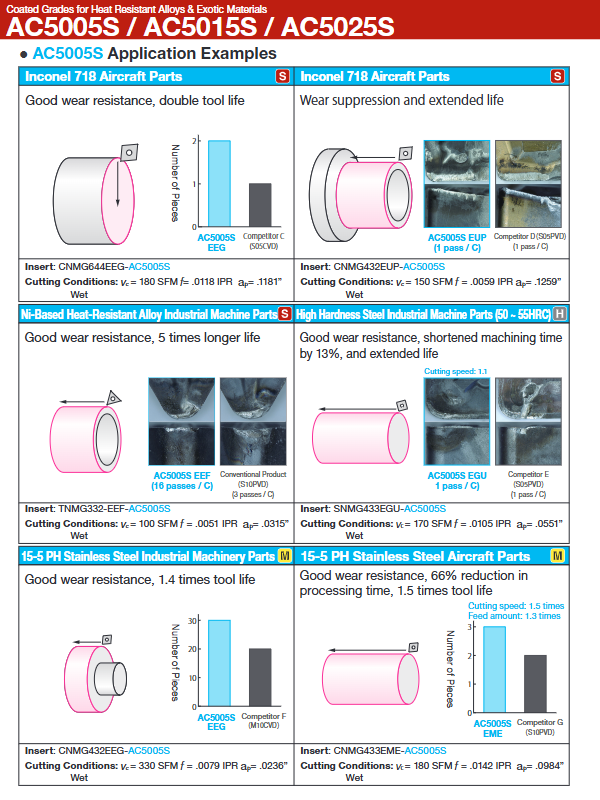
Inconel718 aviation EEG slot: tool life is twice that of competitors;
Nickel based alloy industrial parts EEF groove: lifespan 5 times longer than traditional S10 PVD grades;
50-55HRC high hardness steel EGU groove: improved processing efficiency and shortened processing time;
15-5PH stainless steel EEG: lifespan increased by 1.4 times; EEM slot cutting speed increased by 1.5 times and feed rate increased by 1.3 times.
AC5015S Case Study
Inconel713C automotive parts EEX: doubled lifespan;
Inconel718 aviation component EEG: lifespan is twice that of competitors;
Inconel625 aviation parts EGU: increased lifespan by 1.6 times;
47HRC high hardness steel MESI (walking machine small blade): doubling the lifespan.
AC5025S (intermittent working condition) case
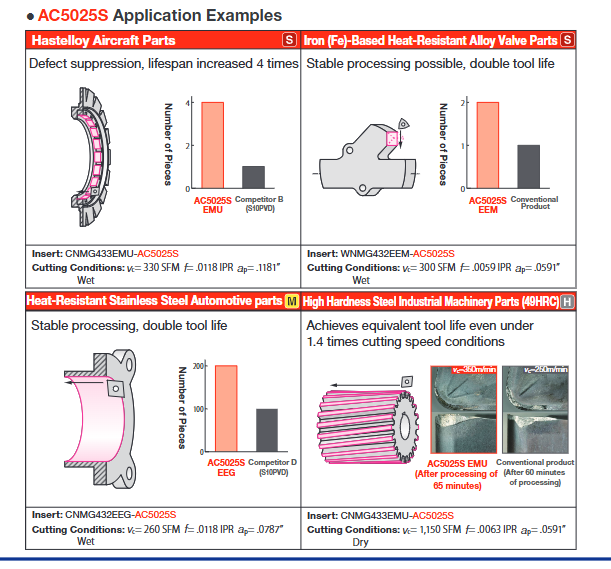
Hastelloy aviation parts EMU slot: suppresses blade defects, increases lifespan by 4 times;
Iron based heat-resistant alloy valve EEM: doubled lifespan;
Heat resistant stainless steel automotive parts EEG: can maintain the same tool life as competitors at 1.4 times cutting speed;
49HRC high hardness steel EMU, which can be dry processed under some working conditions, has significantly better stability than traditional grades.
Overview of Blade Product Specifications
Tag description: Local spot inventory in the United States; Global warehouse transfer.
1) Negative front angle blade (high-temperature alloy mainstream rough and semi precision machining)
80 ° diamond: CNGG/CNGP/CNMA/CNMG/CNMM
55 ° diamond shape: DNGG/DNGA/DNMG
Square: SNMG/SNMM/SNMN
Triangle: TNGA/TNGG/TNMG; Left and right hand EHM groove type
35 ° diamond: VNGG/VNMG
Trigon (Triangle 80 °): WNGG/WNMG
Slot coverage: ESU, EEF, EEX, EUP, EGU, EEG, EMU, EEM, ENZ, ENP, etc.
2) Positive front angle blade (7 °/11 ° rear angle; walking machine, precision machining of small parts, compatible with AC1030U/AC1135U slots)
80 ° diamond: CCGT/CCMT/CPGT/CPMT
55 ° diamond: DCGT/DCMT/DPMT
Square: SCGT/SCMT
Triangle: TCGT/TCMT/TPGT/TPGG/TPMN
35 ° diamond: VCGT/VCMT/VPGT
Trigon WBGT; Circular RCMX, RPGA; SPG square non perforated blade.
Slot types: MEFF, MEFC, MESI, MESL, FX, FY, FYS, ESU, EGU, etc., covering small tool tip radius specifications, suitable for small automatic lathes.