Leuze electronic DDLS 200 series bus type infrared optical data transmission equipment
Product positioning and purpose
DDLS 200 is an infrared optical data transmission system from Leuze Electronics, supporting INTERBUS 500 kBit/s and RS 422 bus for stable data transmission under unobstructed line of sight.
Applicable scenarios: Automated stereoscopic warehouses, fixed transmission between buildings, rotary transmission, long-distance data transmission of stationary/moving objects.
Laser safety: Class 1 (EN 60825-1), prohibits direct viewing of the beam at close range.
Core technical parameters
Category key parameters
Supply voltage 18-30 V DC
Power consumption (24V) without heating ≈ 200 mA; with heating ≈ 800 mA
Transmission distance DDLS200/120:0.2-120m; DDLS200/200:0.2–200 m
Infrared wavelength 880 nm
Optical opening angle ± 0.5 °
Protection level IP65
Working temperature without heating: -5 to+50 ℃; With heating: -30-+50 ℃
Weight ≈ 1200 g
Laser Class 1
Electrical interfaces and functions
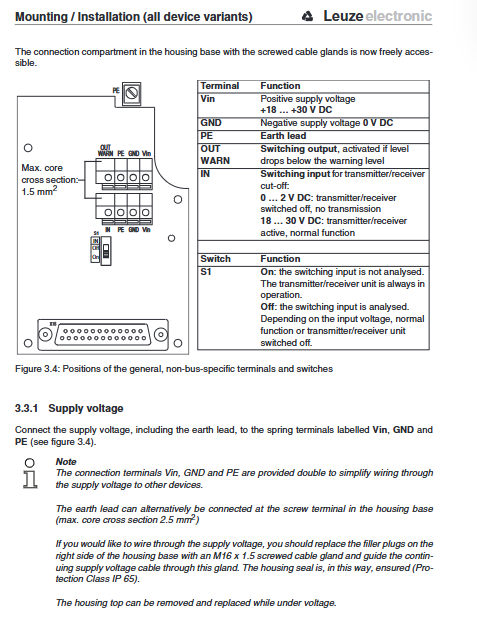
terminal definition
Vin: 18-30 V DC positive pole
GND: 0V negative pole
PE: Protective Grounding
IN: Remote start stop input (0-2 V=off; 18-30 V=on)
OUTTWARN: Receive strength alarm output (maximum 100 mA, short circuit/surge/overheat protection)
Switch S1
On: Ignoring IN input, the device is running frequently
Off: Enable IN input control for start stop
Operation and Display
indicator light
PWR/UL: Power and self-test status
AUT/MAN/DJ: working mode indication
LED light column: 10 segments of received signal strength
working mode
AUT (automatic): Normal operation, displaying the local reception strength
MAN (manual): Debugging mode, threshold increase
ADJ (Alignment): Transmission interruption, displaying the receiving strength of the other end
Mode Switch
Long press>2 seconds: AUT ↔ MAN
Short press: MAN ↔ ADJ (both ends must be MAN)
Installation and alignment requirements
install
Paired installation in opposite directions, unobstructed light path
Fix with 4 Φ 5mm screws
align
Optical opening angle: ± 0.5 °
Fine tuning angle: ± 6 °
Anti interference spacing
Parallel frequency: 120 type ≥ 300 mm; 200 type ≥ 500 mm
Parallel on the same frequency: the minimum spacing needs to be calculated according to the distance formula
Debugging, operation, and maintenance
Power on: Automatic self-test, entering AUT mode normally
Alarm: Signal strength too low → OUTVNet activated
Maintenance: Clean the optical windows monthly using a soft cloth and glass cleaner, and avoid solvents such as acetone
Interruption impact: Power outage/obstruction of the optical path is equivalent to bus disconnection
Key questions and answers
How to control the remote start stop of DDLS 200, and what is the function of S1 switch? Answer: Start stop can be achieved through the IN terminal: 0-2 V DC to turn off transmission and reception, 18-30 V DC to work normally; When S1=On, ignore IN input and keep the device running. When S1=Off, enable IN remote control.
What are the differences and switching rules among the three working modes of DDLS 200? Answer: AUT operates automatically and normally; MAN is for manual debugging; ADJ stands for optical path alignment (transmission interruption). Switching rule: Long press>2 seconds to switch between AUT and MAN; Short press to switch between MAN and ADJ, not directly AUT ↔ ADJ。
What are the core requirements for DDLS 200 installation alignment and anti-interference? Answer: The optical path must be unobstructed, with an optical opening angle of * * ± 0.5 ° and a fine adjustment of ± 6 °; The minimum spacing between parallel frequencies is 300/500 mm * *, and for the same frequency, the spacing should be increased according to the formula; Paired installation ensures coaxial optical paths.