Rockwell 1491/1494 series isolation switch and fuse base
The technical manual for 1491, 1494F/G/H/U series isolating switches and fuse bases released by Rockwell Automation in March 2026 covers the full range of visible blade flange isolating switches, heavy-duty safety isolating switches, hazardous area isolating switches, control circuit/power fuse bases from 30 to 600A. It specifies model selection, electrical parameters, mechanical dimensions, installation wiring, accessory configuration, and certification standards. The entire series supports Class J/R/H fuses, with visible breakpoints, handle lockable, IP20 protection, 200kA short-circuit withstand capability, and meets UL, CSA, CE, CCC, UKCA, and explosion-proof certifications. It is suitable for industrial distribution and equipment main circuit isolation and protection.
Basic Information
Applicable products: 1491, 1494F/1494G/1494H/1494U
Core application: Industrial distribution isolation switch, fuse protection base
Product series and positioning
Series Type Current Core Features Protection
1494U universal visible blade flange switch 30-600A pole/cable dual operation, saving 30% space 3R/4/12/4X
1494F fixed depth flange installation switch 30-100A fixed depth, simplified installation 1/3R/12
1494G heavy-duty/hazardous area switch 30~600A explosion-proof certification, visual window, metal shell 3R/4/12/4X, 7/9
1494H heavy-duty safety switch 30~200A side mounted handle, can hang 3 locks 1/3R/12
1491 fuse base 0.5~600A control circuit/power circuit, branch protection IP00
Core electrical parameters
rated value
Voltage: AC 600V/DC 250-600V
Current: 30/60/100/200/400/600A
Short circuit withstand: 200kA (equipped with Class J/R fuse)
Mechanical lifespan: 10000 to 20000 cycles
Switching frequency: 3-6 times/minute
Fuse adaptation
Support types: Class J, Class R, Class H
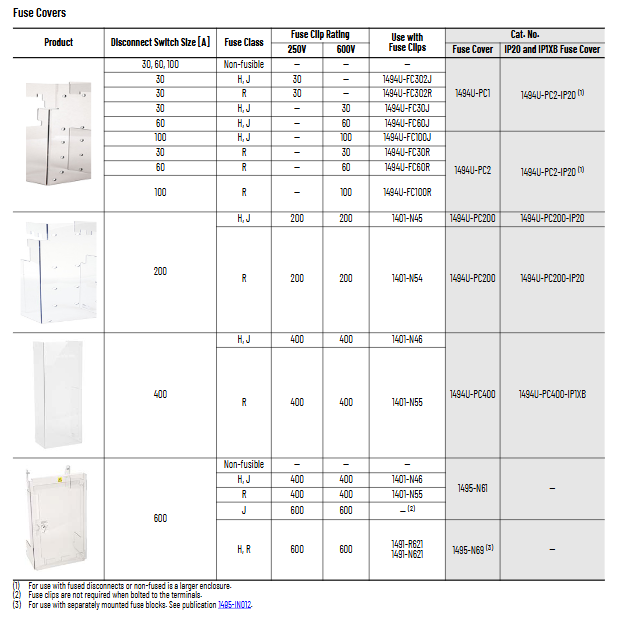
600A specification: J-shaped direct bolt fixation, no clamp needed
Terminal and torque
Wire diameter: 14AWG~500MCM (copper/aluminum)
Torque: 20~305 lb · in (2.3~34.5N · m)
Material: Copper Tin Plating
Structure and safety characteristics
Visual blade structure
The entire system has visible breakpoints that meet NFPA 79 safety requirements.
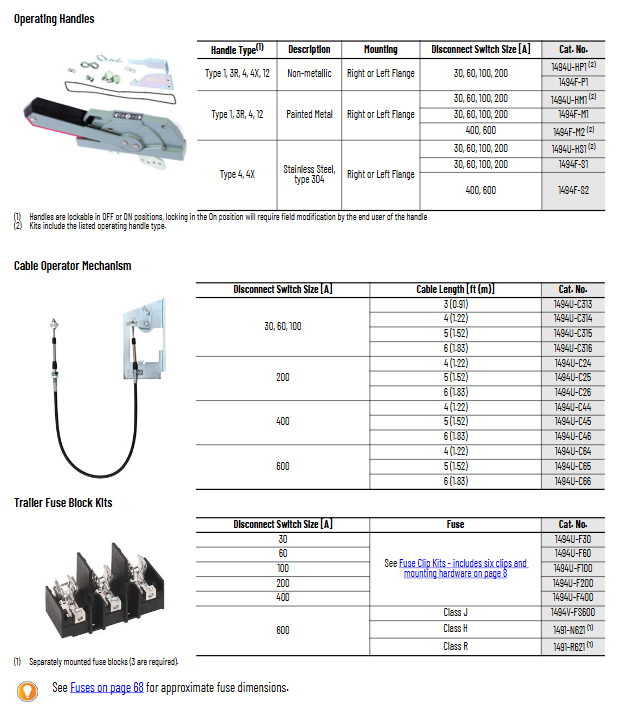
Handle and locking
Standard OFF position with padlock function
1494H can simultaneously hang 3 padlocks
The ON lock requires on-site modification
operating mechanism
1494U supports dual operation of pull rod/cable
Cable length: 3~6ft (0.9~1.8m)
Protection level
Indoor: Type 1/12
Outdoor/Waterproof: Type 3R/4/4X
Hazardous location: Type 7/9 (1494G)
Attachment system
Auxiliary contact
Specification: 10A, NO/NC, combination type
Model: 1494U-NO, 1494U-NC, 1495-N8, etc
Electrical interlock
Early disconnect design to protect electronic components
Specifications: 2NO, 2NO+2NC
terminal block
Single core/multi-core: copper/aluminum
Model: 1494U-LA/LC series
Fuse clip and cover
Clamp seat: 1401-N41~N55 series
Shield: IP20 anti touch finger protection
Certification and Standards
North America: UL, CSA
International: CE, UKCA, CCC
Explosion proof: Class I/II hazardous areas (1494G)
Standard: UL98, UL508, CSA C22.2 No.4
Key issues
Question 1 (Selection Focus)
What are the core differences between 1494U and 1494G isolation switches, and what scenarios are they applicable to? answer:
1494U: Universal type, supports pole/cable dual operation, small size and space saving, suitable for conventional industrial cabinets, standardized power distribution, without explosion-proof certification.
1494G: Dedicated for heavy-duty and hazardous locations, certified as Class I/II explosion-proof, with visible windows and reinforced metal casing, suitable for chemical, oil and gas, and dust explosion hazardous environments.
Question 2 (Safety Focus)
What safety requirements does the “visible blade” and “handle padlock” of this series of isolation switches meet, and what are the restrictions on their use? answer:
Visual blade: Provides visible breakpoints for physical disconnection, meeting NFPA 79 safety requirements for power-off maintenance.
Handle padlock: equipped with OFF position padlock to prevent accidental closing; The ON position padlock requires on-site modification and is not recommended for use in safety mandatory functions.
Question 3 (Application Focus)
1491 fuse bases are divided into control circuit type and power type. What are the differences between the two in terms of current, voltage, and protected objects? answer:
Control circuit type (1491 control): 0.5~30A, 600V, used for transformer, control circuit, PLC power protection, equipped with Class CC fuses.
Power type (1491 power): 30~600A, 600V AC/250V DC, used for main circuit, motor, and high-power equipment protection, equipped with Class J/R/H fuses.