Schneider C60H-DC C-curve DC supplementary protector
Schneider C60H-DC C-curve DC supplementary protector product sample, specially designed for DC distribution/feeder circuits, meets IEC/EN 60947-2, UL1077, GB 14048.2 standards, provides 1P/2P specifications, rated voltage covers 250V DC/500V DC, rated current is 0.5-63A, equipped with C-curve trip, polarity protection, short circuit current limiting, visual breaking indication, suitable for DC scenarios such as industrial automation, transportation, new energy, etc., clarifying core parameters such as breaking capacity, wiring specifications, temperature drop coefficient, auxiliary accessories, etc.
Product basic information
Product Name: C60H-DC C-Curve DC Auxiliary Protector
Function: Short circuit protection, overload protection, control, isolation
Applicable scenarios: DC feeder/distribution systems, industrial automation, transportation, new energy
Execution standards: IEC/EN 60947-2, UL1077, GB 14048.2
Model and electrical specifications
1. Number of poles and voltage
Specification 1P 2P
Rated voltage Un 250V DC 500V DC
Working voltage Ue 12~250V DC 12~500V DC
Module width 9mm × 2 9mm × 4
Weight 128g 256g
2. Rated current (0.5~63A)
1P model: MGN61500~MGN61519
2P models: MGN61520~MGN61539
3. Breaking ability (DC)
1P(250V):5kA
2P(110V):20kA; 2P(220V):10kA; 2P(250V):6kA
2P(440V):10kA; 2P(500V):6kA / 5kA
Core electrical parameters
Magnetic tripping current: 8.5In (± 20%), in accordance with the C-curve
Rated impulse voltage: 6kV
Rated insulation voltage: 500V DC
Rated operating breaking capacity Ics: 75% Icu
Electrical lifespan: Resistance load 6000 times, L/R=2ms 3000 times
Mechanical lifespan: 20000 cycles
Pollution level: 3
Product Category: Class A (No Delay)
Environmental parameters
Working temperature: -25 ℃~+70 ℃
Storage temperature: -40 ℃~+85 ℃
Humidity: 95% (55 ℃ without condensation)
Protection: Suitable for tropical environments
Wiring and installation
Polarity requirements
It is necessary to strictly follow the polarity of the identification, as reverse connection may cause a fire
2P series connection for American system requires * * ≥ 30cm * * cable
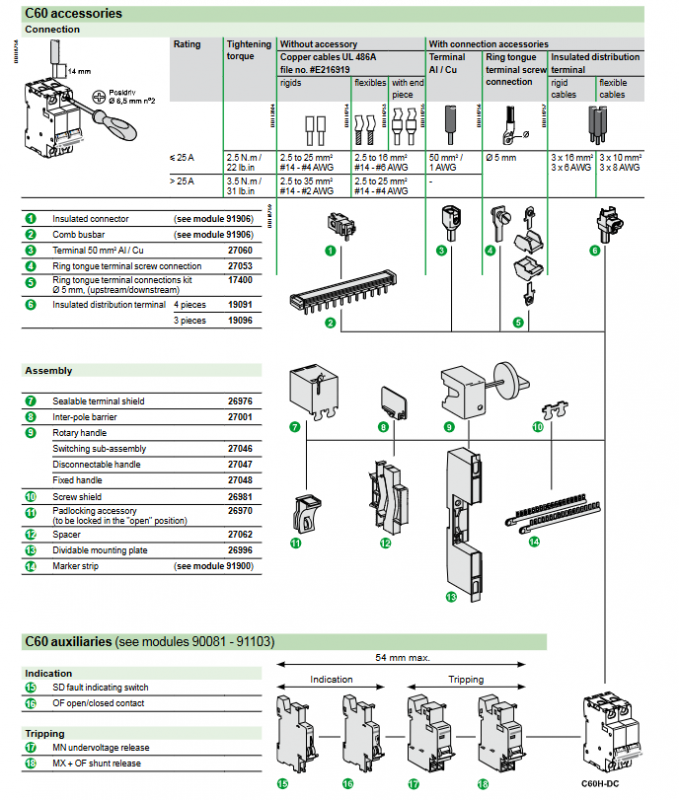
Wiring torque
≤25A:2.5N·m
>25A:3.5N·m
Applicable wire diameter
2.5~16mm ²/2.5~25mm ²/Maximum 50mm ² (AWG # 14~# 1)
Entry method: Both upward and downward entry are acceptable
Attachment system
Wiring accessories: insulated connectors, busbars, ring terminals, shielding covers
Operating attachments: rotating handle, detachable handle, fixed handle, padlock device
Auxiliary contact:
SD: Fault indicator contact
OF: Contact point for opening and closing status
Release attachment:
MN: Under voltage trip
MX+OF: Split excitation release
Installation accessories: partition, spacer, installation plate, marking strip
Protection and release characteristics
C-curve release: Magnetic release action within the range of 7In~10In
Positive polarity disconnection indication: The green bar displays full pole disconnection, indicating safe operation
Current limiting: Quickly disconnect in case of fault to protect the load
Quick closure: independent of handle speed, extending lifespan
Isolation function: meets the isolation requirements of IEC60947-2
Temperature reduction (25 ℃ benchmark)
As the ambient temperature rises, the rated current needs to be reduced according to the coefficient in the table
Multiple units installed side by side in a small cabinet require an additional multiplier of 0.8
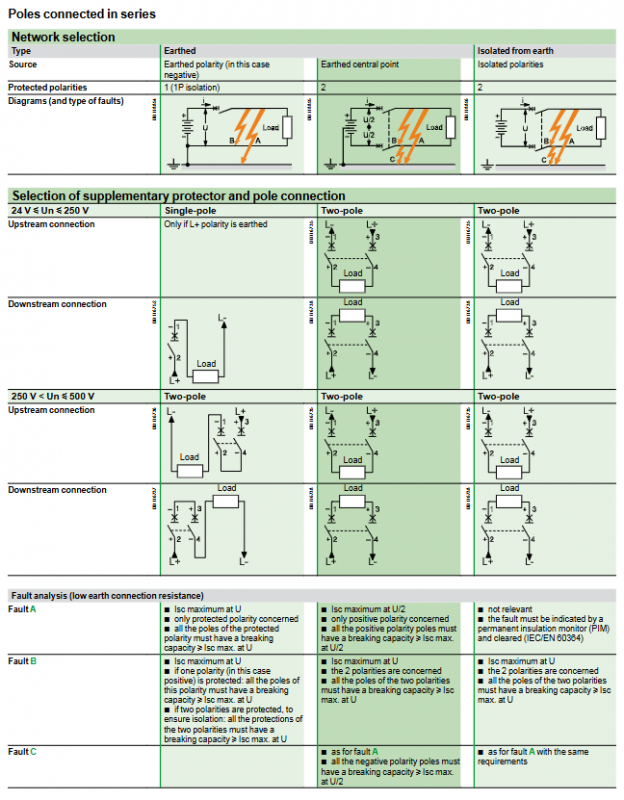
Extreme configuration and fault protection
The grounding system is divided into three categories: grounded/ungrounded/midpoint grounded
24V~250V: 1P/2P optional; 2P is required for voltages greater than 250V
Fault types A/B/C correspond to different polarity protection and disconnection requirements
Key issues
Question 1: What are the magnetic release parameters of C60H-DC? What is the action range of the C-curve?
Answer: The magnetic trip current is 8.5In ± 20%; The electromagnetic trip action range of the C-curve is 7In~10In, used for conventional DC circuit overload and short circuit protection.
Question 2: What are the mandatory safety requirements for the wiring of this product? What are the consequences of violating?
Answer: Polarity must be strictly observed, reverse connection poses a risk of fire and electric shock; 2P series connection for the US power grid requires the use of * * ≥ 30cm * * cables; The wiring torque should meet the standard (2.5/3.5N · m). Violation may result in burning, short circuit, and protection failure.
Question 3: What are the core differences between the P and 2P models in terms of voltage, breaking capacity, and application scenarios?
Answer: 1P rated voltage 250V DC, breaking 5kA, used for ≤ 250V unipolar grounding system; 2P rated 500V DC, maximum breaking 20kA, used for>250V or ungrounded bipolar DC systems, with a wider range of applications and more complete protection.