IUSA Cambridge Lee Copper Tube
Enterprise Overview
Brand: IUSA Cambridge Lee Industries LLC
History: Founded in 1939, entered the copper tube industry in 1955, and was acquired by Mexico’s IUSA in 1993
Capacity: Duplex factories in Mexico and the United States, global distribution
Positioning: Top copper pipe supplier in the United States, Mexico, Latin America, and the Middle East
Quality: Full process eddy current testing, degreasing, dehydration, nitrogen blowing, sealing, environmentally friendly plastic free packaging
Product Classification and Standards
1. Copper tube for refrigeration (ACR)
Characteristics of Series Execution Standards
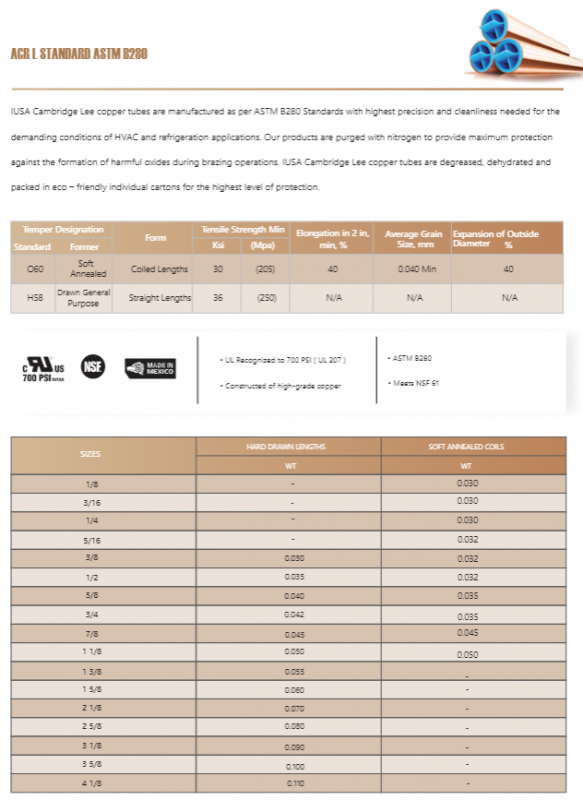
ACR Standard ASTM B280 conventional accuracy, suitable for HVAC systems
ACR Perform ASTM B743 high-performance, suitable for high-pressure refrigerants (such as R410A)
ACR ECO American standard thin-walled lightweight, economical and environmentally friendly
2. Plumbing copper pipes for plumbing
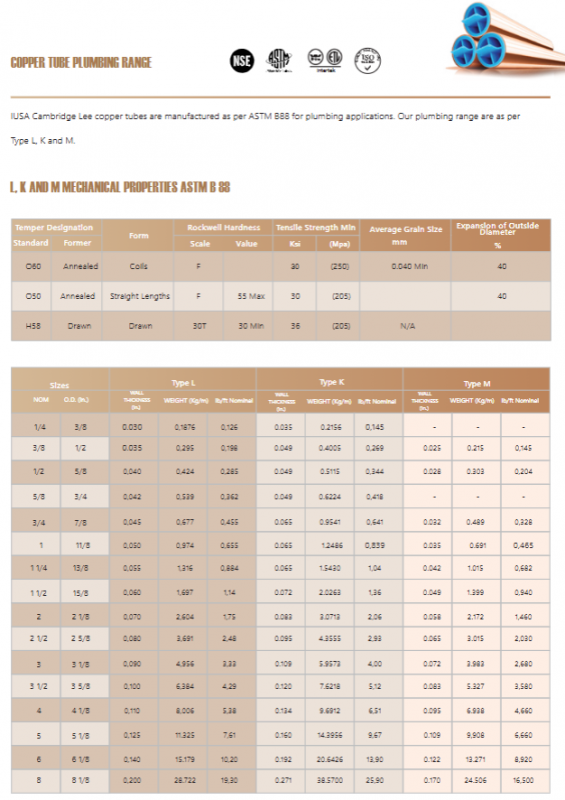
Standard: ASTM B88
Types: Type L (Universal), Type K (High Voltage), Type M (Thin Wall)
Usage: Domestic water supply, firefighting, solar energy, fuel, natural gas
3. Medical/Oxygen specific Copper Tube (Oxy/Med)
Standards: ASTM B819, CGA G4.1, NFPA 99
Requirement: Cleaning, sealing, degreasing, only supply hard straight pipes
Applicable: Hospital oxygen, vacuum, medical gas pipeline network
Material state and mechanical properties
1. Soft and hard specifications
O60 (soft annealing): coil, tensile strength 30 Ksi (205MPa), elongation 40%
H58 (hard drawing): straight pipe, tensile strength of 36 Ksi (250MPa)
2. Core certification
UL 207: Voltage resistance to 700 PSI
NSF 61: Drinking Water Safety Certification
ISO9001:2015、AENOR、BSI
Specification Range (inches)
Pipe diameter: 1/8 “~8-1/8”
Wall thickness: 0.020 “~0.271”
Form: Hard straight pipe, soft coil pipe
Construction technology
Bending: Use a pipe bender to position, clamp, rotate, shape, and verify
Brazing: Cutting pipes to remove burrs → Cleaning → Applying flux → Assembling → Heating → Filling wires → Forming
Customers and Projects
Representative clients: EMAAR, Nakheel, ALDAR, DAMAC, Saudi Aramco
Representative projects: Dubai International Airport, Riyadh Metro, Palm Island, high-end hotel cluster, financial and business district
Key issues
Question 1: Why must ACR refrigeration copper pipes undergo degreasing, dehydration, nitrogen purging, and sealing?
answer:
Defatting/Dehydration: Avoid impurities generated by the reaction between oil, water, and refrigerant, which can clog the compressor and expansion valve.
Nitrogen purging: prevents the formation of oxide scale during welding and ensures system cleanliness.
Sealing: Dust and moisture prevention during transportation and installation to ensure system cleanliness and extend equipment lifespan.
Question 2: What are the core differences between the Type L, K, and M of Plumbing plumbing pipes?
answer:
Type K: Maximum wall thickness, highest pressure bearing, used for underground, high-pressure, and main pipelines.
Type L: Medium wall thickness, universal type, most commonly used for indoor water supply in buildings.
Type M: The thinnest wall thickness, low pressure bearing, used for low-pressure, light load water supply and drainage systems.
Question 3: What are the key differences between medical gas specialized copper tubes and ordinary ACR copper tubes?
answer:
Different standards: Medical tubes follow ASTM B819+CGA G4.1+NFPA 99, with higher cleanliness levels.
Supply form: Medical tubes are only hard straight tubes and coil tubes are prohibited.
Cleaning requirements: Specially designed for oxygen safety, oil-free, impurity free, non flammable, and eliminates the risk of explosion.