Schneider Modicon TM3 Expansion I/O modules for Modicon M221, M241, M251 and M262 controllers
Overall positioning of the product
Modicon TM3 is an optimized I/O expansion system launched by Schneider Electric, designed specifically for Modicon M221/M241/M251 logic controllers and M262 logic/motion controllers. It belongs to the edge control layer product of EcoStruxure Machine architecture and realizes three types of I/O expansion: local, remote, and distributed, meeting the flexible configuration requirements from small devices to motion control devices.
Core Extension Architecture
Local extension
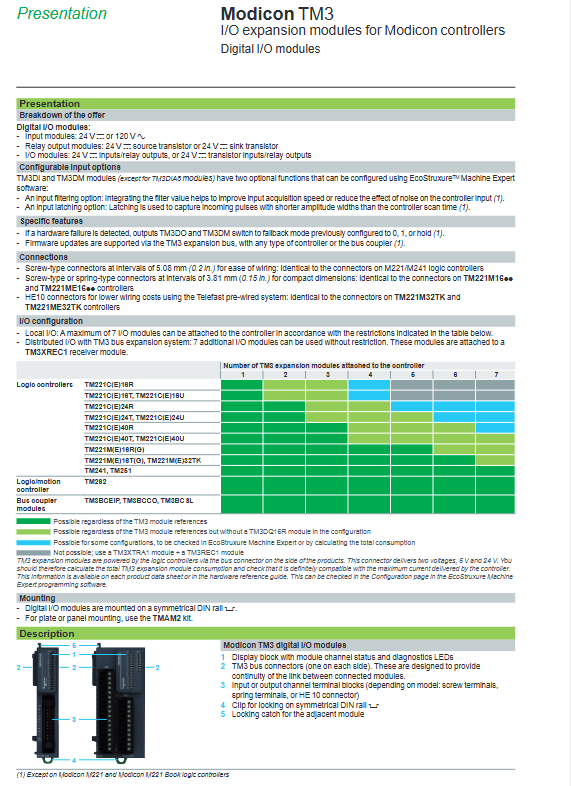
Up to 7 TM3 modules can be mounted on a single controller
Power supply and communication between modules are cascaded through side TM3 bus connectors
Remote Expansion
Sending module TM3XTRA1+receiving module TM3XREC1
Maximum transmission distance of 5m, using Cat5e shielded cable
Expand the total number of modules to 14 (7 local and 7 remote)
Distributed Expansion
Bus coupler to form I/O island, supporting EtherNet/IP, CANopen, Modbus Serial
Support multi coupler cascading to meet the distributed layout of large equipment
Full series module details
1. Digital I/O module
Input: 8/16/32 points, 24V DC/120V AC, source/drain type
Output: 8/16/32 points, relay (2A)/transistor (0.1A/0.5A)
Mixed I/O: 8/24 points, input+relay output
Wiring: Screw/Spring Terminal, HE10 connector optional
Typical models: TM3DI8, TM3DQ8R, TM3DM24R
2. Analog I/O module
Input: 2/4/8 channels, voltage/current/thermocouple/RTD
Output: 2/4 channels, voltage/current
Mixing: 4 in 2 out, 2 in 1 out
Resolution: 12-16 bits, conversion time 1-100ms
Power supply: external 24V DC, optocoupler isolation
Typical models: TM3AI4, TM3AQ4, TM3TI4, TM3AM6
3. Expert functional module
High speed counting module: TM3HHSC202, 10 high-speed inputs, 8 high-speed outputs, 200kHz, 32-bit counting
Motor starter control module: TM3XTYS4, RJ45 directly connected to 4 TeSys U, simplified wiring
4. Functional safety module
Safety level: PL e/Category 4, SIL CL3
Function: Emergency stop, safety light curtain, safety carpet/edge control
Output: 3-channel NO safety relay, microprocessor guided
Model: TM3SAF5R, TM3SAK6R
Certification: UL, CSA, T Ü V, EAC, RCM
5. Bus coupling module
Maximum Slave Station for Model Protocol Interface
TM3BCEIP EtherNet/IP, Modbus TCP 2 x RJ45 90
TM3BCCO CANopen 2×RJ45 64
TM3BCSL Modbus Serial(RS485) 2×RJ45 32
Installation and Electrical Characteristics
Installation method: DIN rail installation, optional TMAM2 panel installation kit
Wiring terminal: detachable screw/spring terminal, spacing 3.81/5.08mm
Power supply: The digital module is powered by the controller; Simulation/Security/Expert Module External 24V DC
Dimensions: Width 17.6~39.1mm, Height 90mm, Depth 70mm
Grounding: TM2XMTGB grounding strip optimized shielding grounding
Configuration and software
Configuration software: EcoStruxure Machine Expert/Basic
Function: Module recognition, parameter configuration, safety parameters, diagnostic monitoring
Diagnosis: Module LED status+bus diagnosis, output can be set to hold/reset in case of fault
Key issues
Question 1: What are the maximum number of modules and distance limits for the local, remote, and distributed expansion modes of the TM3 system?
Answer: The maximum number of local extensions is 7 modules; Remote expansion (sending+receiving) up to 14 modules, with a maximum distance of 5 meters; Distributed I/O is not limited by distance through bus couplers and is only constrained by the bus protocol.
Question 2: What is the highest security level that the TM3 functional security module can reach, and what security scenarios is it mainly used for?
Answer: Up to PL e/Category 4 (EN ISO 13849-1) and SIL CL3 (EN IEC 62061); Mainly used for emergency stop control, safety light curtains, safety carpet/safety edge monitoring.
Question 3: What is the difference in power supply between TM3 analog modules and digital modules?
Answer: The digital module is directly powered by the controller through the TM3 bus; The analog, safety, expert, and bus coupling modules must be independently powered by an external 24V DC power supply to ensure isolation and stability.