Specification for Automation Direct DL06 Series Micro PLC (D0-06DD1)
Product positioning and core models
Product Series: Automation Direct DirectLOGIC DL06 Micro PLC
Key model: D0-06DD1 (20 in/16 out, DC input/DC output)
Price: $251.00
Structure: Integrated design of CPU, power supply, and I/O, supporting expansion modules
Electrical specifications (D0-06DD1)
1. Power specifications
Project parameters
Input voltage 100-240 VAC, 50/60Hz
Maximum power consumption 40VA
Auxiliary DC power supply 20-28VDC, external power supply
2. Enter specifications (20 points, X0-X23)
Project parameters
Type 12-24VDC, drain/source type universal
5 groups of public end, electrically isolated
High speed input X0-X3, response<100 µ s
Normal input X4-X23,<8ms response
Conducting current/level>5mA/>10VDC
Turn off current/level ≤ 0.5mA/<2VDC
3. Output specifications (16 points, Y0-Y17)
Project parameters
Type DC leakage output
4 groups of public end isolation
High speed pulse Y0-Y1, 7kHz, 0.5A/point
Normal output Y2-Y17, 1.0A/point (EN certification downgrading 0.6A)
pressure drop 0.3VDC@1A
Response speed Y0-Y1:<10 µ s (ON)/<20 µ s (OFF)
Y2–Y17:<60µs(OFF)
CPU system performance
Project parameters
Total memory 14.8K words
Program memory 7680 words
V storage 7616 words
Boolean instruction speed 0.6 µ s
Typical scanning time 1K program: 1-2ms
Built in I/O 36 points (20 in/16 out)
Expansion capability supports expansion modules
Real time clock has
Password protection is available
Maintain 128 word V memory and battery backup in case of power failure
Communication function
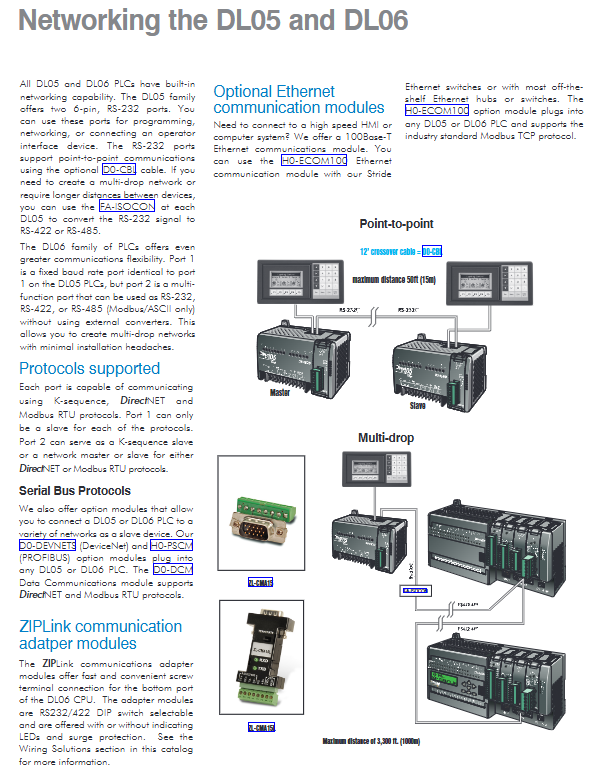
Port 1: RS232, fixed 9600bps, only used as a slave station
Port 2: RS232/RS422/RS485, baud rate 300-38400bps
Support agreement:
Modbus RTU (master/slave)
DirectNET (master/slave)
K-sequence
Optional extensions: Ethernet (H0-ECOM100), DeviceNet, Profibus
Extension module support
Digital quantities I/O: D0-07CDR, D0-08CDD1, D0-10ND3, etc
Analog quantities: 4/8 AI, 4/8 AO, thermistor, thermocouple
Communication: Ethernet, Profibus, DeviceNet, ASCII coprocessor
Special features: high-speed counting, input simulator, LCD panel
Environment and Installation
Project parameters
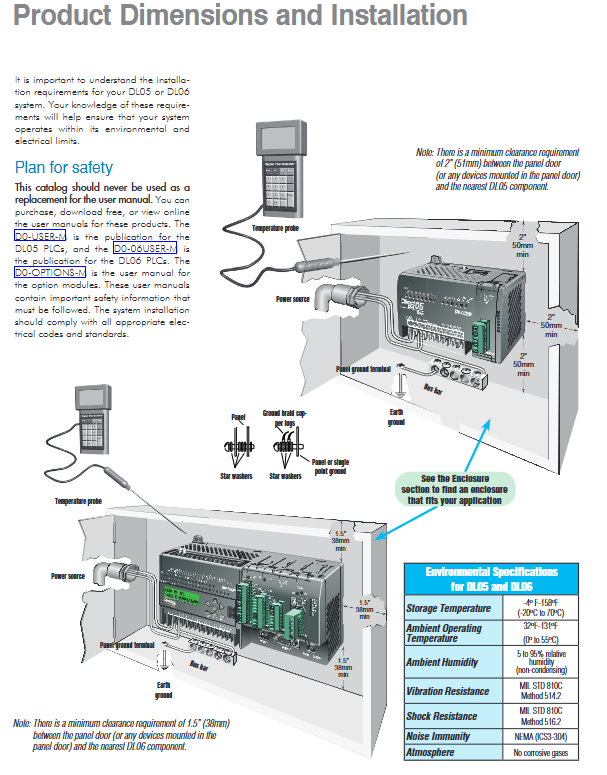
Working temperature 0-55 ℃
Storage temperature -20-70 ℃
Humidity 5-95% RH (no condensation)
Anti vibration/impact MIL-STD-810C
Installation distance and cabinet door distance ≥ 38mm
Installation method: DIN rail
Software and Programming
Programming software: DirectSOFT
Free version: PC-DS100 (limited to 100 word program)
Programming method: ladder diagram RLL, function block, flowchart
Total number of instructions: 229, supporting PID, floating-point operations, trigonometric functions
Key questions and answers
Question 1: What are the high-speed input and high-speed output points of D0-06DD1? What are the performance differences?
answer
High speed input: X0-X3, response time * *<100 µ s * *, suitable for high-speed counting and interrupt signals.
Normal input: X4-X23, response time * *<8ms * *.
High speed pulse output: Y0-Y1, up to 7kHz, rated current 0.5A.
Normal output: Y2-Y17, no high-frequency capability, rated current 1.0A (reduced to 0.6A by EN certification).
Question 2: What are the functions of the dual serial ports of DL06 PLC? How to implement Modbus networking?
answer
Port1 (RS232): Fixed 9600bps, only used for programming HMI、 Communication from the station.
Port2 (RS232/422/485): Can be configured as RS485, supports Modbus RTU master/slave stations, and enables multi device networking.
Networking method: Set Port2 to RS485, configure station number and baud rate, and use MRX/MWX commands to directly read and write data from the slave station.
Question 3: Why do we need to do power budgeting when expanding the DL06 PLC module? What is the power limit for D0-06DD1?
answer
Reason: DL06 has 4 expansion slots and a limited capacity of 5VDC/24VDC built-in power supply. Overloading can cause crashes or malfunctions.
Built in power supply:
5VDC:1500mA
24VDC:300mA
D0-06DD1 consumes 5VDC 600mA, 24VDC 280mA, and the remaining power is used for expanding the module.