Basler DECS-200 Digital Excitation Control System
Product Overview
1. Core positioning
DECS-200 is an integrated fully functional digital excitation system that uses PWM pulse width modulation power circuit to optimize performance for nonlinear load conditions; A single device supports three excitation output voltage levels of 32Vdc/63Vdc/125Vdc, with a rated continuous excitation current of 15Vdc, and can be adapted to almost all specifications of synchronous generators.
2. Core advantages
Fully digital architecture, true RMS sampling, excellent voltage regulation accuracy;
Integrated regulation, restriction, protection, monitoring, waveform recording, and event recording functions;
Support local panel, PC software, remote simulation/communication multi-mode configuration and control;
Capable of mode switching without disturbance, automatic tracking of primary and backup machines, and adapting to parallel and redundant operation of units;
Meets multiple international safety regulations, electromagnetic compatibility, and industry standards, with complete certification in multiple regions worldwide.
Main Function List
(1) Adjust control function
AVR automatic voltage regulation: main operating mode, voltage regulation accuracy within load range ± 0.25%, steady-state accuracy ± 0.1%, excellent temperature drift control.
FCR excitation current regulation (manual mode): directly controls the excitation current and can be used as a backup mode for faults.
VAR regulation: Stabilize the reactive power output of the unit with an accuracy of ± 2.0%.
Power factor (PF) adjustment: Constant unit power factor with an accuracy of ± 0.02.
Soft start: The voltage is gradually built up, and the rise time is continuously adjustable from 1 to 7200s to suppress startup overshoot.
V/Hz low-frequency limit/underfrequency compensation: slope 0~3.0pu (step size 0.1), inflection point frequency 45~65Hz adjustable, to prevent low-frequency iron core overheating.
Parallel compensation: supports reactive power adjustment, cross current (differential) compensation, and is suitable for parallel connection of multiple units; The compensation range for line voltage drop is -30%~0.
Voltage matching: The terminal voltage can be matched with the bus voltage, with a deviation of ≤± 0.15%.
PID stable regulation: Built in 20 sets of standard PID parameters, while supporting user-defined PID to adapt to different excitation winding characteristics.
(2) Excitation limit function
Maximum Excitation Limit (OEL): There are two modes: online (grid connected) and offline (single machine), providing two types of characteristics: summation type and preemption type. High/medium/low current thresholds and inverse time delay are set in stages.
Minimum Excitation Limit (UEL): To prevent phase loss of the unit, it supports built-in curves or 5-point custom curves.
Stator current limit (SCL): Set high and low current thresholds and delays in stages to protect the stator winding from overheating.
(3) Unit protection function (8 standard protections in total)
Including excitation overvoltage, excitation overcurrent, generator overvoltage, generator undervoltage, demagnetization protection, voltage transformer disconnection detection, excitation diode monitoring (EDM), and watchdog fault protection; All protection settings and delays can be finely tuned.
Excitation diode monitoring (EDM): For brushless generators, diode open/short circuits are determined by ripple, and the number of poles, fault threshold, and delay can be set.
(4) Tracking and switching function
Internal mode automatic tracking: Non operating mode follows the current operating mode to achieve disturbance free switching, with a switching deviation of ± 0.5%.
External primary and backup machine tracking (optional): Two DECS-200 are interconnected, and the backup machine tracks the host in real time, automatically switching in case of failure.
(5) Operations and data functions
Sequential Event Recording (SER): capable of storing 127 events with timestamps, recording switch values, status, and alarm changes for easy fault tracing.
Oscillography: Up to 8 sets of waveform recording files can be saved, and 6 monitoring variables can be selected for each set with a sampling interval of 4ms~10s. It follows the COMTRADE standard and is analyzed with BESTWAVE software.
Real time clock: supports 12/24 hour clock, two date formats, and can set daylight saving time.
Password permission: Two level password, distinguishing between read-only and parameter modification permissions to ensure parameter security.
(6) Remote setting function
Support four types of remote fixed value adjustment:
Passive contacts (up/down, mode switching, etc.);
Analog quantity: ± 10Vdc, 4-20mA;
RS-232 ASCII communication;
RS-485 Modbus communication.
Electrical technical parameters
(1) Power input
Control power supply (choose one of three)
16~60Vdc, Power consumption 30W;
85~132Vac(50/60Hz), Power consumption of 50VA;
90~150Vdc, Power consumption is 30W.
AC working power supply (supplying power to the excitation power circuit)
|Excitation output level | nominal AC input | input range | apparent power|
| 32Vdc | 60Vac | 56~70Vac | 780VA |
| 63Vdc | 120Vac | 100~139Vac | 1570VA |
| 125Vdc | 240Vac | 190~277Vac | 3070VA |
Addendum: If the power supply voltage is consistent with the rated value of the equipment, an ICRM-15 surge suppression module should be selected; The minimum starting voltage of the system is 3Vac.
(2) Sampling input
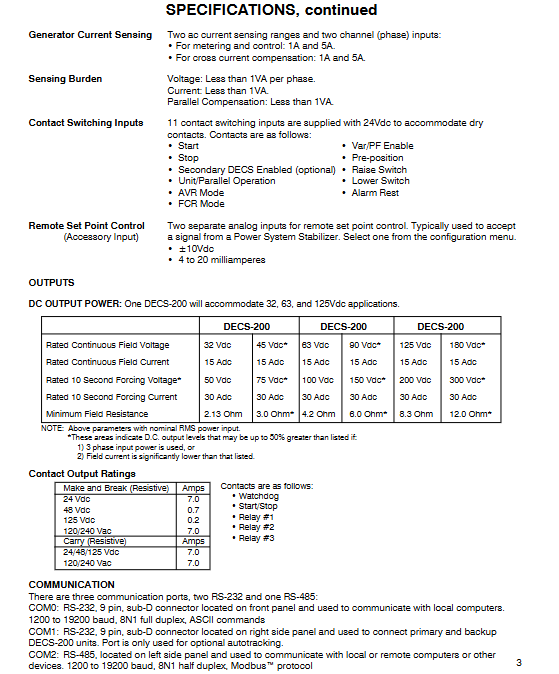
Generator/bus voltage sampling: 4-speed range (100/200/400/500V level), suitable for 50/60Hz, with each phase load<1VA.
Current sampling: Supports two CT secondary specifications of 1A and 5A, including measurement and cross current compensation circuits, with a single circuit load of less than 1VA.
Switching input: There are a total of 11 24Vdc passive contacts, including start stop, mode selection, lifting, resetting, pre positioning, etc.
Remote analog input: Two independent channels, optional ± 10Vdc or 4-20mA.
(3) Excitation power output
Parameter item 32Vdc 63Vdc 125Vdc
Continuous excitation voltage 32V 63V 125V
Continuous excitation current 15ADC 15ADC 15ADC
10s strong excitation voltage 50V 100V 200V
10s strong excitation current 30Adc 30Adc 30Adc
Minimum excitation resistance 2.13 Ω 4.2 Ω 8.3 Ω
Note: Under conditions of low three-phase input and excitation current, the output voltage can increase by up to 50%.
(4) Relay output
There are a total of 4 programmable relays (watchdog, start stop, relay 1/2/3), with clear on/off and current carrying capabilities at different voltage levels, suitable for AC/DC loads.
(5) Summary of Adjustment Accuracy
AVR: Load range ± 0.25%, steady-state ± 0.1%;
FCR: Excitation current accuracy ± 1.0%;
VAR mode: ± 2.0% rated capacity;
PF mode: ± 0.02 power factor.
(6) Protection setting and delay (adjustable range)
Excitation overvoltage: 1~325V, delay 0.2~30s (step size 0.1s);
Excitation overcurrent: 0~16Adc, inverse time characteristic (ANSI C50.13);
Generator overvoltage/undervoltage: 0~30kV, delay of 0.5~60s;
Demagnetization protection: 0~3000Mvar, delay 0.1~9.9s;
Voltage circuit disconnection: 0-100% rated voltage, delay 0-30s;
EDM diode protection: open/short circuit threshold of 0-100%, delay of 10-60s and 5-30s respectively.
(7) Environmental and mechanical parameters
Working temperature: -40 ℃~+60 ℃; Storage temperature: -40 ℃~+85 ℃;
Protection and tolerance: Complies with MIL-STD-810E salt spray testing, multi frequency vibration, and 15G impact standards;
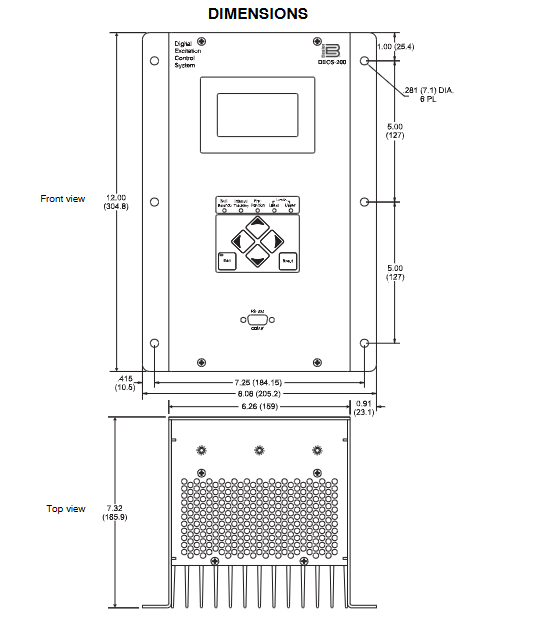
Dimensions: Width 205mm x Depth 171mm x Height 304mm; Weight 6.35kg.
Communication interface
The device is equipped with three independent communication ports, with clear distinctions in protocol, purpose, and transmission distance:
COM0 (Front Panel RS-232): 9-pin DB9, ASCII protocol, baud rate 1200-19200, used for local PC connection and on-site configuration debugging.
COM1 (side panel RS-232): dedicated for external tracking between primary and backup DECS-200, achieving redundant linkage.
COM2 (Side Panel RS-485): Modbus protocol, half duplex, baud rate 1200-19200, maximum communication distance 4000 feet (approximately 1219m), suitable for remote monitoring and PLC docking.
Human Machine Interface (HMI)
The front panel integrates a backlit graphic LCD (64 × 128 pixels), 6 operation buttons, and 6 status indicator lights:
Display screen: View parameters, settings, operating status, alarms, recorded data, and support local parameter modification.
Keys: directional keys (menu page turning, parameter adjustment), edit key, reset key. The edit mode will automatically exit without saving after 5 minutes of inactivity.
Indicator lights: pre positioning, upper and lower limits, zero deviation, internal tracking and other status indicators, providing intuitive feedback on operating conditions.
Supporting software and accessories
1. Supporting software
DECS-200-CD: Windows version configuration software, supporting parameter reading and writing, PID tuning, status monitoring, and waveform reading;
BESTWAVE: OMTRADE waveform file parsing and viewing tool.
2. Standard optional accessories
Install brackets and panel opening accessories;
Dual machine interconnection cable and freewheeling diode module (essential for redundant systems);
ICRM-15 surge suppression module (for use in scenarios where the same power supply is directly connected);
Control power isolation transformer;
IDP-800 color touch screen (remote HMI, RS-485 communication, remote monitoring operation).
Compliance and Certification
The product has passed multiple international authoritative certifications and meets industry standards such as power, industrial control, and maritime
Safety regulations: UL, CSA, CE (LVD/EMC);
Industry certifications: DNV classification certification, Russian GOST-R certification, Belarus certification;
Electrical anti-interference: compliant with IEEE C37.90.1 (surge, fast transient) and IEEE 421.3 standards;
Enterprise system: ISO9001 quality system certification, with US invention patents.