ADLINK MVP-3100 series fanless embedded machine
Product positioning and core overview
The MVP-3100 series is a cost-effective fanless industrial embedded computing platform from Linghua, inheriting the robust industrial design of the Matrix product line. It is designed for industrial automation scenarios (visual inspection, motion control, equipment monitoring) and comes in two forms:
MVP-3100: No expansion backplane, basic I/O model;
MVP-3120: Equipped with a 2-slot backplane, supports PCIe x16+PCI expansion cards, and has stronger expansion capabilities.
Core advantages of fanless technology: eliminating dust and noise interference, improving mean time between failures (MTBF), and adapting to harsh industrial sites; It supports 12/13/14 generation Intel Core processors, DDR5 memory, multiple network ports, rich serial ports/digital IO, and adapts to edge computing scenarios.
Hardware specifications (MVP-3100 vs MVP-3120)
1. Computing core
Processor: 12th/13th/14th generation Intel i3/i5/i7/i9, power consumption 35W/65W; Chipset H610E; Built in Intel UHD 770 core display.
Memory: 2 x DDR5 SO-DIMM slots, up to 64GB DDR5 4800MHz.
Storage: MVP-3100 is equipped with 2 SATA ports; MVP-3120 is equipped with 4 SATA ports; Built in M.2 dual slots: M Key 2280 (NVMe PCIe 3 x2), A+E Key 2230 (Wi Fi/Bluetooth PCIe 3 x1).
Firmware security: Onboard TPM2.0 secure encryption chip.
2. Operating system support
Windows 10 IoT、Windows 11 IoT、Ubuntu 22.04。
3. I/O external interface (universal for both models)
Display: DP 1.4+HDMI 1.4b dual display output;
USB: 4xUSB3.2 Gen1 (5Gbps), 4xUSB2.0 (480Mbps);
Network ports (4 channels): 1 × 2.5G I226-V, 2 × 1G I210-IT, 1 × 1G I219-V; Network port with dual color indicator lights for speed/link;
Serial port: COM1/2 supports RS232/422/485 (BIOS switching), COM3 only supports RS232, DB9 interface with complete pin definitions;
Digital IO: 8-channel non isolated DI+8-channel open drain MOS transistor DO, with input/output circuit schematic and pin list attached;
Audio: microphone input, line output (TEMPO 92HD91 audio chip);
Wireless: 2-channel SMA antenna base, compatible with 2.4G/5G Wi Fi modules;
Control buttons: power button, reset button, external remote power button interface;
Power input: 12-24V wide voltage DC input, rated current 9.6A~19.2A, optional 24V/9.6A 230W original adapter (part number 31-621A0-0010-A0);
Indicator lights: watchdog WD, hard drive storage HD, diagnostic DG, 3-channel user-defined LED, complete explanation of the status meanings of each light.
4. MVP-3120 Exclusive Expansion Backboard
Built in 2-slot backplane: 1 x PCIe Gen4 x16 slot, 1 x 33MHz 32-bit 5V PCI slot (bridged by ITE IT8892E PCIe x1); Two additional SATA and 12V expansion power supplies are provided on the backplane.
Expansion card size limit: length 201.90mm, height 111.15mm, baffle thickness 18.74mm.
5. Mechanical dimensions and weight
Model, external dimensions (mm), overall weight of the machine
MVP-3100 192×240×77.2 3.68KG
MVP-3120 192×240×156.2 4.52KG
Installation method: Wall mounted, equipped with wall bracket and screw kit.
6. Environmental tolerance specifications
Working temperature: 35W CPU -20 ℃~60 ℃; 65W CPU -20℃~50℃;
Storage temperature: -40 ℃~85 ℃;
Humidity: 95% no condensation at 40 ℃;
Vibration/shock (equipped with SSD): 3Grms random vibration of 5-500Hz three-axis; 50G half sine impulse for 11ms;
Electrostatic protection: Contact with ± 4KV, air ± 8KV.
Whole machine structure and onboard internal interfaces
1. Whole machine diagram
The document provides a functional block diagram that fully displays the PCIe/SATA/I2C/eSPI/USB bus connection relationships between the CPU, H610E chipset, memory, display, Ethernet ports, serial ports, digital IO, M.2, SATA, TPM, Super I/O, audio, and power modules.
2. Layout of External I/O Panel
Back panel partition labeling antenna, DC power supply DP/HDMI、USB、 Network port, serial port DI/DO、 Audio and power button positions, accompanied by a comparison table to explain the functions of each interface.
3. Front and back panel slots on the motherboard
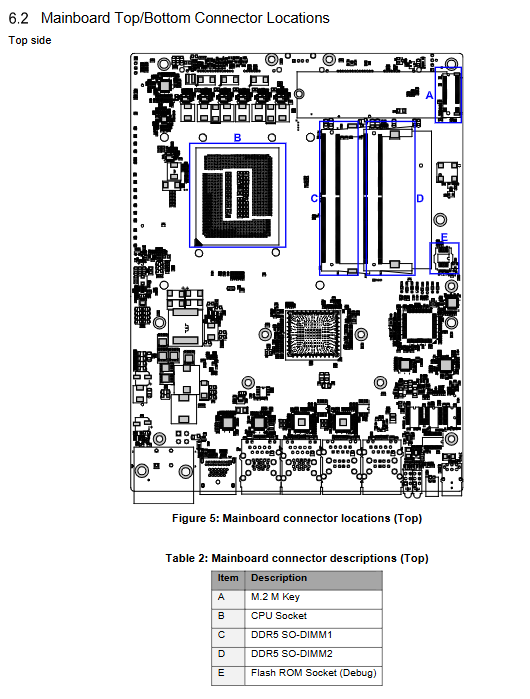
Front of motherboard: CPU socket, 2 DDR5 memory slots, M.2 M Key solid-state slot, debugging Flash ROM;
Back of motherboard: dual SATA hard drive socket, fan power supply, RTC lithium battery socket, M.2 E Key wireless slot, I2C bus pin, external power on/off/reset pin, backplane power supply, COM/DI/DO expansion cable socket, debugging DB40 interface;
4. Layout of 2-slot expansion backplane
The backplane includes PCI, PCIe x16 slots, two SATA ports, PCIe auxiliary 12V power supply, motherboard power supply, and built-in USB 2.0 pins.
Quick Installation and Startup Chapter (Getting Started)
1. Power wiring
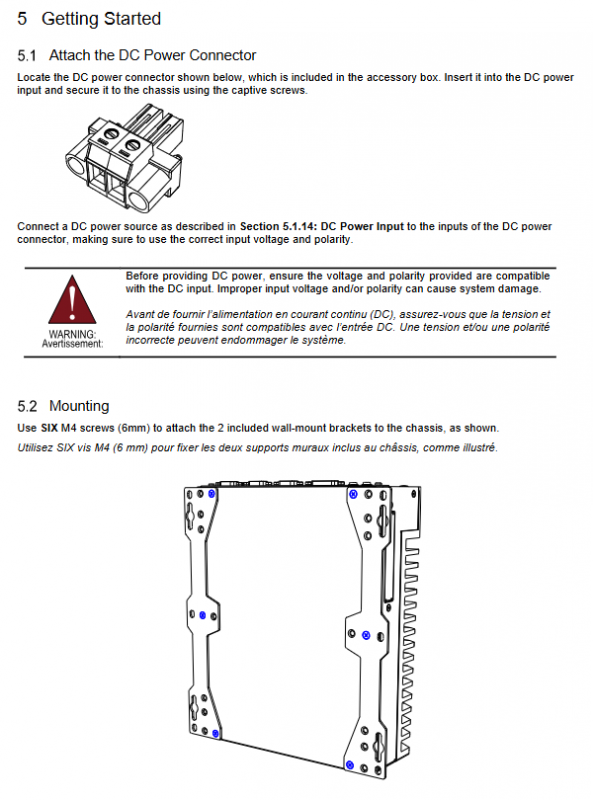
The matching accessory box is equipped with DC power terminals, which are locked with built-in fixing screws; Mandatory requirement to check the voltage and positive and negative poles before powering on, as misconnection can permanently damage the entire machine; Recommend using IEC/UL certified LPS/SELV safety power supply, with a maximum usage altitude of 2000 meters.
2. Wall mounted installation specifications
Bracket fixation: Use 6 M4 × 6mm screws to fix the wall bracket to the chassis;
Wall fixing: fix the whole machine to the wall with 6 M4 × 8mm screws, torque 6kgf · cm;
Installation orientation requirement: Only allow the I/O panel to be installed facing left and right, and it is strictly prohibited to have the I/O facing down or the entire machine placed flat/upside down; Do not cover the heat dissipation fins;
Heat dissipation warning: The body’s heat sink is at high temperature. Touching it again after cooling down may pose a risk of burns.
3. Expansion card installation restrictions
Only MVP-3120 supports PCI/PCIe expansion, strictly limiting the length, width, and thickness of the expansion card, and cannot be assembled beyond the size.
Complete definition of connectors, pins, and jumpers
The document is divided into two modules: external I/O interfaces and internal onboard interfaces, all of which provide pin definitions, electrical parameters, and circuit schematics
External interfaces: antenna, power button, DP/HDMI video, Ethernet port, serial port, DI/DO (input/output MOS circuit schematic), USB, DC power supply, audio;
Internal pins: SATA, built-in USB 2.0, 4-pin PWM speed control interface for system fan, remote power on/off/reset pin, dual I2C bus, 12V power supply for backplane, COM/DI/DO cable, RTC battery, debugging interface;
Serial port multi-mode: DB9 pin distinguishes RS232/422/485 signal definition;
Digital IO electrical: DI high level 2~5.25V, low level 0~0.8V; DO built-in 200 Ω pull-up resistor, single channel maximum 24mA sink/pull current.
Safety regulations (bilingual in Chinese and English)
Operating premise: Before maintenance or disassembly, the power must be completely turned off, and after disassembly, the chassis cover must be restored before powering on;
Usage environment: limited to computer rooms/industrial controlled areas only, prohibited for use in households, schools, and public places;
Protection requirements: Keep away from liquid, high temperature and high humidity environments, and ensure unobstructed heat dissipation channels; The power supply must be grounded;
Battery safety: Equipped with a built-in lithium battery, there is a risk of explosion if the model is replaced incorrectly. Used batteries should be uniformly recycled according to the lithium recycling label;
Maintenance restrictions: Only authorized professionals are allowed to repair. In case of cable damage, water ingress, malfunction, or drop, stop using and contact after-sales service;
Wiring specification: The terminal block only supports copper core wires 30-10, with a tightening torque of 5.3 pound inches;
High temperature warning: The surface of the radiator is hot. Stop the machine and cool it down before touching it again.