Alcatel Lucent 7450 operator Ethernet service switch
Product positioning
As a metropolitan aggregation edge device, 7450 ESS provides line speed Ethernet service delivery, supports L2 Ethernet service+L3 IP/MPLS service hybrid deployment, protects existing network investments, and helps operators develop new value-added services. Typical application scenarios:
Residential Triple Play (broadband IPTV、 Voice based business convergence
Enterprise second/third layer VPN services (VLL, VPLS, IP VPN)
Mobile base station feedback
Deployment of Ethernet services by metropolitan area operators
Can provide a business list
Ethernet service: E-Line/VLL virtual leased line; ELAN/VPLS Virtual Private LAN; Ethernet access IP VPN;
IP services: IPv4/IPv6 IP ‑ VPN, Internet access, IP multicast routing;
Supports PBB/VPLS and BGP VPLS, with a single city area network capable of supporting hundreds of thousands of end users;
The maximum business interface speed can reach 100Gbps.
Core hardware and chassis family
There are a total of 5 chassis models for the whole machine: ESS -1, ESS -6, ESS -6V, ESS -7, ESS -12, covering different scale requirements from small access to large capacity metropolitan aggregation.
Model Switching Capacity (Half Duplex) Single Slot Full Duplex Capability Description
ESS -1 40 Gbps 10 Gbps compact small chassis
ESS -6/6V 320 Gbps 40 Gbps medium capacity, 6V high vertical version chassis
ESS -7 1 Tbps 100 Gbps Large Capacity
ESS -12 2 Tbps 100 Gbps flagship, with a maximum throughput of 2T, occupying 1/3 of the telecom rack space
Hardware module type
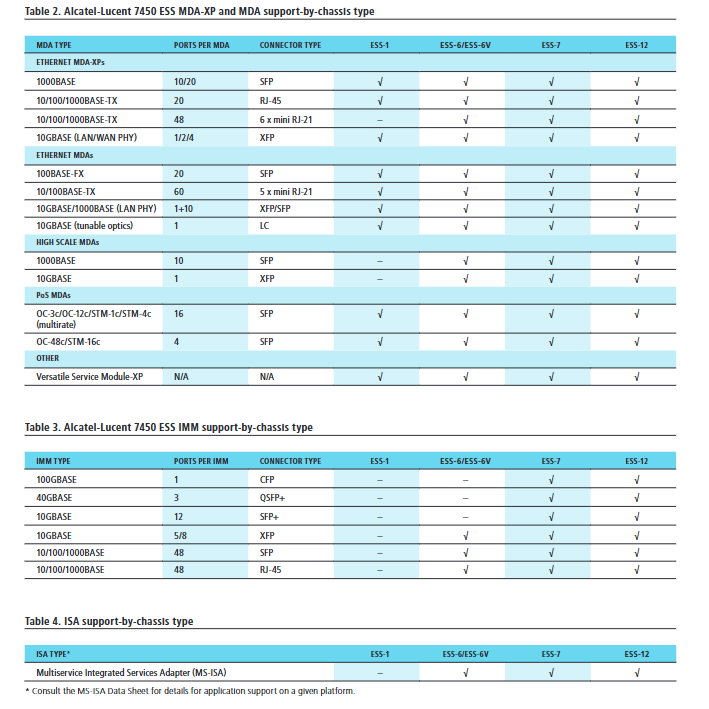
IOM Input/Output Module (IOM3-XP is a new generation, equipped with FP2 self-developed chip): Each IOM can carry up to 2 MDAs and can also accommodate MS-ISA business processing boards; ESS -1 does not support independent IOM.
MDA media adapter board: physical interface daughter card, universal for all chassis; MDA-XP supports SyncE synchronous Ethernet; Supports gigabit/ten gigabit electrical ports, optical ports, adjustable DWDM optical modules, and POS/SONET-SDH traditional interfaces. The highest density of the entire machine rack is 2880 GE ports or 360 10GE ports.
IMM Integrated Media Module: Integrating processing chips and physical interfaces on a single board, providing high-density 10G/40G/100G interfaces, using FP2 chips.
MS-ISA Multi Service Integration Business Adapter (not supported by ESS -1): Provides L3-L7 deep service processing, supports DPI deep message detection, application recognition and control, IPTV fast channel switching, retransmission and other value-added services to achieve business monetization.
FP2 chip capability: Supports in-situ upgrading to 100G full duplex slots on existing chassis without the need for complete machine replacement (no forklift upgrade), fully protecting hardware investment.
Hardware redundancy and hot plugging
The main control switching matrix SF/CPM, power PEM-3, fan, IOM, MDA, and MS-ISA all support hot plugging;
Power supply 1+1 redundancy; Different chassis adopt various airflow cooling schemes such as side to side, side to back, and front to back.
Interface support
Ethernet: 10M-100G, SFP/XFP/CFP/QSFP+, RJ45 electrical port; MDA-XP supports SyncE synchronous Ethernet for mobile backhaul time synchronization;
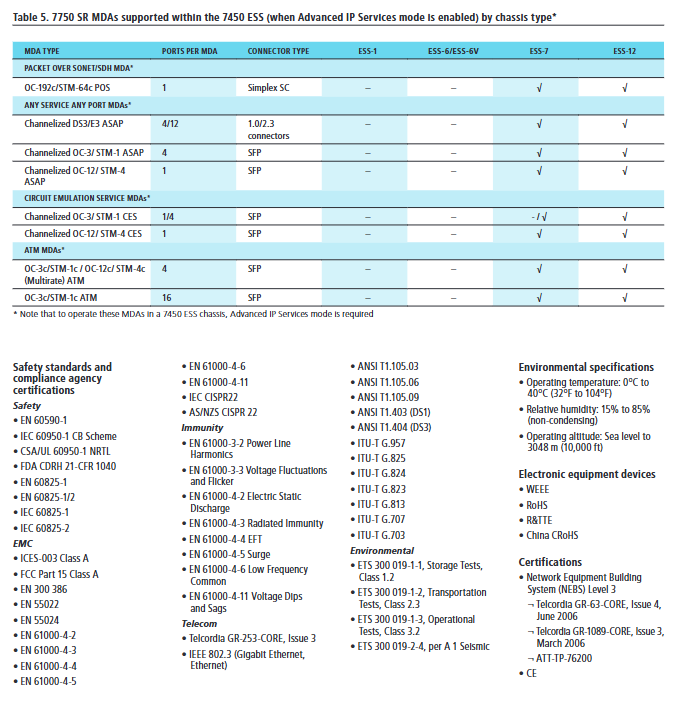
Traditional SONET/SDH POS: OC-3/12/48/192; Support CES circuit simulation and ATM interface (requires advanced IP service mode to be enabled);
Adjustable DWDM 10 Gigabit MDA, used for urban wavelength division direct connection.
Software: SR-OS operating system
The 7450 ESS and 7750 SR routers use the exact same SR-OS operator operating system, with unified business definition and operation and maintenance across the entire network.
High availability capability (carrier level uninterrupted business)
ISSU business does not interrupt software upgrades;
Uninterrupted routing NSR, uninterrupted service NSS, and full state fault switching in case of failure;
Multi chassis LAG, APS automatic protection;
Ethernet ring protection: ITU-T G.8031 (point-to-point protection), G.8032 (Ethernet ring network protection);
MPLS FRR fast rerouting, BFD bidirectional forwarding detection, PW pseudowire redundancy, Graceful Restart; All businesses continue to forward traffic even in the event of a control plane failure.
QoS: Hierarchical QoS
Hardware implementation of multi-level shaping, speed limit, and labeling; Support business queues and network queues; With fine granularity, it can strictly implement SLA service level agreements, and simultaneously carry video and voice, key enterprise businesses, and ordinary Internet traffic.
OAM operation and maintenance fault detection
Complete Ethernet/MPLS/IP OAM toolset: ITU-T Y.1731, IEEE802.1ag, IEEE802.3ah, E-LMI, built-in SAA service agent for connectivity, performance, and fault detection.
Management Suite
5620 SAM Service Aware Manager: Core network management, unified management of network elements, networks, and services;
5650 CPAM: Control Plane Assurance Manager;
5670 RAM Report Analysis Manager; It can complete business activation, fault location, performance statistics, and SLA monitoring.
Product brings business benefits
Increase business revenue: Powerful PBB/VPLS/BGP-VPLS, large-scale deployment of layer 2 VPN; Simultaneously providing IP VPN three-layer services; MS-ISA provides DPI and IPTV value-added services; Layered QoS ensures high-value service SLA.
Large scale ubiquitous business coverage: integrating Ethernet and MPLS TE, deploying VPLS/BGP VPLS across metropolitan and regional areas; BGP VPLS supports cross operator docking; Unified platform for residential, corporate, and mobile data transmission.
High availability enhances customer experience: NSR/NSS, G.8032, FRR, no perception of faulty business, enhances operator brand.
ROI improvement: Single platform integration of multiple businesses, reducing the number of devices; FP2 chip supports in-situ upgrading of 100G slots; High port density, single machine service for more users.
Reduce operational OPEX: Unified SR-OS and unified network management suite; Powerful OAM accelerates fault location; Gradually phasing out old traditional equipment and simplifying operation and maintenance architecture.
Investment protection: The hardware platform relies on software iteration to add new features, without the need for frequent replacement of chassis.
Green energy saving: FP2 chip power optimization reduces power and cooling costs.
Compliance and environmental parameters
Working temperature: 0-40 ℃; Humidity 15-85% without condensation; The highest altitude is 3048 meters;
Certification: NEBS Level 3, CE, RoHS/WEEE; Meet telecommunications equipment standards such as GR-63-CORE; IEC/UL safety, FCC EMC, etc.