SUMITOMO AC8000P series (AC8115P/AC8020P/AC8025P/AC8035P) steel turning
Four brand positioning and coating substrate technology
All adopt the ABSO-TECH CVD coating system: high toughness alumina Al ₂ O Ⅲ layer+fine grain TiCN layer+high adhesion interface technology+special surface pre stress smoothing treatment; Pre stressing treatment is applied to the surface to suppress crack propagation and enhance the resistance to chipping. The golden surface facilitates wear identification.
Brand positioning focuses on core performance and applicable working conditions
AC8115P (new grade) high-speed continuous processing ultimate wear resistance, anti plastic deformation steel high-speed continuous precision semi precision processing; Both wet and dry methods are acceptable; Resistant to crescent shaped depressions and high-temperature plastic deformation; Replace the old model AC8015P
AC8020P has outstanding anti chipping performance in efficient machining and moderate cutting load; Continuous, slightly intermittent, resistant to impact and collapse damage
AC8025P universal main grade anti adhesion+anti collapse balance, with the highest comprehensive reliability. The steel is continuous and slightly intermittent; The top recommended grades for the vast majority of carbon steel and alloy steel
AC8035P heavy intermittent processing reduces residual tensile stress in coatings, resists fracture heavy impact, strong intermittent, rough processing of forgings with oxide skin, and prioritizes solving the problem of blade breakage
Applicable workpiece materials: low carbon steel, medium carbon steel, high carbon steel, low alloy steel, high alloy steel, forged steel parts; Processing supports wet and dry cutting.
Complete chip breaker system (negative rake angle+positive rake angle)
Groove coverage: ultra precision → precision machining → light cutting → medium cutting → rough machining → heavy rough machining; Negative front angle is the main feature, while positive front angle is suitable for walking machines and small parts.
Groove type code, processing grade, characteristics, and purposes
EFE ultra precision machining with small cutting depth and sharp cutting edge with minimal margin for precision machining
ELU/ESE/ESU precision machining with low cutting resistance, good surface quality precision machining, mirror finish machining; ELUW provides Wiper polishing blades
EEX precision turning for light to medium cutting of curved grooves to reduce thermal load and transition from precision to semi precision
EUP light medium cutting double positive rake angle, sharp, light load, high feed rate
EGU Medium Cutting [General Preferred] Wide chip removal window, comprehensive balance of the majority of steel outer circular end faces, recommended groove type for sample first
EGE medium cutting balances wear resistance and chip removal with moderate load semi precision
EUX medium cutting impact resistance, suitable for intermittent mild intermittent priority
EEG medium – rough machining edge strength improvement for semi rough machining
EMU rough machining takes into account both cutting strength and chip removal rough turning
EEM rough machining with large cutting depth and feed rate, high cutting edge strength for rough turning conditions
EMX rough machining, thermal shock resistance, intermittent rough machining
EHG/EHP/EHF heavy rough machining with super large cutting depth, heavy load rough turning, big knife cutting
ENP slotless type, negative rake angle extreme cutting edge strength is severe, heavy intermittent blanks and forgings
Chip window chart: horizontal feed rate f (IPR), vertical cutting depth ap (inch); Different groove types have clear applicable ranges for ap-f.
Performance test results
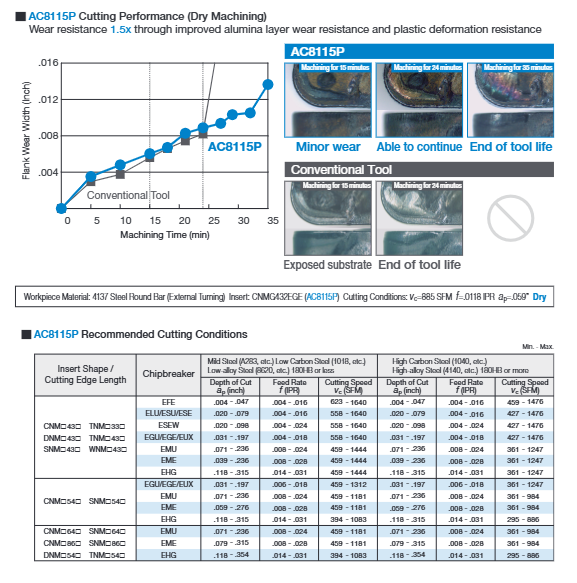
AC8115P (4137 steel): Whether it is conventional wet cutting, high-speed wet cutting, or dry cutting, its resistance to plastic deformation and crescent wear is significantly better than traditional grades; After the same processing time, the wear rate of the cutting surface is only half that of traditional cutting tools, and the service life is ≥ 1.5-2 times.
AC8020P (forged with intermittent 4137 steel): its anti chipping ability is 2.5 times that of traditional cutting tools; Suppressing coating cracks under multiple impacts, suitable for efficient production.
AC8025P (8620 steel end face): Surface smoothing process suppresses material adhesion; Resistance to adhesive fracture is twice that of traditional methods; Long term processing only produces normal wear and tear, without sticking or chipping of the blade.
AC8035P (4140 intermittent outer circle): The technology reduces the tensile stress of the coating, and the fracture resistance is twice that of traditional methods; Multiple impact tests have been conducted, and multiple cutting edges can continue to be processed. Competitors have failed due to premature blade breakage.
Recommended cutting parameters (in imperial units, distinguishing between low-carbon/low-alloy steel ≤ 180HB and high carbon/high alloy steel>180HB)
The document provides the corresponding ap (in) cutting depth, f (IPR) feed, Vc (SFM) cutting speed for each groove type and blade specification, supporting dry cutting/wet cutting; The red parameter represents the priority recommendation interval.
AC8115P: Low carbon steel with a maximum Vc of 1640 SFM; High alloy steel with a maximum of 1444 SFM is suitable for high speeds.
AC8020P: Low carbon steel 525-1378-SFM; High carbon steel 394-1214 SFM, efficient processing.
AC8025P (General Main): Low carbon steel 492-1148 SFM; High carbon steel 328-984 SFM.
AC8035P (intermittent): Low carbon steel 394-984 SFM; High carbon steel 197-656 SFM, intermittent working conditions require a reduction in line speed.
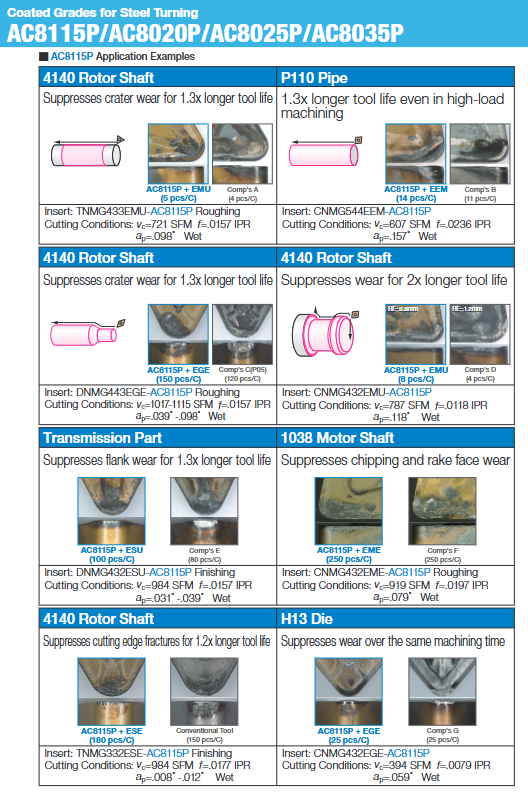
Actual Processing Application Cases
AC8115P (high-speed wear-resistant)
4140 rotor shaft EMU slot: lifespan 1.3 times that of competitors;
P110 pipeline EEM slot: heavy load processing life 1.3 times;
ESU precision machining of transmission parts: lifespan 1.3 times longer;
H13 mold steel EGE: equal time to suppress wear.
AC8020P (efficient anti collapse)
Carbon steel CVJ components ESE: increased lifespan by 1.7 times;
1035 machine tool parts ESE: doubled lifespan;
Cr Mo steel transmission parts EGU, 4140 automotive parts EGE, boron steel shaft EUX: lifespan varies from 1.5 to 3 times.
AC8025P (General Main Force)
1045 axle ENP; 5115 gear ring EME; 1045 steel ring EGE; Soft steel cylinder ESU; Multiple cases have a lifespan of 1.2-3 times; Continuous processing is stable and suppresses tool sticking.
AC8035P (heavy intermittent)
1035 planetary small gear EUX: heavy intermittent life 1.5 times;
Hot rolled steel flange EGU: 3 times the service life;
Ni Cr steel gears, 5140 flanges, alloy steel shafts: forgings/notched blanks to suppress sudden blade breakage.
Typical parts: automotive CVJ, rotor shaft, gear, ring gear, transmission shaft, pipeline, forged blank, mold steel parts.
Overview of Blade Product Specifications
Tag: Local spot goods in the United States; Global warehouse transfer.
Negative rake angle blade (mainstream for steel turning)
80 ° diamond shape: CNMG/CNMM; 55 ° diamond shaped DNMG/DNMM; Square SNMG/SNMM;
Triangle TNMG/TNMM; 35 ° diamond shaped VNMG; Trigon WNMG; Circular RNMG. Complete coverage of groove type EFE、ELU、ESU、EEX、EUP、EGU、EGE、EUX、EEG、EMU、EEM、EMX、EHG、EHP、ENP Wait.
Positive front angle blade (7 °/11 ° rear angle; walking mechanism, small parts)
CCMT, DCMT, SCMT, TCMT, TPMT, VBMT, VCMT, RCMT/RCMX circular blades;
Slot type ELU, ELB, ESU, ENK, EGU, EMU, etc., suitable for small parts of automatic lathes and walking machines.
The complete large table in the appendix of the manual lists the internal circle, thickness, cutting edge R, hole diameter, and inventory status of each model.