Albatross Control System NMEA 2000 ® Standard modular shipborne monitoring and control system
System positioning and core standards
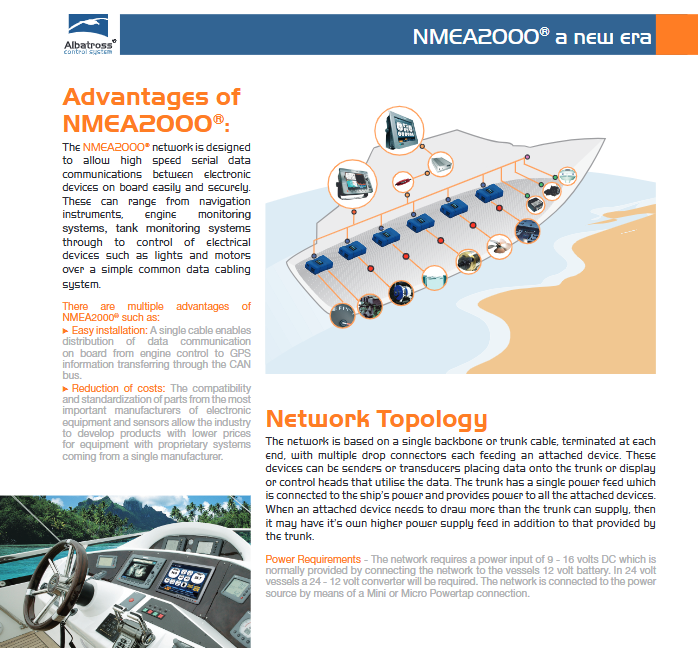
Albatross Control System is an open shipborne monitoring and control platform for yachts/ships, fully based on NMEA 2000 ®** Industrial standard design.
Communication speed: 250kbps, 26 times faster than NMEA0183
Network structure: single backbone bus+branch nodes, terminal resistors at both ends, centralized power supply
Power supply requirement: 9-16VDC; 24V ships need to be equipped with a 24 → 12V converter
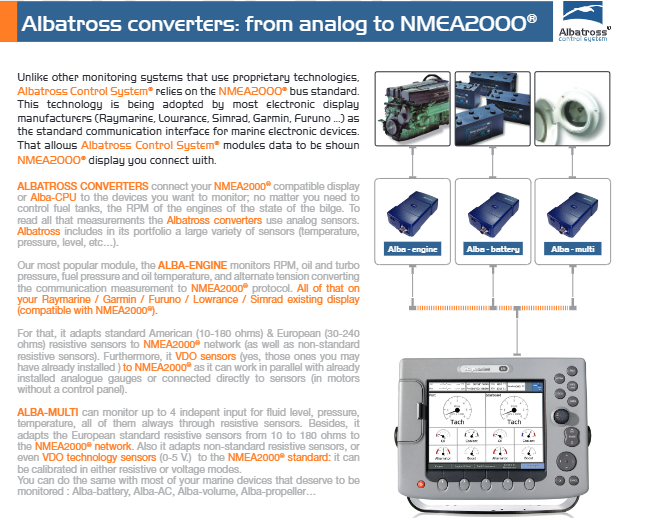
Hardware module system (analog to NMEA 2000) ®)
Module Name Core Function Adaptation Sensor
Alba Engine speed, oil pressure, boost pressure, fuel pressure, oil temperature, generator voltage American standard 10-180 Ω, European standard 30-240 Ω VDO
Alba Multi 4-channel independent liquid level/pressure/temperature monitoring resistor type, 0-5V voltage type VDO
Alba Battery Voltage, Temperature, Battery Level, and Range Battery Pack Universal
Alba AC AC parameter monitoring for marine generators/power grids
Alba In digital input acquisition switch, alarm, liquid level
Alba Out relay output controls lights, pumps, and valves
Alba Lighting navigation lights/interior lights control+fault detection for all ship lighting
Alba Propeller Propeller Controlled Propulsion System
Alba CPU system core processor global data center
Albatross On Board Software
Version: v1.6B308
Architecture: Client server, supporting Ethernet/WiFi multi terminal
Software package:
ALBA-OB I: Basic Monitoring (Essential)
ALBA-OB II: Advanced Features (Full Monitoring)
Core competencies:
Real time display of engine, fuel tank, battery, temperature, pressure, lighting, etc
Data log storage, configurable alarms
Interface customization: layout, units, colors, day/night mode
Remote control equipment, automatic logic programming
Dedicated display terminal
Protection: IP65 waterproof and dustproof
Panel: High brightness sunlight readable, LED low-power backlight
Touch: USB touch interface
Power supply: 8-36VDC wide voltage
Installation: VESA standard bracket
Interfaces: VGA, DVI, S-Video, USB
Usage: nautical chart relay, navigation monitoring CCTV、 Video playback
Core advantages
Open Standard: No brand binding, compatible with all NMEA 2000 ® equipment
Analog to Digital: Directly connect to existing resistor/VDO sensors without the need for replacement
Minimalist wiring: Single bus replaces complex wiring harnesses, significantly reducing installation costs
Full ship coverage: integrated monitoring and control, supporting lighting automation and fault alarm
High cost-effectiveness: achieving glass cockpit and onboard intelligence at low cost
Key issues
Question 1: What is the core technological advantage of the Albatross system? NMEA 2000 ® What are the advantages compared to traditional solutions?
Answer: The core advantage is based on the open NMEA 2000 ® Standard, existing analog sensors can be directly converted into digital buses without the need for proprietary protocols. NMEA 2000 ® Using CAN bus and 250kbps high-speed, 26 times faster than NMEA0183; Single cable networking, simple wiring, low cost, compatible with all mainstream ship power brands.
Question 2: What engine parameters can the Alba Engine module monitor? What common marine sensors does it support?
Answer: It can monitor engine speed, oil pressure, boost pressure, fuel pressure, oil temperature, and generator voltage. Supports American standard 10-180 Ω, European standard 30-240 Ω resistance sensors, as well as VDO sensors, which can be used in parallel with existing analog meters or directly connected to sensors.
Question 3: What is the difference between the OB-I and OB-II versions of Albatross shipborne software? What remote and automation capabilities does the system support?
answer:
OB-I is a basic package that only provides basic parameter display and is a necessary underlying package for running.
OB-II is an advanced package that provides complete monitoring, alarm, data logging, advanced interface, and control functions.
The system supports WiFi/Ethernet multi client, and can remotely switch devices, program automatic logic, provide navigation light fault alarms, and automatically control lighting.