Pilz PSS 4000 Automation System
Core positioning and overall value
System positioning
Security+standard automation integrated distributed control system, supporting single machine to whole plant networking, in line with Industry 4.0 requirements.
core advantage
Physical integration of security and automation, logical isolation, no cross interference
Multi master real-time Ethernet SafetyNET p communication, long-distance, high reliability
Modular and scalable, hardware and program decoupled, engineering efficiency increased by about 30%
Unified software platform, one-stop configuration/programming/diagnosis/visualization
Open protocol, compatible with third-party controllers and fieldbus
Applicable scenarios
Automobiles, rail transit, packaging, presses, logistics, elevators, wind power, stage equipment, cable cars, etc.
Hardware System: Controller and I/O
1. Core controller
PSSuniversal PLC
A versatile controller that supports IEC 61131-3 full language programming and can be used as a central PLC or distributed node to meet complex safety and automation tasks.
PSSuniversal multi
Small and lightweight controller, suitable for standalone/small networked devices, using PASmulti graphical programming, simple and efficient.
PSS 4000 I/O
Distributed I/O scheme:
PSSuniversal I/O: Installed inside the cabinet, capable of mounting up to 64 I/O modules
PSS67 I/O: IP67 protection, direct on-site installation without control cabinet
2. Hardware structure and characteristics
Modular combination: Head module+Base+I/O/Power/Function module, freely expandable
Built in power supply, integrated switch, SD card storage project and configuration
Safety level: EN/IEC 61508 SIL3, EN ISO 13849 PL e
Supports linear topology, long-distance transmission, and resistance to electromagnetic interference
3. Module type
Digital/analog I/O, power module
Encoder module (incremental/absolute)
Fast Control Unit (400 μ s level response)
Communication module (RS232/RS485), link module
Special features: safety electronic cam, safety motion monitoring
Communication System: SafetyNET p Real time Ethernet
core position
PSS 4000 system communication backbone, secure and standard data transmission via cable.
Key Features
100Mbps Ethernet, compliant with IEEE 802.3
The security mechanism follows the black channel principle and meets PL e/SIL3 requirements
Transmission distance: 100m for electrical port, 5km for multimode fiber, 32.5km for single-mode, 10km for DSLs, supporting WLAN wireless
Support routing, ring network redundancy (MRP), and parallel coexistence of multiple protocols
compatibility protocol
EtherCAT, EtherNet/IP, Modbus TCP, PROFIBUS, Powerlink, Sercos, etc. can be connected to third-party systems through gateways.
Software Platform: PAS4000
positioning
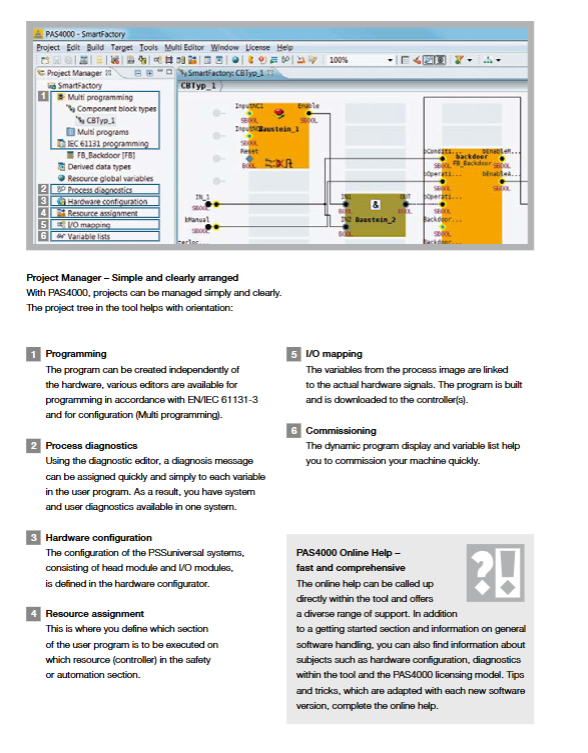
Unified engineering software covering the entire process of configuration, programming, debugging, diagnosis, and operation and maintenance.
Programming method
IEC 61131-3: Instruction List IL, Structured Text ST, Ladder Diagram LD
Graphics: PASmulti, drag and drop connections, suitable for rapid development
Software Block Library
Security authentication block: emergency stop, safety door, light barrier, dual hand control, muting
Hardware driver blocks: encoder, analog quantity
Application Blocks: Cam Control, Burner Management
Standard logic block: AND/OR/flip-flop/timer
core functionality
Project tree management, hardware configuration, resource allocation, I/O mapping
Unified process diagnosis, variable binding alarm information
Support hardware independent programming and flexible allocation in the later stage
Multi language interface, online help
Visualization and Diagnosis
1. PASvisa (Web Visualization)
Web based, cross platform, client free, local/remote access
Directly linked with PAS4000 project, variables automatically synchronized
Prefabricated safety block diagnostic panel, alarm list, historical records
Supports multiple languages, user permissions Unicode
2. PMVisu (Visual Terminal)
7-inch/12 inch capacitive touch screen
Pre installed PASvisa, plug and play
Built in user management, SD card storage, and multiple interfaces
Core functions and distinctive technologies
Safety Movement Monitoring
Single encoder: maximum PL d, speed/static monitoring
Dual encoder: safe speed+safe position, maximum PL e
Quick response, local fast switching not affected by PLC cycles
Fast Control Unit
Local security logic 400 μ s level output
Capable of processing narrow pulses of 650 μ s
Inductive load back pressure protection
Safety electronic cam
Replace mechanical cam, adapt to press control, comply with EN 692, dynamic safety stop, tamper proof.
distributed control
Centralized program editing, distributed operation, execution of any program segment at any node, unified diagnosis.
Certification and Industry Applications
1. Security certification
Universal: PL e, SIL 3
Rail transit: SIL 2/3/4, EN 5012x series
Elevator/Escalator: EN 81-1/2, EN 115-1
Combustion safety: NFPA 85/86
Global certifications: CE, BG, T Ü V, cULus, EAC, KOSHA
2. Typical industry applications
Automobile: body welding and painting line
Rail transit: speed monitoring, emergency braking, subway signal replacement and renovation
Packaging: Whole line safety monitoring, replacing traditional safety relays
Press: Mechanical cam transformed into electronic safety cam
Logistics: AGV, elevator, cross traffic collision prevention
Other: Stage equipment, cable cars, wind power, bridge safety monitoring
Infrastructure and Selection
web component
Non managed switch: plug and play, LED diagnostic
Management switch: Web management, ring network redundancy, dual power supply
Gateway: Modbus TCP to CANopen/EtherCAT
Industrial connectors, cables, and stripping tools
software license
PASunits point authorization (500/1000/5000/10000), PASkey encrypted USB storage.
service system
Risk assessment, safety plan, design implementation, verification, CE certification LOTO、CMSE ® Certification training.