Honeywell ControlEdge HC900 Controller
Product Overview
ControlEdge HC900 is a modular advanced loop and logic controller launched by Honeywell, designed for process equipment control and data management. It can be paired with a 900 Control Station operator station to shorten configuration time, and runs with an independent watchdog protection program. It supports Modbus TCP open Ethernet and is compatible with various HMI/SCADA.
Core parameters of CPU module
CPU model, architecture, memory, maximum I/O points, functional block limit, network redundancy
C30 32-bit RISC 64MB DDR2 (ECC) 384 400 single network port not supported
C50 32-bit RISC 64MB DDR2 (ECC) 4608 2000 single network port not supported
C70 32-bit RISC 128MB DDR2 (ECC) 4608 15000 dual port not supported
C75 32-bit RISC 128MB DDR2 (ECC) 4608 15000 dual port support
Storage: Flash storage for configuration programs, battery backup memory for dynamic data, power outage can last for 24 days
Scanning: Fast scanning within 10ms (local), remote/redundant starting from 25ms; Routine scan 100ms
SOE: 1ms high-precision timestamp, only supported by non redundant UIO
Hardware architecture and I/O capability
Rack specifications: Provide 4/8/12 slot racks, redundant CPU racks without local I/O
Universal analog input: 8 points, supporting TC/RTD/voltage/current mixed use
UIO universal I/O: 16 points, configurable DI/DO/AI/AO, redundant mode 14 points
Digital quantity: 16/32 points, universal for AC and DC, electrically isolated between channels
Output: Analog, Relay, High Voltage Output, Supports Fault Safety Default State
Remote I/O
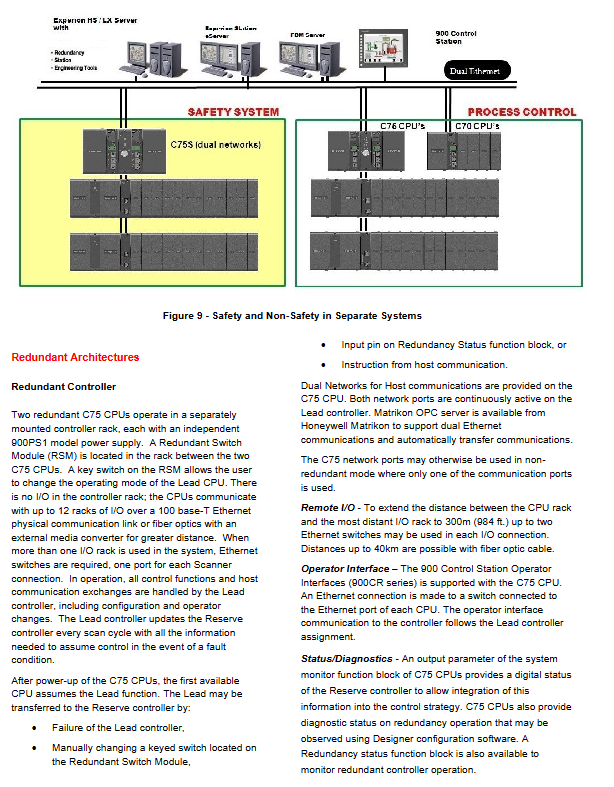
Ethernet connection, dual switches up to 300 meters away
Single mode fiber optic up to 40 kilometers away
Redundant CPU supports up to 12 remote racks
redundant design
C75 achieves one-to-one CPU redundancy, with redundant switching module RSM control
Switching time 0~100ms, undisturbed switching
Support redundant power supply, redundant network, and redundant I/O bus
Control and Function Blocks
control algorithm
PID+Accutune III self-tuning with fuzzy logic suppression for overshoot
Support dedicated circuits such as cascade, proportion, carbon potential, dew point, humidity, etc
Output: current, time ratio, position ratio, dual output
function block
Main functional blocks: PID, program segment, sequencer, timer
Standard Function Blocks: Accumulation, Mathematical Operations, Average, Mass Flow, Gas Flow (AGA)
Voting function block: AI-V/DI-V (1oo2/2O3), AO-V/DO-V output verification
Formula and Scheduling
The recipe pool memory is configurable and supports variable recipes, set value programs, sequences, and scheduling
Each program/schedule has a maximum of 50 segments, with a sequencer consisting of 64 steps and 16 outputs
Communication capability
Ethernet
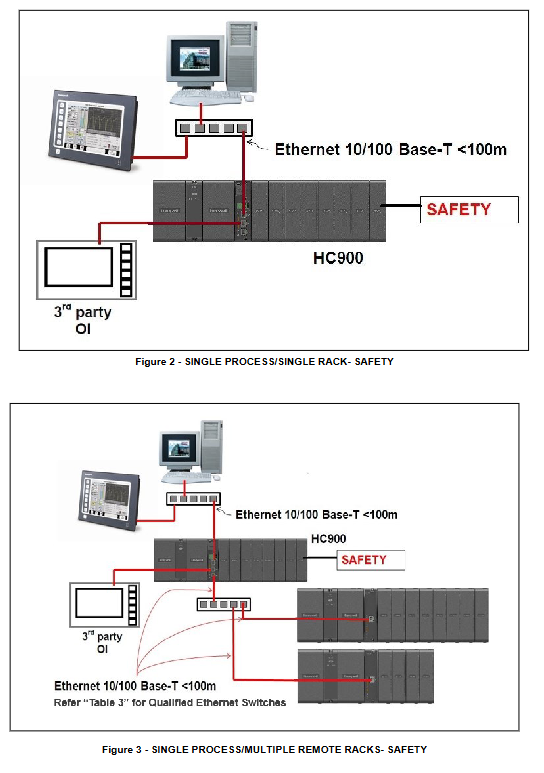
10/100Base-T,Modbus TCP, Supports Modbus TCP Initiator
C70/C75 dual network ports, up to 10 concurrent host connections
Peer to peer communication: supports interconnection of 32 controllers, with a maximum of 2240 parameter exchanges
serial port
Dual isolation RS485, Modbus RTU, distance 609 meters
Supports Modbus master/slave, up to 32 slave stations can be mounted
HART
Support HART IP and integrate with Honeywell FDM equipment management system
Supports instruction 3/48, default port 5094
other
Email alarm: 3 receiving addresses, priority level 4 alarm
Supports Profibus (via gateway) OPC、Experion、SpecView32
Software and Operator Interface
Designer configuration software
Windows platform, supports multiple languages including Chinese/English/Russian/German
Online editing, uploading/downloading, program review, version management
Graphic function block configuration, providing debugging and reporting tools
operator station
Support 900 Control Stations (900CR series), up to 3 units
Ethernet/serial port connection, simplified configuration for database import
Certification and Environment
Safety certification: SIL2 (IEC 61508), ATEX, IECEx, UKCA, CE
Environment: Working temperature of 0-60 ℃, storage temperature of * * -40~70 ℃, humidity of 5-90% RH**
Protection: Installation category II, pollution level 2, in compliance with IEC 60664, UL840
Key issues
Question 1: How to implement the redundant architecture of HC900 controller? What are the core advantages?
Answer: The redundant system consists of C75 CPU, independent redundant rack, dual power supply, and redundant switching module RSM; The main controller synchronizes data to the backup machine every cycle, and switches without disturbance from 0 to 100ms in case of a fault. The dual network ports ensure uninterrupted communication. The core advantage is high availability, which meets safety critical scenarios such as ESD and burner management, and avoids downtime risks.
Question 2: What is the maximum I/O and remote expansion capability of HC900? What are the differences between different CPUs?
Answer: C30 has a maximum of 384 I/O points and does not support remote I/O; C50/C70/C75 has a maximum of 4608 I/O points and supports remote racks. C75 has a maximum of 1008 redundant UIO points. Remote I/O is extended through Ethernet, with twisted pair cables up to 300 meters and single-mode fiber optic cables up to 40 kilometers, suitable for large distributed factories.
Question 3: What are the core capabilities and applicable scenarios of HC900 in terms of safety control?
Answer: Through SIL2 certification, it supports secure universal I/O, secure peer-to-peer communication, input/output voting function blocks, independent safety worksheets, and can achieve safety functions such as emergency shutdown (ESD), burner management (BMS), and leak prevention. Suitable for process industries such as chemical, mining, power, and pharmaceutical industries that require high safety and reliability.